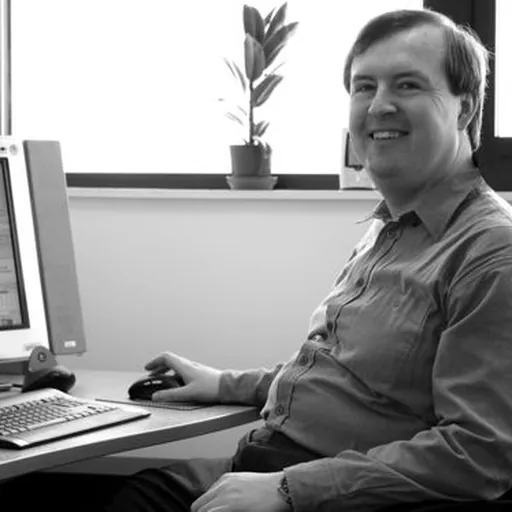
David Tudor Jones
British bioinformatician
About David Tudor Jones
Born 1966. David Tudor Jones is a bioinformatician.
Research and career Jones's main research interests are in protein structure prediction and analysis protein folding, transmembrane protein analysis, machine learning applications in bioinformatics, and genome analysis including the application of intelligent software agents. He has consulted for a few different companies, including GlaxoSmithKline, but his main industry experience was as a co-founder of Inpharmatica Limited, is popularly known as protein fold recognition (threading), a method of protein modeling, which is used to model those proteins which have the same fold as proteins of known structures. The input is an amino acid sequence with unknown protein structure, then THREADER will output a most probable protein structure for this sequence. The degree of compatibility between the sequence and the proposed structure is evaluated by means of set of empirical potentials derived from proteins of known structures. This work got preceded by David Baker and his colleagues, who have taken THREADER idea further in the form of the Rosetta method which has a huge impact in the field.
MEMSAT MEMSAT is an approach to predict the positions of transmembrane helix segments based on the recognition of the topological models of proteins. The method uses a set of statistical tables derived from well-characterized membrane protein data, and we have a dynamic programming algorithm to recognize the membrane topology models by maximizing the expectation. Since MEMSAT was originally built back in 1994, it then triggered a lot of improvements in the prediction of secondary structure. The newest version is MEMSAT3, released in 2007. It uses a neural network to determine the locations of residues are on the cytoplasmic side of the membrane or in the transmembrane helices.
CATH database Jones was involved in the early stage of development of the CATH database, with Christine Orengo and Janet Thornton which is a hierarchical domain classification of protein structures in the Protein Data Bank, where the 4 major levels in hierarchy are: Class, Architecture, Topology, and Homologous superfamily. The CATH database employs a combination of automatic and manual techniques.
GenTHREADER GenTHREADER is a faster and more powerful tool for protein fold recognition, that can be applied to either whole/individual protein sequences. The method uses a traditional sequence alignment algorithm to generate alignments, and then the alignment will be evaluated by threading techniques. As the last step, each model will be evaluated by a neural network to produce a measurement of the confidence level in the proposed prediction. The emergence of GenTHREADER has enabled a series of improvement work. So far, there are several improved methods available now: mGenTHREADER, pDomTHREADER, and pGenTHREADER.
PSIPRED This is a server that aggregates several structure prediction methods. It includes the newly implemented method also known as PSIPRED (Predict Secondary Protein Structure), a technique for protein secondary structure prediction, and the other techniques Predict Transmembrane Topology (MEMSAT3), and Fold Recognition (GenTHREADER). Users submit a protein sequence, perform any prediction of interest, and receive the results by e-mail.
Academic service Since 1996, Jones has been involved in many research committees, including: Biotechnology and Biological Sciences Research Council (BBSRC), Engineering and Physical Sciences Research Council (EPSRC), Medical Research Council (MRC), and Research Councils UK. His research has been funded by the BBSRC, The Wellcome Trust, Elsevier, the EPSRC, the MRC, The Royal Society, The European Commission, AstraZeneca, GlaxoSmithKline and Sun Microsystems. In 2022, Jones was elected as a Fellow of the International Society for Computational Biology and Fellow of the Royal Society in 2023.
Don’t just read it —
keep it.
Full-length biographies made to live with: read them, listen on the way to work, watch them tonight.
- E-book
- Audio
- Video
Instant download · yours to keep · every purchase keeps this site free
Important facts
People in David Tudor Jones's life
Named in this biography and alive at the same time


Related people
Same field, nearest in time




Contemporaries
People whose lives overlapped David Tudor Jones's




Frequently asked questions
Who is David Tudor Jones?
British bioinformatician
When was David Tudor Jones born?
David Tudor Jones was born in 1966.
What is David Tudor Jones's occupation?
David Tudor Jones is a bioinformatician.
Sources & further reading
· Wikipedia: David Tudor Jones
· DBpedia: David T. Jones (biochemist)
Cite this page
APA: Biography.guide. (2026). David Tudor Jones. https://biography.guide/david-tudor-jones/
MLA: "David Tudor Jones." Biography.guide, https://biography.guide/david-tudor-jones/.
Chicago: "David Tudor Jones." Biography.guide. https://biography.guide/david-tudor-jones/.
Data last updated: 2026-09-20 · Spot an error? Report a correction.
Page generated 2026-09-27 05:10 UTC