
About David Tabor
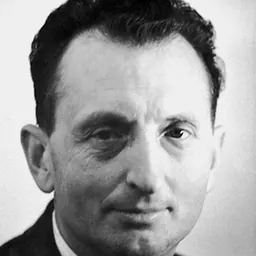
Lived 1913 – 2005 (aged 92). David Tabor was a British physicist.
David Tabor , FRS (23 October 1913 – 26 November 2005) was a British physicist who was an early pioneer of tribology, the study of frictional interaction between surfaces, and well known for his influential undergraduate textbook Gases, Liquids and Solids.
Early life and education David Tabrisky was the sixth of seven children of Russian Jewish parents Charles (born "Ezekiel") Tabrisky and Rebecca (née Weinstein), who had emigrated to the United Kingdom and lived at Notting Hill Gate. His father had been a non-commissioned officer in, and armourer to, the Russian Imperial Army, and had run a business as a gunsmith and metalworker. On coming to England, he established a small metalworking business specialising in customised fittings and designs. Charles Tabrisky changed the family's surname to "Tabor" in the early 1920s. Tabor was educated at the Portobello Road Primary School, Regent Street Polytechnic Secondary School, and Imperial College London (to which he won a scholarship), then went to Cambridge to undertake research in the Department of Chemistry.
Academic career In 1957, Tabor was elected a Fellow of Gonville and Caius College, Cambridge. In 1964, the University of Cambridge appointed him Reader in Physics. From 1969 to 1981, he served as Head of Physics and Chemistry of Solids at the Cavendish Laboratory. In 1973, he was promoted to Professor of Physics. He was made Professor Emeritus when he retired in 1981. Much of Tabor's tribology research was performed alongside Frank Philip Bowden, with whom he published his popular book 'The Friction and Lubrication of Solids '.
Honours He was elected a Fellow of the Royal Society in 1963. He was awarded the Society of Tribologists and Lubrication Engineers International Award in 1965. In 1968 he was awarded the A. A. Griffith Medal and Prize. He was the first recipient of the Tribology Gold Medal, which is awarded by the Tribology Trust and administered by the Institution of Mechanical Engineers, in 1972. He was awarded the Mayo D. Hersey award from the American Society of Mechanical Engineers in 1974. He also received the Guthrie Medal of the Institute of Physics, 1975 and the Royal Society's Royal Medal, one of their three highest awards, 1992.
The David Tabor Medal and Prize from the Institute of Physics was named in his honour.
Personal life In 1943, Tabor married Hanna Stillschweig, who survived him with their two sons.
Don’t just read it —
keep it.
Full-length biographies made to live with: read them, listen on the way to work, watch them tonight.
- E-book
- Audio
- Video
Instant download · yours to keep · every purchase keeps this site free
Important facts
People in David Tabor's life
Named in this biography and alive at the same time


Related people
Same field, nearest in time



Contemporaries
People whose lives overlapped David Tabor's





Frequently asked questions
Who was David Tabor?
British physicist (1913–2005)
When was David Tabor born?
David Tabor was born on 23 October 1913 in London.
When did David Tabor die?
David Tabor died on 26 November 2005 in Cambridge.
What was David Tabor's occupation?
David Tabor was a physicist.
What nationality was David Tabor?
David Tabor was British.
Sources & further reading
· DBpedia: David Tabor (physicist)
Cite this page
APA: Biography.guide. (2026). David Tabor. https://biography.guide/david-tabor/
MLA: "David Tabor." Biography.guide, https://biography.guide/david-tabor/.
Chicago: "David Tabor." Biography.guide. https://biography.guide/david-tabor/.
Data last updated: 2026-09-20 · Spot an error? Report a correction.
Page generated 2026-09-27 05:11 UTC