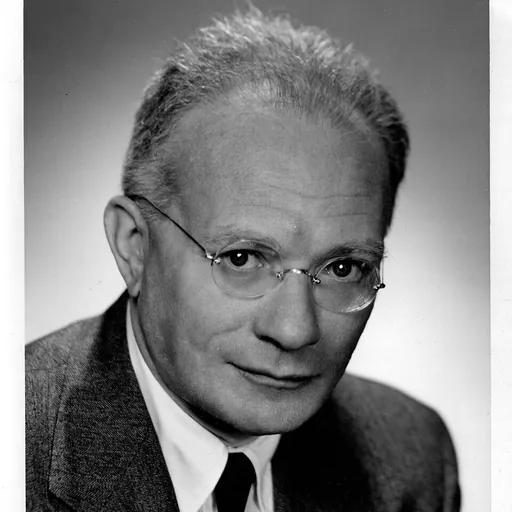
About David Shakow
Lived 1901 – 1981 (aged 80). David Shakow was an American psychologist, known for Schizophrenia and Scientist-practitioner model.
David Shakow (1901–1981) was an American psychologist. He is perhaps best known for his development of the Scientist-Practitioner Model (or Boulder Model) of graduate training for clinical psychologists, adopted by the American Psychological Association in 1949.
He also did pioneering research in schizophrenia, especially focusing on how deterioration and deficit results in the loss of normal functioning. His work helped to humanize those with schizophrenia, which was then seen largely as dangerous and untreatable. He is also known in the field for creating one of the first U.S. clinical psychology internship programs while he was at Worcester State Hospital. His stay at the Madison House introduced him to influences such as Freud, Jung, and James, which inspired Shakow's interest in psychopathology. He began his college education at Harvard University, where he received both his bachelor's degree and then master's degree in science. He then began his dissertation, but after marrying his wife Sophie and beginning a family, decided to begin work at Worcester State Hospital in 1926. In 1948, he accepted a position as a psychology professor at the University of Illinois in the College of Medicine, and also did additional work at the University of Chicago in the Department of Psychology, where he taught for several years before moving on to a career in research. Shakow influenced the creation of NIMH Laboratory of Psychology where he was granted the position of chief in 1954. Here he focused on research and continued on to oversee over 500 articles. Shakow retired in 1966, but remained on staff as a senior research psychologist to conduct more research, articles, and memoirs, until he died of a heart attack at 80 years old in February 1981.
Major contributions
The Scientist-Practitioner Model
David Shakow was chief psychologist at the Worcester State Hospital, as well as a member of the Committee on the Training of Clinical Psychologists. His extensive schizophrenia research at the Worcester State Hospital helped him to develop what we know as the Boulder Model, or the Scientist-Practitioner Model. It aims to guide students in graduate programs to develop a foundation of research methodology, field work, and scientific practice through engagement to shape and improve their future work in the field of clinical psychology. Shakow developed further the clinical psychology field as a profession by specifying goals and functions of the field, training, and by creating relationships with allied professors (p. 211). By rejecting definitions that were too narrow, which limited the clinician to just research, but too broad, which would make the field get diluted with other fields, and from his experience in working in medical psychiatric fields, he formalized what clinical psychologists are to diagnose, research, and do therapy as part of their profession. Internships for getting experience in the field were not standardized, nor were clinical psychology students given a uniform title in which they would be recognized in as they worked as interns. The four-year training program stressed the setting up of goals as a rough guide for the students to see the expectations and for them to be aware of what is involved in the program and prepare them for their careers as clinical psychologists. The award winner receives up to $500 to travel to the year's APA convention.
Awards and recognition
Shakow eventually moved to NIMH where he developed the laboratory and created special sections to study schizophrenia, childhood development, aging, perception, and even personality. Due to his work he was awarded the Distinguished Scientific Contribution Award and the Distinguished Professional Contribution Award. Over the years, Shakow also completed biographies on Herman Ebbinghaus and Kurt Goldstein for the American Journal of Psychology.
Honorary Membership in the Washington Psychoanalytic Society (1955) Distinguished Contribution Award, Division of Clinical Psychology, APA (1959) Collier Lecturer, University of Rochester (1960) Stanley R. Dean Research Award in Schizophrenia (1963) Helen Sargent Memorial Award, Menninger Foundation (1965) Honorary Fellowship in the American Psychiatric Association (1969) Doctor of Science, Honoris Causa, University of Rochester (1971) 3rd Annual Seymour D. Vestermark Memorial Award (1971) National Association of Mental Health Special Recognition Award at the 25th Anniversary of NIMH (1971) First Award for Notable Contribution to Psychopathology, Section of Experimental Psychopathology, Division of Clinical Psychology, APA (1971) Salmon Medal for Distinguished Service in Psychiatry (1971) Honorary Membership in the American Psychoanalytic Association (1976) American Psychological Association's (APA) Distinguished Scientific Award (1975) and its Distinguished Professional Contribution Award (1976) First Rapaport-Klein Memorial Lecturer (1974) NIH Scientist Emeritus (1974-1975)
Works
Journals on Schizophrenia
Shakow, D. (1946). The nature of deterioration in schizophrenic conditions" Nervous & Mental Disorders Monograph Series 70, vii - 88.
Other journals
Books
Shakow, D. (1901). Clinical psychology as science and profession. Chicago: Aldine Pub. Co. Shakow, D. (1979). Adaption in schizophrenia: the theory of segmental set. New York: John Wiley & Sons Canada, Limited. Shakow, D. & Rapaport, D. (1964). The influence of Freud on American psychology. Michigan: International Universities Press.
Don’t just read it —
keep it.
Full-length biographies made to live with: read them, listen on the way to work, watch them tonight.
- E-book
- Audio
- Video
Instant download · yours to keep · every purchase keeps this site free
Important facts
People in David Shakow's life
Named in this biography and alive at the same time



Related people
Same field, nearest in time


Contemporaries
People whose lives overlapped David Shakow's

Frequently asked questions
Who was David Shakow?
American psychologist
When was David Shakow born?
David Shakow was born on 2 January 1901 in New York.
When did David Shakow die?
David Shakow died on 26 February 1981 in Washington, D.C..
What was David Shakow's occupation?
David Shakow was a psychologist.
What was David Shakow known for?
David Shakow was known for Schizophrenia and Scientist-practitioner model.
What nationality was David Shakow?
David Shakow was American.
Sources & further reading
Cite this page
APA: Biography.guide. (2026). David Shakow. https://biography.guide/david-shakow/
MLA: "David Shakow." Biography.guide, https://biography.guide/david-shakow/.
Chicago: "David Shakow." Biography.guide. https://biography.guide/david-shakow/.
Data last updated: 2026-09-23 · Spot an error? Report a correction.
Portrait: Wikimedia Commons · author & licence
Page generated 2026-09-27 05:06 UTC