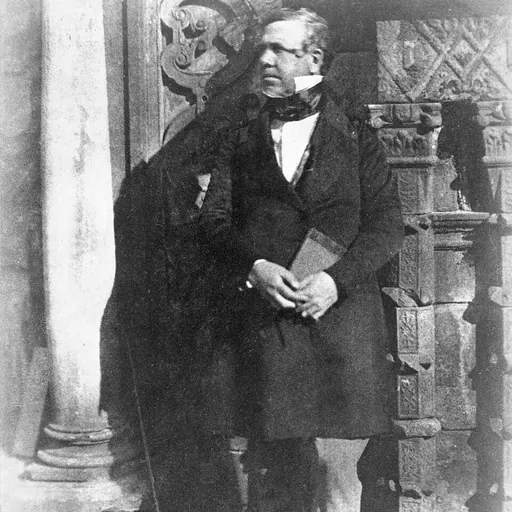
About David Roberts
Lived 1796 – 1864 (aged 68). David Roberts was a British painter.
David Roberts (24 October 179625 November 1864) was a Scottish painter. He is especially known for The Holy Land, Syria, Idumea, Arabia, Egypt, and Nubia, a prolific series of detailed lithograph prints of Egypt and the Near East that he produced from sketches he made during long tours of the region (1838–1840). These and his large oil paintings of similar subjects made him a prominent Orientalist painter. He was elected as a Royal Academician in 1841.
Early life
David Roberts was born at Edinburgh in Scotland, the eldest son of John Roberts and his wife Christian. He was apprenticed for seven years to house painter and decorator Gavin Beugo; his fellow apprentice was David Ramsay Hay, who became a lifelong friend. During this time he studied art in the evenings. After his apprenticeship was complete, Roberts's first paid job came in the summer of 1815, when he moved to Perth to serve as foreman for the redecoration of Scone Palace. Roberts returned in the spring of 1816 and lived with his parents while looking for work.
His next job was to paint scenery for James Bannister's circus on North College Street, launching a career as a painter and designer of stage scenery. Bannister liked Roberts's set designs and on 10 April 1816 engaged him at a salary of 25 shillings per week to travel with the circus on a tour of England. Roberts departed Edinburgh with the circus later the same month and travelled to Carlisle, Newcastle, Hull and York, returning to Edinburgh in January 1817. During his time with the circus, Roberts was called on to take several minor stage roles as a foil for the clowns' skits.
For the first few months of 1817, Roberts worked as the stage designer's assistant at the Pantheon Theatre in Edinburgh, a new joint venture between Bannister and an Italian musician named Corri. However the Pantheon was a financial failure and closed in May 1817, putting Roberts out of work. He reluctantly returned to house painting, working on the mansion house of Abercairny, near Perth, designed by Gillespie Graham. Although he was working from 5 a.m. to 7 p.m. he took the opportunity to sketch in the woods around the mansion in the evening. He followed this up with a stint painting imitation wood and marble at a mansion at Condie, near Bridge of Earn, in Perthshire. At the urging of his parents, Roberts returned to Edinburgh in January 1818, where he took employment with John Jackson, a decorative painter. Working for Jackson during 1818, Roberts decorated Lord Lauderdale's Dunbar House (known later as Lauderdale House) and then the library of Craigcrook Castle for Lord Jeffrey, who had recently leased the property.
In 1818, the Pantheon Theatre reopened in Edinburgh. Initially, a company from London with their own scene painters was in residence, but after they left, Roberts was able to get work from Corri as a scene painter. While Corri offered Roberts the position on 25 July 1818, he was already committed to house-painting work for Jackson and was unable to start at the Pantheon until the winter season. As there was no separate painting room, Roberts had to paint sets directly on the stage, which was occupied by rehearsals during the day and performances in the evening. Therefore, Roberts generally began work after the evening production had finished, working through the night. Roberts's work was noticed by the stage-manager, Mr. Monro. After the Pantheon closed, Monro moved on to the Theatre Royal, Glasgow, where he arranged for Roberts to be hired as a principal scene-painter.
In 1819, Roberts became the scene painter at the Theatre Royal in Edinburgh (having at this time James Ballantine as his apprentice). There Roberts met the Scottish actress Margaret McLachlan, said to be the illegitimate daughter of a Highland gypsy girl and a clan chief. They married in 1820, "for pure love". Although the marriage did not last long, it produced Roberts' only daughter, Christine, who was born in 1821.
Although he was making a living from scene painting, it was around this time that Roberts began to produce oil paintings seriously. In 1821 he became friends with the artist William Clarkson Stanfield, who joined him to paint scenery at the Theatre Royal, and Roberts developed his love of landscape painting. In 1821 the Fine Arts Institution of Edinburgh accepted three of Roberts's paintings – views of Melrose and Dryburgh abbeys – two of which sold. At Stanfield's suggestion, Roberts also sent three pictures to the 1822 Exhibition of Works by Living Artists, held in Edinburgh.
Move to London
In 1822 the Coburg Theatre, now the Old Vic in London, offered Roberts a job as a scenic designer and stage painter. He sailed from Leith with his wife and their six-month-old Christine and settled in London. After working for a while at the Coburg Theatre, Roberts moved to the Theatre Royal, Drury Lane to create dioramas and panoramas with Stanfield.
A miniature by Roberts from this time shows Margaret as a delicate woman with blonde ringlets, holding the smiling three-year-old Christine. But Roberts' family life was not as idyllic as this picture suggests: Margaret had become an alcoholic, and eventually, in 1831, Roberts sent her back to Scotland to be cared for by friends. Roberts may have burned some letters from this period in shame at his wife's drinking problem, but he was unusually frank in a letter to a friend, David Ramsay Hay. Roberts and Hay had been an apprentices together, and Hay had been seeing a mistress since his own wife had started drinking. "If you do not know our cases are almost parallel. Yours is not as bad as mine, having some consolation. The state of my nerves is such I can scarcely write. But thank God she leaves tomorrow—I hope for ever."
In 1824, he exhibited another view of Dryburgh Abbey at the British Institution and sent two works to the first exhibition of the newly formed Society of British Artists. In the autumn of 1824 he visited Normandy. His paintings based on this trip began to lay the foundation of his reputation; one of them, a view of Rouen Cathedral, sold for 80 guineas.
His last volume of illustrations, Italy, Classical, Historical and Picturesque, was published in 1859. In 1839 he was elected an associate and in 1841 a full member of the Royal Academy; and in 1858 he was presented with the freedom of the city of Edinburgh. The last years of his life were occupied with a series of views of London from the Thames. He had executed six of these, and was at work upon a picture of St Paul's Cathedral as seen from Ludgate Hill, when he died suddenly.
Selected works Paintings Departure of the Israelites (1829) The Great Staircase, Stafford House (1832), UK Government Art Collection Interior of Seville Cathedral (1834) A View in Cairo (1840), The Royal Collection, Windsor Castle The Temple at Dendera (1841) The Gateway to the Great Temple at Baalbec (1841) Ruins of the Great Temple at Karnak, in Upper Egypt (1845) The Destruction of Jerusalem (1850) The Church of the Jesuits, View on the Grand Canal, Venice (1854), Yale Center for British Art, Paul Mellon Collection, New Haven, Connecticut Edinburgh from the Calton Hill (1858) The Dogana and Santa Maria, Venice (1862) Sheffield Galleries & Museums Trust Street in Cairo (Royal Holloway Collection, University of London) Pilgrimage to Jerusalem (Royal Holloway Collection, London)
Prints Picturesque Sketches in Spain (London, 1835–36) The Holy Land, Syria, Idumea, Arabia, Egypt, and Nubia (London 1842–1849, originally as The Holy Land, Syria, Idumea and Arabia and Egypt and Nubia, in 2x3 volumes.) Link to Images Cities of North Africa (London 1852)
Journals Roberts, David, Record Book, 1829–1864, unpublished manuscript, Yale Center for British Art, New Haven. Roberts, David, Eastern Journal, 1838–1839, unpublished manuscript, National Library of Scotland, Edinburgh.
Gallery
Don’t just read it —
keep it.
Full-length biographies made to live with: read them, listen on the way to work, watch them tonight.
- E-book
- Audio
- Video
Instant download · yours to keep · every purchase keeps this site free
Important facts
People in David Roberts's life
Named in this biography and alive at the same time



Related people
Same field, nearest in time


Contemporaries
People whose lives overlapped David Roberts's






Frequently asked questions
Who was David Roberts?
Scottish painter (1796–1864)
When was David Roberts born?
David Roberts was born on 24 October 1796 in Stockbridge.
When did David Roberts die?
David Roberts died on 25 November 1864 in London.
What was David Roberts's occupation?
David Roberts was a painter.
What nationality was David Roberts?
David Roberts was British.
Sources & further reading
· DBpedia: David Roberts (painter)
Cite this page
APA: Biography.guide. (2026). David Roberts. https://biography.guide/david-roberts-painter/
MLA: "David Roberts." Biography.guide, https://biography.guide/david-roberts-painter/.
Chicago: "David Roberts." Biography.guide. https://biography.guide/david-roberts-painter/.
Data last updated: 2026-09-22 · Spot an error? Report a correction.
Portrait: Wikimedia Commons · author & licence
Page generated 2026-09-27 05:03 UTC