
About David Parry
Lived 1793 – 1826 (aged 33). David Parry was a painter.
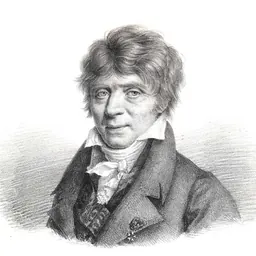
David Henry Parry (1793 – 1826) was a British portrait painter. He was the son of Joseph Parry and brother of James Parry, both also artists.
A native of Manchester, he was the "founding father" of the city's first cultural institution—the Royal Manchester Institution.
Early life Parry was born on 7 June 1783, the second-youngest of the biological children of Joseph and Esther Parry. He was born in Manchester; his father, an artist, had moved there from Liverpool in 1790 to seek the patronage of the city's new class of wealthy industrialists and merchants. Joseph Parry was an influential figure within Manchester's early artistic community, being given the title of "the Father of Art in Manchester" by his contemporaries for his role as a mentor and teacher of the younger artists who followed in his wake—including both David and his younger brother James, who studied in Joseph's studio. Career Parry specialised in portraits, painting in both oils and watercolours. In an 1822 guide to Manchester, James Butterworth described Parry as an "eminent portrait painter" whose works "possess in themselves, a voice and an utterance superior to the eloquent praise that could be bestowed by Cicero: the common talent of a common artist may sometimes require a compliment, through the medium of the press, to bring them into more general notice; but his works (in my humble opinion) are his own panegyrist."
At the dawn of the 19th century several of the industrialising cities of Northern England had started to develop their first self-sustaining artistic communities, with institutions similar to London's Royal Academy of Art—but Manchester was a conspicuous laggard relative to peer cities like Liverpool and Birmingham, with a reputation for philistinism that would endure well into the Victorian era. This began to change in 1823, when Parry and fellow artist Frank Stone (along with their mutual friend William Brigham, a local businessman) visited an exhibition in Leeds put on by the Northern Society for the Encouragement of the Fine Arts, which had been formed by Leeds' artists in the 1800s as a way of collectively soliciting patronage from the city's wealthy industrialists. Inspired, they returned home and together with a small group of other local artists—including James Parry, Arthur Perigal, and Charles Calvert—formed a new society called the Associated Artists of Manchester.
Over the following months the group secured support from prominent local figures (including Sir Oswald Mosley), elected a board of governors, and agreed on a primary objective: the establishment of "the Manchester Institution for the Promotion of Literature, Science, and the Arts," containing art galleries (for annual exhibitions of works by local artists), lecture theatres, a library, and research laboratories. In the meantime, the newly christened Royal Manchester Institution held Manchester's first public exhibition of paintings in an art dealer's gallery on Market Street in 1827.
However, Parry did not live to see this exhibition—in 1826 he moved to London after securing commissions there, but died only a few months later at the age of 33. Parry's reputation is now largely tied to the origin story of the Royal Manchester Institution—for example, Dennis Child's Painters in the Northern Counties of England and Wales (1994), a standard reference text used by historians and auction houses for identifying works produced by artists working pre-1940, describes Parry as the Institution's "founding father."
Parry's youngest son, wool merchant Charles James Parry, had minor success as a landscape painter, and his two sons were also artists.
Don’t just read it —
keep it.
Full-length biographies made to live with: read them, listen on the way to work, watch them tonight.
- E-book
- Audio
- Video
Instant download · yours to keep · every purchase keeps this site free
Important facts
more
ParryPeople in David Parry's life
Named in this biography and alive at the same time




Related people
Same field, nearest in time


Contemporaries
People whose lives overlapped David Parry's




Frequently asked questions
Who was David Parry?
English portrait painter (1793–1826)
When was David Parry born?
David Parry was born on 7 June 1793 in Manchester.
When did David Parry die?
David Parry died on 15 September 1826 in London.
What was David Parry's occupation?
David Parry was a painter.
Sources & further reading
Cite this page
APA: Biography.guide. (2026). David Parry. https://biography.guide/david-parry-painter/
MLA: "David Parry." Biography.guide, https://biography.guide/david-parry-painter/.
Chicago: "David Parry." Biography.guide. https://biography.guide/david-parry-painter/.
Data last updated: 2026-09-20 · Spot an error? Report a correction.
Page generated 2026-09-27 05:03 UTC