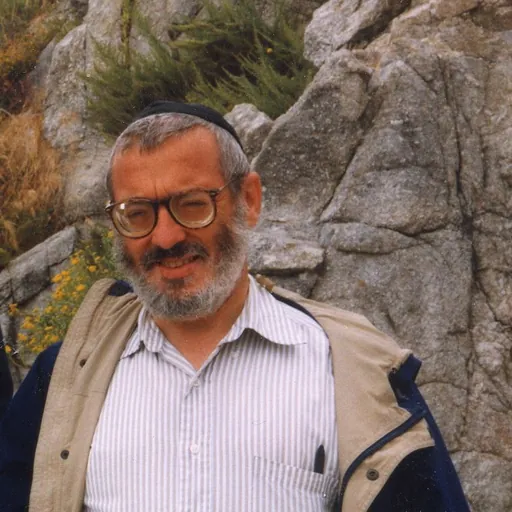
About David Kazhdan
Born 1946. David Kazhdan is a Russian, American and Israeli mathematician, known for Kazhdan's property (T), Kazhdan–Lusztig polynomial and Kazhdan–Margulis theorem.
David Kazhdan , born Dmitry Aleksandrovich Kazhdan (; born 20 June 1946), is a Soviet and Israeli mathematician known for work in representation theory. Kazhdan is a 1990 MacArthur Fellow. In 2012, he received the Israel Prize for Mathematics and Computer sciences. His father is Alexander Kazhdan. He earned a doctorate under Alexandre Kirillov in 1969 and was a member of Israel Gelfand's school of mathematics. He is Jewish, and emigrated from the Soviet Union to take a position at Harvard University in 1975. He changed his name from Dmitri Aleksandrovich to David and became an Orthodox Jew around that time.
In 2002, he immigrated to Israel and is now a professor at the Hebrew University of Jerusalem as well as a professor emeritus at Harvard.
On October 6, 2013, Kazhdan was critically injured in a car accident while riding a bicycle in Jerusalem.
Kazhdan has four children. His son, Eli Kazhdan, was general director of Natan Sharansky's Yisrael BaAliyah political party (now merged with Likud), chief of staff in the Ministry of Industry and Trade and the Ministry of Interior, and a foreign policy advisor to Sharansky.
Research He is known for collaboration with Israel Gelfand, Victor Kac, George Lusztig (on the Kazhdan–Lusztig conjecture on Verma modules), with Grigory Margulis (Kazhdan–Margulis theorem), with Yuval Flicker and S. J. Patterson on the representations of metaplectic groups. Kazhdan's property (T) is widely used in representation theory.
Kazhdan held a MacArthur Fellowship from 1990 to 1995. He was the doctoral advisor of Vladimir Voevodsky, a recipient of the Fields Medal, one of the highest awards in mathematics. Kazhdan has been a member of United States National Academy of Sciences since 1990, of the Israel Academy of Sciences since 2006, and of the American Academy of Arts and Sciences since 2008. In 2012, he was awarded the Israel Prize, the country's highest academic honor, for mathematics and computer science. In 2020 he received the Shaw Prize in Mathematics.
Selected publications Quantum fields and strings: a course for mathematicians. Vol. 1, 2. Material from the Special Year on Quantum Field Theory held at the Institute for Advanced Study, Princeton, NJ, 1996–1997. Edited by Pierre Deligne, Pavel Etingof, Daniel S. Freed, Lisa C. Jeffrey, David Kazhdan, John W. Morgan, David R. Morrison and Edward Witten. American Mathematical Society, Providence, RI; Institute for Advanced Study (IAS), Princeton, NJ, 1999. Vol. 1: xxii+723 pp.; Vol. 2: pp. i--xxiv and 727–1501. , 81-06 (81T30 81Txx)
Don’t just read it —
keep it.
Full-length biographies made to live with: read them, listen on the way to work, watch them tonight.
- E-book
- Audio
- Video
Instant download · yours to keep · every purchase keeps this site free
Important facts
People in David Kazhdan's life
Named in this biography and alive at the same time





Related people
Same field, nearest in time


Contemporaries
People whose lives overlapped David Kazhdan's

Frequently asked questions
Who is David Kazhdan?
Israeli mathematician
When was David Kazhdan born?
David Kazhdan was born on 20 June 1946 in Moscow.
What is David Kazhdan's occupation?
David Kazhdan is a mathematician.
What is David Kazhdan known for?
David Kazhdan is known for Kazhdan's property (T), Kazhdan–Lusztig polynomial and Kazhdan–Margulis theorem.
What nationality is David Kazhdan?
David Kazhdan is Russian, American and Israeli.
Sources & further reading
Cite this page
APA: Biography.guide. (2026). David Kazhdan. https://biography.guide/david-kazhdan/
MLA: "David Kazhdan." Biography.guide, https://biography.guide/david-kazhdan/.
Chicago: "David Kazhdan." Biography.guide. https://biography.guide/david-kazhdan/.
Data last updated: 2026-09-21 · Spot an error? Report a correction.
Portrait: Wikimedia Commons · author & licence
Page generated 2026-09-27 05:01 UTC