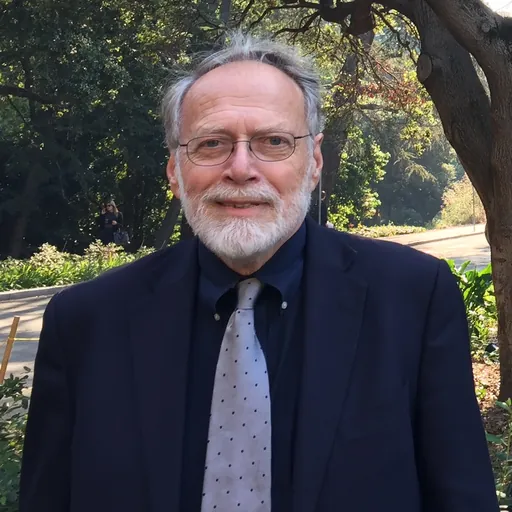
About David Hollinger
Born 1941. David Hollinger is an American historian and university teacher.
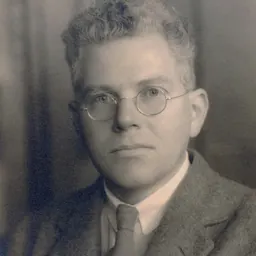
David Albert Hollinger (born April 25, 1941 in Chicago, Illinois) is the Preston Hotchkis Professor of History, emeritus at the University of California, Berkeley. His specialties are American intellectual history and American ethnoracial history.
Hollinger is the author of several books, including Postethnic America: Beyond Multiculturalism (1995), Protestants Abroad: How Missionaries Tried to Change the World but Changed America (2017), and Christianity’s American Fate: How Religion Became More Conservative and Society More Secular (2022).
His influence in the field of religious history was discussed in 2013 in The New York Times.
Life Hollinger grew up in the Church of the Brethren, a denomination in which his father, grandfather, and great-grandfather had been ministers, but Hollinger has identified himself as an atheist for most of his adult life. He documented his family's history in his 2019 family memoir, When This Mask of Flesh is Broken: The Story of an American Protestant Family (2019) is an account of the Hollinger family’s history and its role in the Brethren community. He detailed his upbringing in the chapter "Church People and Others" from his 2013 book After Cloven Tongues of Fire.
While completing his undergraduate education, Hollinger worked as a part-time sportswriter for the Pomona Progress-Bulletin. Hollinger has been the Ph.D. advisor to people who have become well established as publishing scholars in history, including S. M. Amadae, Jennifer Burns, Daniel Immerwahr, Healan Gaston, Daniel Geary, Nils Gilman, Andrew Jewett, Susan Nance, Kevin Shultz, and Gene Zubovich.
Hollinger was president of the Organization of American Historians in 2010-2011 and was the Harmsworth Professor of American History at the University of Oxford in 2001–2002. He was an elected fellow of The American Academy of Arts and Sciences in 1997. He has been a trustee of the National Humanities Center and of the Institute For Advanced Study. He is an elected member of the American Philosophical Society in 2017.
Scholarship Hollinger developed an interpretation of American intellectual history based on the accommodation of Protestant Christianity with the Enlightenment and the tension between cosmopolitan and provincial drives. These themes inform “The American Intellectual Tradition”, a standard sourcebook co-edited with Charles Capper across seven editions (1989–2017). The same emphases are found throughout Hollinger’s single-authored books and articles on philosophy, religion, literature, higher education, the ideology of science, and debates over race and ethnicity. His work is known in three subfields: the role of Jews in public life, the origins and dynamics of multiculturalism, and the role of Protestants in public life.
Hollinger’s study of Jewish integration into American culture began with “Morris R. Cohen and the Scientific Ideal” (1975) and expanded in “Science, Jews, and Secular Culture” (1996). The influential of his later essays in this domain were “Rich, Powerful and Smart: Jewish Overrepresentation Should be Explained Instead of Avoided or Mystified,” Jewish Quarterly Review (2004), and “Communalist and Dispersionist Approaches to American Jewish History in an Increasingly Post-Jewish Era,” American Jewish History (2009). Hollinger has argued that Jews, as a culturally conspicuous population of non-Christians, have powerfully diversified American life and have weakened Anglo-Protestant hegemony.
Central to Hollinger’s work in the area of multiculturalism and diversity is his book, Post ethnic America: Beyond Multiculturalism (1995; 2000; 2006). This book placed the late twentieth-century preoccupation with ethnic and racial diversity in a historical context and defended national and universal solidarities against identity politics. He also edited, for the American Academy of Arts and Sciences, The Humanities and the Dynamics of Inclusion Since World War II (Johns Hopkins University Press, 2006).
During the later period of his career, Hollinger has been primarily concerned with the role of Protestant Christianity in public life. He has focused on the historic tension between the liberal-ecumenical and conservative-evangelical families of Protestants and their very different orientations to pluralist democracy. After Cloven Tongues of Fire: Protestant Liberalism in Modern American History (Princeton University Press, 2013), addressed the writings of William James, Reinhold Niebuhr, and other Protestant intellectuals while arguing that Christianity’s role in the United States had been gradually diminished by a combination of demographic diversity and epistemic demystification. Protestants Abroad: How Missionaries Tried to Change the World but Changed America (Princeton University Press, 2017) demonstrated that the most educated and theologically liberal missionaries sent abroad by American churches often turned against proselytization and devoted themselves to service and to advancing appreciation of foreign cultures. This book confirmed the basic claims of “contact theory” as developed by Gordon Allport and other social scientists. Christianity’s American Fate: How Religion Became More Conservative, and Society More Secular (Princeton University Press, 2022) interpreted the appeal of evangelicalism largely as a safe harbor for Protestants who wanted to be counted as Christian without engaging the challenges of an ethnically and racially diverse society and a scientifically informed culture.
Personal life Since 1967, he has been married to legal scholar Joan Heifetz Hollinger. He is the father of two children.
Works Hollinger, David A.; Capper, Charles (1989). The American Intellectual Tradition: A Sourcebook. 1620-1865. Oxford University Press. . Hollinger, David A. (April 1989). In the American Province: Studies in the History and Historiography of Ideas. JHU Press. . Hollinger, David A. (2006-02-28). Postethnic America: Beyond Multiculturalism. Basic Books. . Hollinger, David A. Science, Jews, and Secular Culture: Studies in Mid-Twentieth Century American Intellectual History. Princeton University Press, 1996 Carson, Cathryn; Hollinger, David A., eds. Reappraising Oppenheimer: Centennial Studies and Reflections. UC Berkeley, 2005 Hollinger, David A. (2006-03-06). Cosmopolitanism and Solidarity: Studies in Ethnoracial, Religious, and Professional Affiliation in the United States. Univ of Wisconsin Press. . Hollinger, David A. (2013-04-21). After Cloven Tongues of Fire: Protestant Liberalism in Modern American History. Princeton University Press. . Hollinger, David A. (2017-10-17). Protestants Abroad: How Missionaries Tried to Change the World But Changed America. Princeton University Press. Hollinger, David A. (2019). When this Mask of Flesh is Broken: The Story of an American Protestant Family. Outskirts Press. . Hollinger, David A. (2022). Christianity’s American Fate: How Religion Became More Conservative and Society More Secular. Princeton University Press. ISBN 9780691233888
Presentations and Panels
"The Role of Christianity in Modern US History" with David Hollinger, [Video] (Fall 2023) Christianity’s American Fate: How Religion Became More Conservative and Society More Secular (Princeton University, Wilson Center, Oct. 17, 2022) Race in the Age of Obama, American Academy of Arts & Sciences, St. Louis, MO (2012) Kuhn, the Quotidian, and the Question of God's Death, Center for Science, Technology, Medicine & Society at the University of California, Berkeley (2013)
Interviews
The Marc Steiner Show: ‘This is the hill to die on for universities’: free speech can survive Trump, but not without a fight (November 13, 2025) "Their Generation" The Long View Substack by Julian Zelizer, An interview with David Hollinger (January 30, 2026)
Don’t just read it —
keep it.
Full-length biographies made to live with: read them, listen on the way to work, watch them tonight.
- E-book
- Audio
- Video
Instant download · yours to keep · every purchase keeps this site free
Important facts
People in David Hollinger's life
Named in this biography and alive at the same time





Related people
Same field, nearest in time


Contemporaries
People whose lives overlapped David Hollinger's


Frequently asked questions
Who is David Hollinger?
American historian
When was David Hollinger born?
David Hollinger was born on 25 April 1941 in Chicago.
What is David Hollinger's occupation?
David Hollinger is a historian and university teacher.
What nationality is David Hollinger?
David Hollinger is American.
Sources & further reading
Cite this page
APA: Biography.guide. (2026). David Hollinger. https://biography.guide/david-hollinger/
MLA: "David Hollinger." Biography.guide, https://biography.guide/david-hollinger/.
Chicago: "David Hollinger." Biography.guide. https://biography.guide/david-hollinger/.
Data last updated: 2026-09-24 · Spot an error? Report a correction.
Portrait: Wikimedia Commons · author & licence
Page generated 2026-09-27 05:08 UTC