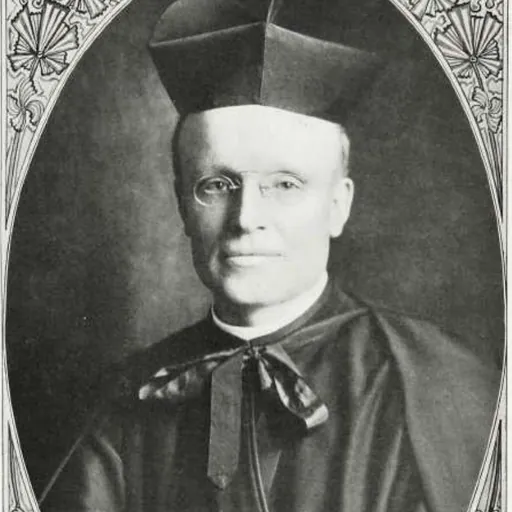
David Hillhouse Buel
American Catholic priest and Episcopal minister
About David Hillhouse Buel
Lived 1862 – 1923 (aged 60). David Hillhouse Buel was an American catholic priest, teacher and academic administrator.
David Hillhouse Buel Jr. (July 19, 1862 – May 23, 1923) was an American priest who served as the president of Georgetown University. A Catholic priest and Jesuit for much of his life, he later left the Jesuit order to marry, and subsequently left the Catholic Church to become an Episcopal priest. Born at Watervliet, New York, he was the son of David Hillhouse Buel, a distinguished Union Army officer, and descended from numerous prominent New England families. While studying at Yale University, he formed an acquaintance with priest Michael J. McGivney, resulting in his conversion to Catholicism and joining the Society of Jesus after graduation.
In 1901, Buel became a professor at Georgetown University. He took charge of the university in 1905, after the sudden removal of the president. In this role, he promoted intramural sports, oversaw construction of Ryan Gymnasium, and reformed the curriculum and university governance. He also instituted strict discipline and curtailed intercollegiate athletics, stoking fierce opposition from the student body and their parents, which resulted in his removal by the Jesuit superiors in 1908. Buel then performed pastoral work and taught for several years, before resigning from the Jesuit order in 1912 and secretly marrying in Connecticut. When word reached Washington, D.C., his former Jesuit colleagues publicly condemned him, and the media claimed his actions resulted in his excommunication latae sententiae.
Buel resumed teaching in a secular capacity in New England, but after his marriage, he lived at times in poverty despite his wife's considerable inheritance. He formally left the Catholic Church in 1922 to be ordained an Episcopal priest, but never took up rectorship of a church. He spent his last years in New York City.
Early life
David Hillhouse Buel was born on July 19, 1862, at Watervliet Arsenal in West Troy, New York. His father, David Hillhouse Buel, was a graduate of the United States Military Academy, and distinguished Union Army officer. He rose to the rank of lieutenant colonel during the Civil War, and was appointed Chief of Ordnance of the Army of the Tennessee. He had been awarded a brevet while a major. She was of Scottish ancestry, and the daughter of Brigadier General Charles McDougall.
Buel's ancestry includes several prominent and influential families, such as the McDougalls, Hansons, Wilmers and Hillhouses, the latter of which produced many statesmen and scholars in Connecticut. The Buel family was also prominent in Connecticut, and was one of the oldest in New England. His earliest American ancestor, William Buel, arrived in 1630 from England.
Education and conversion to Catholicism
Buel attended Williston Seminary in Easthampton, Massachusetts, where he graduated in 1879. and the president pro tempore of the United States Senate. At Yale, Buel became interested in theater. Along with other Protestant students, Buel began attending Catholic Mass at St. Mary's after the Protestant chapel services at which Yale required attendance of all students. At St. Mary's, he became friendly with Michael J. McGivney, a Catholic priest. Upon McGivney's suggestion, Buel focused his theatrical interests on the classics, rather than what McGivney viewed as unseemly subjects, such as the minstrel shows that were popular with the students of Yale at the time. Heeding the advice, he wrote Medea: A Travesty, based on the Greek tragedy of Medea, His theatrical interest remained with him later in life, and he continued to write operettas. and convert to Catholicism shortly thereafter, Two of Buel's Protestant classmates were also guided by McGivney, and converted to Catholicism.
Buel then moved to Georgetown University in Washington, D.C. to serve as a professor of mechanics and physics from 1901 to 1904. He attained the grade of professed father in the Society of Jesus on February 3, 1902, being promoted to Doctor of Divinity. In 1905, he became father minister (vice president) of the university. Buel succeeded him in 1905 as president of Georgetown University. He was also successful in reducing the university's debt.
Reform of athletics
Continuing the work of his predecessor, Buel reduced the prominence of athletics by de-professionalizing the football, baseball, and track programs, which involved strict limits on intercollegiate travel for athletics. He also considered abolishing the football team altogether, as Columbia University, New York University, and Stanford University had already done, due to a spate of severe injuries and deaths in college football. Nonetheless, students were generally unhappy with the reform.
Discipline
Buel's presidency was characterized by the institution of rigid discipline. One of his measures included putting into place a strict daily schedule by which students were required to abide. As well as classes, students were obligated to attend study hall, meals, Mass, night prayers, and benediction. Failure to abide by this agenda resulted in punishment according to a new demerit system.
His rigidity was met with strong opposition by the students, their parents, and faculty. Buel made no allowances for absence from these requirements, even at the request of parents to allow their sons to attend family events, St. Patrick's Day celebrations, or, in one case, to attend the Democratic Party state convention nominating a student's father for Congress. According to his disciplinary system, transgression of his decision to compel attendance resulted in expulsion from the university of a student who had left to act as godfather at the baptism of his sister's child. Her mother, Mary Powers, née Conway, Following their marriage, they moved to Kip's Bay in Manhattan. Their marriage did not produce any children. Buel responded to the criticism by writing an open letter to the United Press, saying he was not a Jesuit at the time of his marriage, having previously tendered his resignation to the Society of Jesus as a member in good standing. He argued that the Jesuits' public criticism of his marriage was a personally motivated departure from their usual policy of secrecy, and cited several former Jesuits who withdrew from the order and received no public condemnation.
Conversion to Episcopalianism
Soon after marrying, Buel moved to Massachusetts, where he taught Latin, Greek, and French at Roxbury Preparatory School from 1913 to 1914. He then opened a summer camp for boys in Allerton Heights, Massachusetts, called Camp Hillhouse-by-the-Sea. From 1915 to 1918, he tutored students at the camp. When visited one winter by the Unitarian minister William Laurence Sullivan, he said he was prepared to take any kind of work, including being a guard in the subway.
Buel sought admittance to the priesthood of the Episcopal Church, of which he had been a member before converting to Catholicism in college. On June 2, 1922, he was ordained at St. Thomas's Church in New Haven by Bishop Chauncey B. Brewster of the Episcopal Diocese of Connecticut. Eventually, he became ill, and one of the local Catholic priests visited him at his bedside the day before his death to offer him last rites and hear his confession; Buel, who could no longer speak, refused both. He died of pneumonia on May 23, 1923, and was buried in Oakwood Cemetery in Troy, New York.
Don’t just read it —
keep it.
Full-length biographies made to live with: read them, listen on the way to work, watch them tonight.
- E-book
- Audio
- Video
Instant download · yours to keep · every purchase keeps this site free
Important facts
more
Jr.Family & relationships
People in David Hillhouse Buel's life
Named in this biography and alive at the same time



Related people
Same field, nearest in time

Contemporaries
People whose lives overlapped David Hillhouse Buel's




Frequently asked questions
Who was David Hillhouse Buel?
American Catholic priest and Episcopal minister (1862-1923)
When was David Hillhouse Buel born?
David Hillhouse Buel was born on 19 July 1862 in Watervliet Arsenal.
When did David Hillhouse Buel die?
David Hillhouse Buel died on 23 May 1923 in New York City.
What was David Hillhouse Buel's occupation?
David Hillhouse Buel was a catholic priest, teacher and academic administrator.
What nationality was David Hillhouse Buel?
David Hillhouse Buel was American.
Sources & further reading
· Wikipedia: David Hillhouse Buel
· DBpedia: David Hillhouse Buel (priest)
Cite this page
APA: Biography.guide. (2026). David Hillhouse Buel. https://biography.guide/david-hillhouse-buel/
MLA: "David Hillhouse Buel." Biography.guide, https://biography.guide/david-hillhouse-buel/.
Chicago: "David Hillhouse Buel." Biography.guide. https://biography.guide/david-hillhouse-buel/.
Data last updated: 2026-09-24 · Spot an error? Report a correction.
Portrait: Wikimedia Commons · author & licence
Page generated 2026-09-27 05:08 UTC