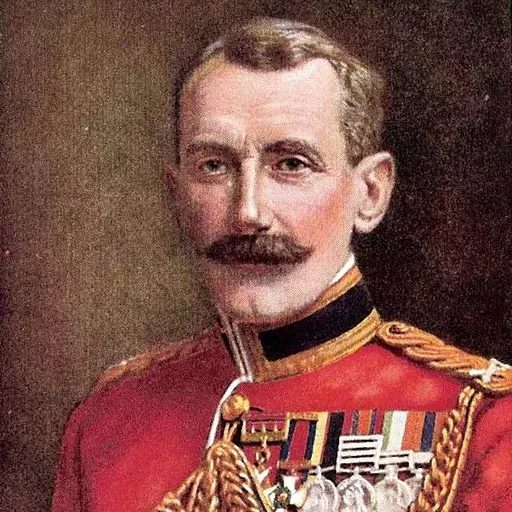
About David Henderson
Lived 1862 – 1921 (aged 59). David Henderson was a British military personnel.
Lieutenant-General Sir David Henderson, (11 August 1862 – 17 August 1921) was the senior leader of British military aviation during the First World War, having previously established himself as the leading authority on tactical intelligence in the British Army. He served as the commander of the Royal Flying Corps in the field during the first year of the First World War, After the war Henderson was the first Director-General of the League of Red Cross Societies.
Henderson entered the University of Glasgow in 1877 at the age of just 15. While there, he read engineering and in his fourth year (1880–1881) he studied civil engineering and mechanics as well as office and field work in engineering. For reasons now unknown, he left the university to train for a military career at the Royal Military College, Sandhurst, instead of graduating from Glasgow. but Ian Henderson predeceased his parents, dying in a flying accident in June 1918.
Military career
Following officer training at the Royal Military College Sandhurst, Henderson was commissioned into the British Army on 25 August 1883, joining the Argyll and Sutherland Highlanders as a lieutenant.
Lord Kitchener at the Peace Conference that ended the Second Boer War. Colonel Henderson is stood on the extreme left.
He was promoted to captain on 26 February 1890, and graduated from the Staff College, Camberley in 1895, the same year he married Henrietta Caroline Dundas (later Dame Henrietta Henderson, DBE). Subsequently, he was a member of the Nile Expedition of 1898, following which he received a brevet promotion to the rank of major on 16 November 1898. Three months before the outbreak of the Second Boer War Henderson was posted to Natal as an intelligence officer.
During the opening stage of the war he took part and was wounded at the Siege of Ladysmith. In a despatch dated 23 June 1902, Kitchener wrote how Henderson had "invariable done his best to cope with the great difficulties of his position." For his service in the war, he was awarded the Distinguished Service Order (DSO) in the October 1902 South Africa Honours list. His subsequent works, Field Intelligence: Its Principles and Practice (1904) and The Art of Reconnaissance (1907), did much to establish his reputation as the Army's authority on tactical intelligence. After having served as a deputy assistant quartermaster general, Henderson was, in November 1905, promoted to brevet colonel and succeeded Colonel Archibald Murray as an assistant adjutant general of the 1st Division. He was promoted to the substantive rank of lieutenant colonel in January 1907 and to colonel in November. In December that year he appointed as a staff officer to the staff of the inspector general of the forces, General Sir John French, for which he was, in April, granted the temporary rank of brigadier general while holding this post. In June 1909 he was made a Companion of the Order of the Bath.
In 1911, at the age of 49, Henderson learned to fly, making him the world's oldest pilot at that time. In July 1912 he took over the post of director of military training at the War Office, again in succession to Archibald Murray. In 1913 the control of military aviation was separated from the responsibilities of the Master-General of the Ordnance. A new Department of Military Aeronautics was established and Henderson was appointed the first director He was promoted to the temporary rank of brigadier general in August 1914.
On 22 November 1914, Henderson, promoted to major general the month before, was appointed General Officer Commanding (GOC) of the 1st Division and his chief of staff Frederick Sykes took up command in his stead. However, Henderson did not spend long commanding the 1st Infantry Division. The decision to post Henderson and replace him with Sykes was not to Field Marshal Lord Kitchener's liking, and he ordered a reversal of the appointments. On 20 December 1914, Henderson resumed command of the Royal Flying Corps in the Field and Sykes was once again his chief of staff.
In 1915 Henderson returned to London to resume his London-based duties as director-general of military aeronautics, was well placed to assist. While seconded to Smuts, Henderson wrote much of what came to be called the Smuts Report. He sat on the government's "Advisory Committee for Aeronautics", located at the National Physical Laboratory, under the chairmanship of Richard Glazebrook and presidency of John Strutt, Lord Rayleigh.
In January 1918, Henderson, who the year before had been made a substantive lieutenant general, was made a member of the Air Council,
Following his departure from the Air Council, Henderson returned to France where he served until October 1918. After the armistice, Henderson served as a military counsellor during the Paris Peace Conference
David Henderson Avenue, built on the former School of Service Intelligence site in Ashford, Kent, is named after him.
Don’t just read it —
keep it.
Full-length biographies made to live with: read them, listen on the way to work, watch them tonight.
- E-book
- Audio
- Video
Instant download · yours to keep · every purchase keeps this site free
Important facts
People in David Henderson's life
Named in this biography and alive at the same time



Related people
Same field, nearest in time




Contemporaries
People whose lives overlapped David Henderson's





Frequently asked questions
Who was David Henderson?
British army and air force officer
When was David Henderson born?
David Henderson was born on 11 August 1862 in Glasgow.
When did David Henderson die?
David Henderson died on 17 August 1921 in Geneva.
What was David Henderson's occupation?
David Henderson was a military personnel.
What nationality was David Henderson?
David Henderson was British.
Sources & further reading
· DBpedia: David Henderson (British Army officer)
Cite this page
APA: Biography.guide. (2026). David Henderson. https://biography.guide/david-henderson-military-personnel/
MLA: "David Henderson." Biography.guide, https://biography.guide/david-henderson-military-personnel/.
Chicago: "David Henderson." Biography.guide. https://biography.guide/david-henderson-military-personnel/.
Data last updated: 2026-09-22 · Spot an error? Report a correction.
Portrait: Wikimedia Commons · author & licence
Page generated 2026-09-27 05:04 UTC