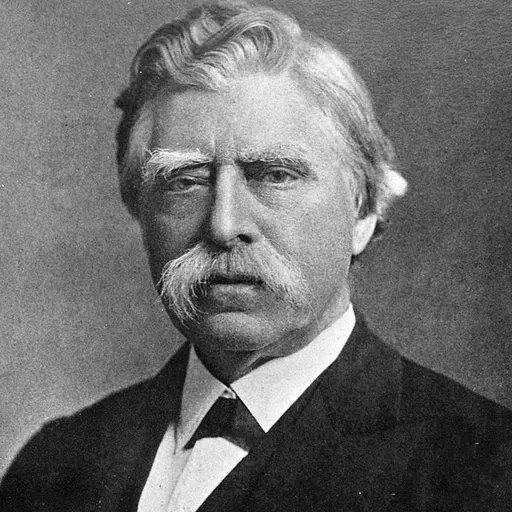
About David Edward Hughes
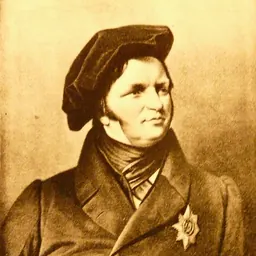
Lived 1831 – 1900 (aged 68). David Edward Hughes was a British and American musician, inventor, physicist, musicologist, teacher and technician, known for Microphone, Radio wave and Teleprinter.
Biography Hughes was born in 1830, the son of a musically talented family hailing originally from Y Bala (the place of birth was either London or Corwen, Denbighshire), and emigrated to the United States at the age of seven. to a very high standard. At an early age, Hughes developed such musical ability that he is reported to have attracted attention of Herr Hast, an eminent German pianist in America, who procured for him a professorship of music at St. Joseph's College in Bardstown, Kentucky. Hughes also worked as a practical experimenter, coming up with the printing telegraph in 1855. He moved back to London in 1857 to sell his invention, and worked on the transmission of sound over wires. He worked on microphones and the development of the induction balance (later used in metal detectors). Despite Hughes' facility as an experimenter, he had little mathematical training. He was a friend of William Henry Preece.
Printing telegraph The Hughes telegraph was the first telegraph printing text on a paper tape; this one was manufactured by Siemens and Halske, Germany (Warsaw Muzeum Techniki).
In 1855, Hughes designed a printing telegraph system. In less than two years a number of small telegraph companies, including Western Union in early stages of development, united to form one large corporation — Western Union Telegraph Company — to carry on the business of telegraphy on the Hughes system. In Europe, the Hughes Telegraph System became an international standard.
Microphone
In 1878 Hughes published his work on the effects of sound on the powered electronic sound pickups, called "transmitters", being developed for telephones. Based on its ability to pick up extremely weak sounds, Hughes referred to it as a "microphone effect" (using a word coined by Charles Wheatstone in 1827 for a mechanical sound amplifier ). He conducted a simple demonstration of this principle of loose contact by laying an iron nail across two other nails connected to a battery and galvanometer. His paper was read before the Royal Society of London by Thomas Henry Huxley on May 8, 1878, and his new "microphone" was covered in the July 1 edition of Telegraph Journal and Electrical Review. Hughes published his work during the time that Thomas Edison was working on a carbon telephone transmitter and Emile Berliner was working on a loose-contact transmitter. Both Hughes and Edison may have based their work on Philipp Reis' telephone work. He developed an improved detector to pick up this unknown "extra current" based on his new microphone design and developed a way to interrupt his induction balance via a clockwork mechanism to produce a series of sparks. By trial and error experiments he eventually found he could pick up these "aerial waves" as he carried his telephone device down the street out to a range of . Hughes was not a physicist and seems to have accepted Stokes observations and did not pursue the experiments any further.
Hughes did not publish his findings but did finally mention them in an 1899 letter to The Electrician magazine where he commented that Hertz's experiments were "far more conclusive than mine", and that Marconi's "efforts at demonstration merit the success he has received...[and] the world will be right in placing his name on the highest pinnacle, in relation to aerial electric telegraphy". The carbon rod and two carbon blocks, which he would refer to as a "coherer" in 1899 and won their Royal Medal in 1885. After Hughes' death the Hughes Medal was created by the Royal Society in his honour, to be awarded to other scientists "in recognition of an original discovery in the physical sciences, particularly electricity and magnetism or their applications". It included a gift of £1000 and was first awarded in 1902. A listing follows of Hughes Medal recipients:
YearNameRationaleNotes1902 "for his numerous contributions to electric science, especially in reference to the phenomena of electric discharge in gases" 1903 "for his long continued experimental researches on the electric discharge in liquids and gases" 1905 "for his experimental researches in electrical science, including electric vibrations" 1906 "for her experimental investigations on the electric arc, and also on sand ripples" 1908 "for his discoveries on the nature of electric discharge in rarefied gasses" 1910 "for his researches in electricity and electrical measurements" 1913 "for his share in the invention of the telephone, and more especially the construction of the telephone receiver" 1918 "for his researches in molecular physics" 1920 "for his work in experimental physics, and especially thermionics" 1925 "for his determination of fundamental electrical units and for researches in technical electricity" 1926 "for his pioneer work in the scientific investigations of radiotelegraphy and its application to navigation" 1933 "for his researches into the effect of the Heaviside layer upon the transmission of wireless signals" 1936 "for his discovery of the Schrot effect in thermionic emission and his invention of the screen-grid tetrode and a superheterodyne method of receiving wireless signals" 1943 "for his distinguished work in nuclear physics and mastery of methods of generating and applying high potentials" 1945 "for his work on atmospheric electricity and of other physical researches" 1946 "for his distinguished researches into fluorescent materials and into the production of high frequency electro-magnetic radiation"—1948 "for his distinguished contributions to atmospheric physics and to the development of radar"1954 "for his distinguished and original experimental researches in radio astronomy" 1960 "for his distinguished contributions to radio astronomy both in the study of solar and of cosmic ray emission"—1971 "for his distinguished work in developing a new form of stellar interferometer, culminating in his observations of alpha virginis" 1977 "for his outstanding contributions to radioastronomy, including the discovery and identification of pulsars" 1990 "for his fundamental contributions to theoretical astrophysics including seminal theoretical studies of the role of electromagnetic induction in cosmic systems"
Death Hughes died in London and was buried in a family vault on the outer ring of the Circle of Lebanon at Highgate Cemetery.
His wife Anna Chadbourne Hughes was buried with him.
In his will he left the greater part of his property (£473,034) to a trust fund, to be distributed between the four London hospitals, the Middlesex Hospital, the London Hospital, the King's College Hospital and the Charing Cross Hospital. He also left bequests to the Institute of Electrical Engineers, the Société Internationale des Electriciens, the Royal Society, the Académie des Sciences de l'Institut, and to the Royal Institution of Great Britain.
Awards The honours Hughes received as an inventor included:
A Grand Gold Medal awarded at the Paris Exhibition, in 1867. Royal Society gold Medal in 1885. Society of Arts Albert Gold Medal in 1897. Chevalier of the Legion of Honour, presented by Napoleon III for his inventions and discoveries in 1860, granting him the title "Commander of the Imperial Order of the Legion of Honour".
He was also awarded:
The Order of Saints Maurice and Lazarus (Italy) The Order of the Iron Crown (Austria) which carried with it the title of Baron (Freiherr) The Order of Saint Anne (Russia) The Noble Order of Saint Michael (Bavaria) Commander of the Imperial Order of the Grand Cross of the Medjidie (Turkey) Commander of the Royal and Distinguished Order of Carlos III (Spain) The Grand Officer's Star Collar of the Royal Order of Takovo (Serbia) Officer of the Order of Leopold (Belgium)
Patents
Don’t just read it —
keep it.
Full-length biographies made to live with: read them, listen on the way to work, watch them tonight.
- E-book
- Audio
- Video
Instant download · yours to keep · every purchase keeps this site free
Important facts
People in David Edward Hughes's life
Named in this biography and alive at the same time




Related people
Same field, nearest in time




Contemporaries
People whose lives overlapped David Edward Hughes's



Frequently asked questions
Who was David Edward Hughes?
Welsh-American scientist and musician (1831–1900)
When was David Edward Hughes born?
David Edward Hughes was born on 16 May 1831 in Bala.
When did David Edward Hughes die?
David Edward Hughes died on 22 January 1900 in London.
What was David Edward Hughes's occupation?
David Edward Hughes was a musician, inventor, physicist, musicologist, teacher and technician.
What was David Edward Hughes known for?
David Edward Hughes was known for Microphone, Radio wave and Teleprinter.
What nationality was David Edward Hughes?
David Edward Hughes was British and American.
Sources & further reading
· Wikipedia: David Edward Hughes
· DBpedia: David Edward Hughes
Cite this page
APA: Biography.guide. (2026). David Edward Hughes. https://biography.guide/david-edward-hughes/
MLA: "David Edward Hughes." Biography.guide, https://biography.guide/david-edward-hughes/.
Chicago: "David Edward Hughes." Biography.guide. https://biography.guide/david-edward-hughes/.
Data last updated: 2026-09-21 · Spot an error? Report a correction.
Portrait: Wikimedia Commons · author & licence
Page generated 2026-09-27 05:00 UTC