
About David Cushing
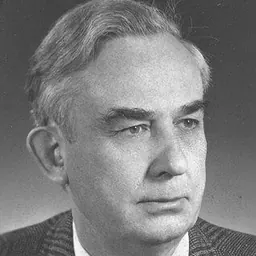
Lived 1920 – 2008 (aged 88). David Cushing was a British biologist, known for Match/mismatch.
David Henry Cushing FRS (1920–2008) was an English born fisheries biologist, who is credited with the development the match/mismatch hypothesis as an explanation for reduced fish stocks as associated with climatic variability. David Cushing was the first to demonstrate what we now know as "recruitment overfishing" through his work on the collapse of the North Sea herring.
Early life Cushing was born in Alnwick, England. His father was an English teacher and his mother was a nurse. By way of his own desire to be a naturalist, his father's desire for him to become a diplomat, and his mother's desire for him to become a doctor, Cushing found a great interest in fisheries biology and management. Cushing also served in the British military in the Royal Artillery (1940–1945) and the Royal Fusiliers (1945–1946). Cushing is survived by his wife, Diana Antona-Traversi, whom he married in 1943, and his daughter.
Career Cushing received his lower education from Duke's School (Alnwick) and the Royal Grammar School (Newcastle upon Tyne) and received his PhD in 1950 from Balliol College at Oxford University. His PhD dissertation focused on the vertical migration of zooplankton.
After receiving his PhD, Cushing worked primarily for government organisations that oversaw the fisheries in Great Britain. For most of his career (1946–1980), he worked for the Centre for Environment, Fisheries, and Aquaculture Science (CEFAS). At CEFAS, he held the positions of scientific officer, deputy director, and as the head of fish population dynamics. His last position allowed him to focus primarily on factors influencing the stock dynamics of local fisheries and the management strategies those fisheries open.
Match/mismatch hypothesis The match/mismatch hypothesis was coined by Cushing as a result of noticeable variations in fish stock recruitment. The hypothesis focused on the timing, as a function of climate, of the blooms of primary producers (i.e. phytoplankton). Blooms of phytoplankton directly influence the increased population sizes of zooplankton, as the phytoplankton are the primary food source for zooplankton. Most pelagic fish, in their larval stages, feed directly upon the phytoplankton and zooplankton. So as logic follows, large populations of phytoplankton will support large populations of zooplankton, and the presence of both will sustain larval fishes. As Cushing noticed, however, there are climatic influences where temperature anomalies will inhibit phytoplankton blooms, or impact the range of the bloom. When such events occur, they will have cascading effects that will influence the ability for larval fish to develop, thus reducing the number of fish that recruit into an existing population. With the previously mentioned events, the "match" portion of the hypothesis occurs when plankton blooms occur just prior the hatching of the fish larvae. In a "match" situation, the fish larvae are able to feed on large quantities of plankton, thus increasing their potential for successful recruitment. The "mismatch" portion of the hypothesis occurs when plankton blooms occur either earlier than usual, later than usual, or simply in far lesser quantities than expected. As a result, there are less prey for the fish larvae to feed upon, and the success of a recruitment event is severely diminished.
The match/mismatch hypothesis is featured in many of Cushing's writings, however the most influential purpose of the hypothesis is that of awareness of climate change and fisheries management. The intent of the hypothesis was to explain climate induced temperature anomalies (as a result of climate change) on fish stocks and the proper management strategies that could be associated with such changes. With some level of predictability, then, fish stocks would then avoid over-exploitation and be harvested at sustainable levels.
Publications Marine Ecology and Fisheries (Cambridge University Press, 1970) Plankton production and year-class strength in fish populations: an update of the match/mismatch hypothesis (1990) in Advances in Marine Biology Climate and Fisheries (Academic Press New York, 1982)
The Provident Sea (Cambridge University Press, 1988) Population Production and Regulation in the Sea: a Fisheries Perspective (Cambridge University Press, 1995)
Don’t just read it —
keep it.
Full-length biographies made to live with: read them, listen on the way to work, watch them tonight.
- E-book
- Audio
- Video
Instant download · yours to keep · every purchase keeps this site free
Important facts
People in David Cushing's life
Named in this biography and alive at the same time

Related people
Same field, nearest in time





Contemporaries
People whose lives overlapped David Cushing's




Frequently asked questions
Who was David Cushing?
British biologist
When was David Cushing born?
David Cushing was born on 14 March 1920 in Alnwick.
When did David Cushing die?
David Cushing died on 14 March 2008 in England.
What was David Cushing's occupation?
David Cushing was a biologist.
What was David Cushing known for?
David Cushing was known for Match/mismatch.
What nationality was David Cushing?
David Cushing was British.
Sources & further reading
Cite this page
APA: Biography.guide. (2026). David Cushing. https://biography.guide/david-cushing/
MLA: "David Cushing." Biography.guide, https://biography.guide/david-cushing/.
Chicago: "David Cushing." Biography.guide. https://biography.guide/david-cushing/.
Data last updated: 2026-09-20 · Spot an error? Report a correction.
Page generated 2026-09-27 05:28 UTC