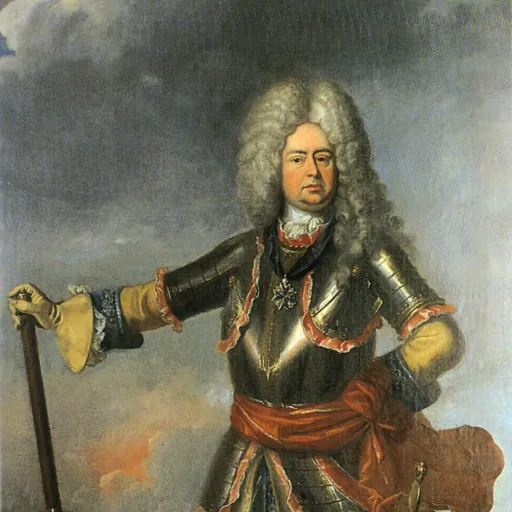
Daniel Wolffgang von Dopff, Heer van Agimont en Nedercanne
Est 1650 - 15 Apr 1718 Maastricht
About Daniel Wolffgang von Dopff, Heer van Agimont en Nedercanne
Lived 1650 – 1718 (aged 67–68). Daniel Wolffgang von Dopff, Heer van Agimont en Nedercanne was a politician.
Daniël Wolf baron van Dopf (10 January 1650 – 15 April 1718) was a Dutch States Army officer and nobleman. He was, among other things, general of the cavalry of the Dutch army during the War of the Spanish Succession, Quartermaster general of that army, and later commander and governor of the fortress of Maastricht.
Life Personal life Daniel Wolfgang ("Wolf") Dopff hailed from a non-noble family from Hesse . His father was employed as a bailiff and toll collector of the County of Hanau-Münzenberg. Daniel was educated in Hanau at the Count's gymnasium illustre. He was married with Catharina Maria van Volckershoven. They had a son: Fredrik Karel. In 1709 he bought Ruyff Castle in Hendrik-Kapelle, but it is not known whether he renovated or added anything to it. In 1716 he sold the castle again. About the same time he bought the Hartelstein estate near Itteren, which he bequeathed to his son Frederik Karel. Van Dopff was also the builder of the Neercanne Castle, which he had erected near the village of Kanne after his appointment as commander. Van Dopff had the old Agimont Castle largely demolished on site and built a pleasure castle in the style of Dutch classicism, modeled on the Johanniter castle Sonnenburg near Kostrzyn nad Odrą, designed by Pieter Post.
Career At the age of 16 Dopff entered the service of the count's army. He later transferred to the army of Frederick William, Elector of Brandenburg . In the disaster year of 1672 he fought on the side of the Dutch Republic against the French armies in the Franco-Dutch War. For his gallantry he was decorated with a Brandenburg knighthood, the Ordre de la Générosité . Van Dopff would later include the black, eight-pointed star from this order in his family coat of arms . After this he transferred to the Dutch States Army. In 1675 he was appointed engineer-fortification master in the regiment Van Sijpesteyn; in 1679 he was already an ordinaris-engineer, one of the highest ranks of military engineer.
In 1683, under the command of Prince Georg Friedrich of Waldeck, he joined the Imperial troops, who managed to lift the Siege of Vienna by the Turks . On 17 October 1685, the emperor granted him the noble title of Reichsfreiherr (baron) for this. The Prince of Waldeck emerged as his lifelong patron. He appointed Van Dopff as his chamberlain, who then regularly stayed in Maastricht, where the prince had been appointed governor of the fortress . Van Dopff was put in charge of the fortifications. He played the same role for king William as Jules Louis Bolé, marquis de Chamlay and Jacques de Chastenet, Marquis of Puységur played for Louis XIV. At the Battle of Fleurus (1690) he accompanied Waldeck as his chief of staff. On the eve of the Battle of Steenkerque in 1692 he was among the generals king William asked for advice on the strategy to follow in a council of war.
After the death of the Duke of Holstein in 1704, Van Dopff was acting governor of Maastricht for almost ten years. Like the late king William, Prince Eugene of Savoy and Marlborough profited from Van Dopff's expertise on logistics and military strategy. In the aftermath of the Battle of Elixheim, Van Dopff clashed with General Slangenburg over the chosen strategy. Slangenburg argued that the Allies should advance towards Leuven. Leuven was necessary to secure the logistics of the Allied army if they wanted to capture Brussels and would perhaps have forced Villars to fight, something the Allies wanted. Marlborough felt something for his plan, but told Slangenburg to convince Nassau-Ouwerkerk, the senior Dutch commander, and Van Dopff. Both were against Slangenburg's plan of action. Van Dopff argued that the troops would be too tired and that it would be difficult to construct bridges across the Gete river in time. This was one of the conflicts in 1705 that would eventually lead to Slangenburg's dismissal.
As a Lieutenant General with the cavalry, Van Dopff had an important role during Battle of Ramillies in 1706, which ended in a great victory for the Allies. Later that year he assisted Nassau-Ouwerkerk with the capture of Ostend. In 1708 he supported Prince Eugene and the Duke of Marlborough at the Battle of Oudenarde in 1708, and in 1709 at the Battle of Malplaquet.
In the planning of the Allied Campaign of 1709 the allied leaders would have preferred to engage the French army under Claude Louis Hector de Villars, 1st Duke of Villars directly, but Van Dopff advised that this was impossible as long as Villars remained within the line of French fortresses that had been erected after 1708, so they reluctantly opted for the Siege of Tournai (1709).
In 1710, at the start of the campaign of that year, Van Dopff advised Marlborough to initiate the campaign with the Siege of Douai (1710). That took longer than expected and Van Dopff then advised to besiege either Béthune or Aire. (The fact that Van Dopff was so influential did not sit well with people like the Dutch Field deputy Sicco van Goslinga, who considered him a parvenu, who thanked his rise to William III.) And William indeed thought he was worth his weight in diamonds, as Van Nimwegen remarks.
In 1712, Maastricht was the base of a large force led by Prince Eugene, which had to push back the French definitively. Van Dopff, together with two others, was sent on reconnaissance and almost managed to reach Paris. The negotiations leading up to the Peace of Utrecht ended the expedition prematurely. It was not until 1713, after the Treaty of Utrecht, that Van Dopff was officially appointed military governor of Maastricht. The fact that he had to wait so long for this appointment probably had to do with his non-noble background (his predecessors were all born into the nobility).
Don’t just read it —
keep it.
Full-length biographies made to live with: read them, listen on the way to work, watch them tonight.
- E-book
- Audio
- Video
Instant download · yours to keep · every purchase keeps this site free
Important facts
People in Daniel Wolffgang von Dopff, Heer van Agimont en Nedercanne's life
Named in this biography and alive at the same time

Related people
Same field, nearest in time


Contemporaries
People whose lives overlapped Daniel Wolffgang von Dopff, Heer van Agimont en Nedercanne's




Frequently asked questions
Who was Daniel Wolffgang von Dopff, Heer van Agimont en Nedercanne?
Est 1650 - 15 Apr 1718 Maastricht
When was Daniel Wolffgang von Dopff, Heer van Agimont en Nedercanne born?
Daniel Wolffgang von Dopff, Heer van Agimont en Nedercanne was born on 10 January 1650 in Hanau.
When did Daniel Wolffgang von Dopff, Heer van Agimont en Nedercanne die?
Daniel Wolffgang von Dopff, Heer van Agimont en Nedercanne died in 1718 in Maastricht.
What was Daniel Wolffgang von Dopff, Heer van Agimont en Nedercanne's occupation?
Daniel Wolffgang von Dopff, Heer van Agimont en Nedercanne was a politician.
Sources & further reading
· Wikipedia: Daniel Wolffgang von Dopff, Heer van Agimont en Nedercanne
Cite this page
APA: Biography.guide. (2026). Daniel Wolffgang von Dopff, Heer van Agimont en Nedercanne. https://biography.guide/daniel-wolffgang-von-dopff-heer-van-agimont-en-nedercanne/
MLA: "Daniel Wolffgang von Dopff, Heer van Agimont en Nedercanne." Biography.guide, https://biography.guide/daniel-wolffgang-von-dopff-heer-van-agimont-en-nedercanne/.
Chicago: "Daniel Wolffgang von Dopff, Heer van Agimont en Nedercanne." Biography.guide. https://biography.guide/daniel-wolffgang-von-dopff-heer-van-agimont-en-nedercanne/.
Data last updated: 2026-09-20 · Spot an error? Report a correction.
Portrait: Wikimedia Commons · author & licence
Page generated 2026-09-27 04:57 UTC