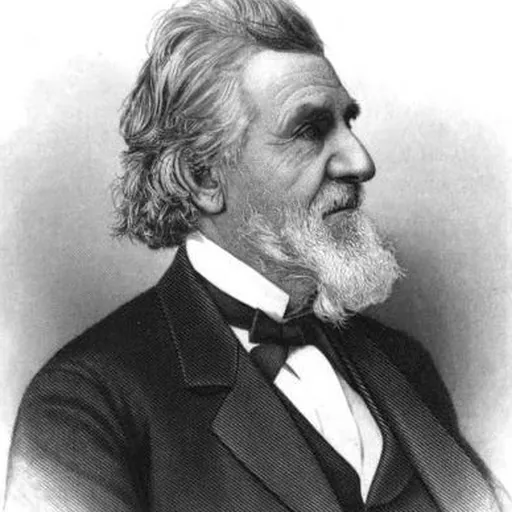
About Daniel Wells Jr.
Lived 1808 – 1902 (aged 93). Daniel Wells Jr. was an American politician and businessperson.
Daniel Wells Jr. (July 16, 1808 – March 18, 1902) was an American businessman, Democratic politician, and Wisconsin pioneer. He was a major contributor to the early economic development of the city of Milwaukee, and was critical to the establishment of the Milwaukee–St. Paul Railroad. He was the wealthiest man in Wisconsin at the time of his death; he is the namesake of the Wells Building and Wells Street in Milwaukee.
He served two terms in the U.S. House of Representatives (1853–1857), representing southeast Wisconsin. Before Wisconsin's statehood, he served two years on the Council of the Wisconsin Territory (upper legislative chamber; 1838–1840).
Early life Daniel Wells Jr. was born in 1808, into a modestly wealthy family in West Waterville, Massachusetts (now Oakland, Maine). As a child, he worked at his father's farm and cloth mill, and attended public school during the winter seasons. After completing his primary education, he began teaching school in the area. During those years, he also devoted his personal time to the study of surveying and navigation.
At age 22, in 1830, he invested his savings in a supply of apples, cider, butter, cheese, dry goods, and other groceries, and traveled to the colony of Magnolia, Florida, to sell his stock. He then traveled to Tallahassee, where he met Robert B. Kerr, a tutor in the household of Robert Butler, the surveyor general of the Florida Territory. Kerr had been offered a contract by Butler to conduct a survey of government land in eastern Florida, but did not have funds to carry out the expedition. Wells chose to invest the profits from his grocery sales into Kerr's expedition, and was taken on as a partner to Kerr. The expedition began in December 1830 and completed three months later. Wells earned a significant profit from the job, and proved himself a proficient surveyor, but became severely ill for several months after. Although his first purchases were from Juneau, the bulk of Wells' Milwaukee property was in the area known as Kilbourntown, the settlement established by Byron Kilbourn. Kilbourn would become a key business ally in Wells' later railroad enterprises.
During this first visit, Wells traveled about the eastern Wisconsin Territory, studying the land along the rough, then-heavily forested route between Milwaukee and Green Bay. At Green Bay, he attended a government land auction in August 1835, purchasing the rights to several tracts. Along his trip, Wells carried more than $7000 cash (about $260,000 adjusted for inflation) which he also used to make additional land purchases from smaller private land owners—at the time of his death, obituaries speculated that his hoard of cash represented more than half of all the hard money in the territory in 1835. His land purchases were largely concentrated in the vicinity of Manitowoc and Milwaukee. In the general election, Wells defeated the incumbent Free Soil candidate Charles Durkee and Whig nominee Henry S. Durand. In the 33rd Congress, he was appointed chairman of the House Committee on Expenditures in the Department of State.
During his first term, Wells was instrumental in securing grants of federal land for Wisconsin to be used for railroad construction connecting the east and west of the state. He also clashed with Secretary of War Jefferson Davis over his attempts to link the new Pacific coast states and territories to the rest of the country via a southern railroad route (many in the north considered this an attempt to export slavery to the new west; but it also represented an economic threat to the new northwestern states, like Wisconsin). He split with his party to vote against the pivotal Kansas–Nebraska Act, which would set the country on the road to civil war.
He ran for re-election in 1854, defeating Republican candidate Wyman Spooner. The 1854 election resulted in no party holding a majority in the House in the 34th Congress, and thus a long battle ensued over the election of a speaker. In February 1856, Wells secured the votes of twelve Democrats—including himself—to pass a temporary rule change to allow the election of a speaker by plurality. The rule change enabled the opposition to elect Nathaniel P. Banks as speaker. The new leadership of the House being indebted to Wells, they rewarded him with substantial land grants for railroad construction in Minnesota.
During 1857 and 1858, Wells was also caught up in the massive corruption investigation of the La Crosse and Milwaukee Railroad, in which dozens of Wisconsin state legislators and other officials received railroad bonds as bribes to secure railroad land grants; Wells was listed as having received about $10,000 of bonds (about $400,000 adjusted for inflation) and testified to the Legislative investigative committee, but was never charged with any actual wrongdoing. During the corruption scandal, the railroad was undergoing a corporate reorganization due to the panic of 1857, and Wells emerged as an officer in the reorganized company.
During these years, Wells was also expanding his interest in financial institutions, particularly banks in the northern and western parts of the state where his railroads would connect frontier lumbering operations to the other population centers. He also became a major shareholder in the insurance company that would become Northwestern Mutual Insurance Company.
Wells never retired from his business pursuits, and continued working up until his death at age 93. One of his last business endeavors was the construction of the Wells Building, which still stands at the intersection of and At the time of its construction, it was described as the biggest terracotta structure ever erected. He visited the building almost daily in his final years, making his last visit just three days before his death. His remains were interred at Milwaukee's historic Forest Home Cemetery.
The Wells family were descendants of Thomas Wells , who emigrated from England to the Massachusetts Bay Colony in 1635.
On November 23, 1831, Daniel Wells Jr. married Marcia Bryant, at Palmyra. Marcia was the daughter of Dr. Bezer Bryant. They had no biological children, but adopted a daughter; Marcia died in 1883.
Electoral history
YearElectionDateElectedDefeatedTotalPlurality 1852 General Democratic 8,342 46.48%F.S. 5,731 31.93% 17,946 2,611Whig 3,870 21.56% 1854 General Democratic 8,458 54.60%Rep. 7,026 45.35% 15,492 1,432
Don’t just read it —
keep it.
Full-length biographies made to live with: read them, listen on the way to work, watch them tonight.
- E-book
- Audio
- Video
Instant download · yours to keep · every purchase keeps this site free
Important facts
People in Daniel Wells Jr.'s life
Named in this biography and alive at the same time





Related people
Same field, nearest in time





Contemporaries
People whose lives overlapped Daniel Wells Jr.'s






Frequently asked questions
Who was Daniel Wells Jr.?
American politician (1808–1902)
When was Daniel Wells Jr. born?
Daniel Wells Jr. was born on 16 July 1808 in Oakland.
When did Daniel Wells Jr. die?
Daniel Wells Jr. died on 18 March 1902 in Milwaukee.
What was Daniel Wells Jr.'s occupation?
Daniel Wells Jr. was a politician and businessperson.
What nationality was Daniel Wells Jr.?
Daniel Wells Jr. was American.
Sources & further reading
Cite this page
APA: Biography.guide. (2026). Daniel Wells Jr.. https://biography.guide/daniel-wells-jr/
MLA: "Daniel Wells Jr.." Biography.guide, https://biography.guide/daniel-wells-jr/.
Chicago: "Daniel Wells Jr.." Biography.guide. https://biography.guide/daniel-wells-jr/.
Data last updated: 2026-09-23 · Spot an error? Report a correction.
Portrait: Wikimedia Commons · author & licence
Page generated 2026-09-27 05:05 UTC