
About Daniel van den Dyck
Lived 1610 – 1670 (aged 59–60). Daniel van den Dyck was a Belgian painter, printmaker and copper engraver.
Daniel van den Dyck, known in Italy as Daniel Vandich (baptized on 3 December 1614, Antwerp – 1663, Mantua) was a Flemish painter, printmaker, architect and engineer. After training in Antwerp he left for Italy where he first worked in Venice and later became a court painter in Mantua.
Life Very little is known about the early life of Daniel van den Dyck. He was born in Antwerp as the son of Jan van den Dyck and Cornelia Kerstboom. He was baptized in Antwerp Cathedral on 3 December 1614. He was registered as a pupil of Peter Verhaeght in the Antwerp Guild of Saint Luke in the guild year 1631–1632. He was registered as a master of the Antwerp Guild of Saint Luke in the guild year 1633–1634. It is assumed that shortly after becoming a master he left Antwerp as he was not involved in any of the large commissions on which Antwerp painters worked in the middle of the 1630s such as the decorations for the Joyous Entry into Antwerp of the new governor of the Habsburg Netherlands Cardinal-Infante Ferdinand and the decorations for the hunting pavilion Torre de la Parada of the Spanish king Philip IV near Madrid.
From late 1657 van den Dyck was living with his family in Mantua. On 2 April of the next year he was named by duke Carlo II Gonzaga as his official court painter, architect, surveyor of his building program and engineer for stage designs for the theatre. This may explain why van den Dyck operated a large workshop with assistants. These assistants would produce his works which he would then 'touch up'. He is known to have created more altarpieces as well as portraits during his stay in Venice. Marco Boschini mentions in his Le ricche minere della pittura veneziana of 1674 a Portrait of three lawyers including Giovan Francesco Loredano (still alive) by van den Dyck as being kept at the Doge's Palace in Venice.
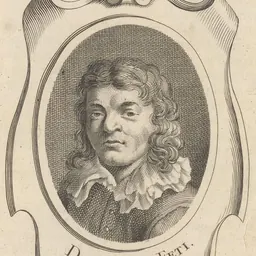
A number of portraits have been attributed to van den Dyck. His portrait style retains a Flemish painterly quality derived from his early training in Antwerp. His early style is also close to that of other painters active in Bergamo or Mantua such as Carlo Ceresa and Domenico Fetti to whom some of his portraits have been erroneously attributed in the past and vice versa.
Van den Dyck painted 13 flower pieces for the duke of Mantua's Gabinetto. These works are considered lost.
His graphic work is mainly distinguished by its cursive and quick character, which predates developments in the 17th century. This is quite evident in his Deification of Aeneas by nymphs and cupids, which likely dates from his Mantuan period. This work shows the classicist influences of Giulio Romano as well as the Flemish Baroque with its muscular and bearded hero Aeneas who is being submitted by the robust nymphs to a grooming before his elevation to godly status. His print of a Bacchanal on the other hand shows the possible influence of Giovanni Benedetto Castiglione who was also active in Mantua. A preliminary study for this print is kept at the British Museum. The heavy use of the brush and the painterly quality of the landscape in the drawing also show a closeness to Castiglione.
Don’t just read it —
keep it.
Full-length biographies made to live with: read them, listen on the way to work, watch them tonight.
- E-book
- Audio
- Video
Instant download · yours to keep · every purchase keeps this site free
Important facts
more
daniel van den dyck, Daniel Wandich, D. Van den Dyck, Daniel Vandendeich, Daniel VandichPeople in Daniel van den Dyck's life
Named in this biography and alive at the same time



Related people
Same field, nearest in time

Contemporaries
People whose lives overlapped Daniel van den Dyck's




Frequently asked questions
Who was Daniel van den Dyck?
Flemish painter (1610-1670)
When was Daniel van den Dyck born?
Daniel van den Dyck was born in 1610 in Antwerp.
When did Daniel van den Dyck die?
Daniel van den Dyck died in 1670 in Mantua.
What was Daniel van den Dyck's occupation?
Daniel van den Dyck was a painter, printmaker and copper engraver.
What nationality was Daniel van den Dyck?
Daniel van den Dyck was Belgian.
Sources & further reading
· Wikipedia: Daniel van den Dyck
· DBpedia: Daniel van den Dyck
Cite this page
APA: Biography.guide. (2026). Daniel van den Dyck. https://biography.guide/daniel-van-den-dyck/
MLA: "Daniel van den Dyck." Biography.guide, https://biography.guide/daniel-van-den-dyck/.
Chicago: "Daniel van den Dyck." Biography.guide. https://biography.guide/daniel-van-den-dyck/.
Data last updated: 2026-09-20 · Spot an error? Report a correction.
Page generated 2026-09-27 05:22 UTC