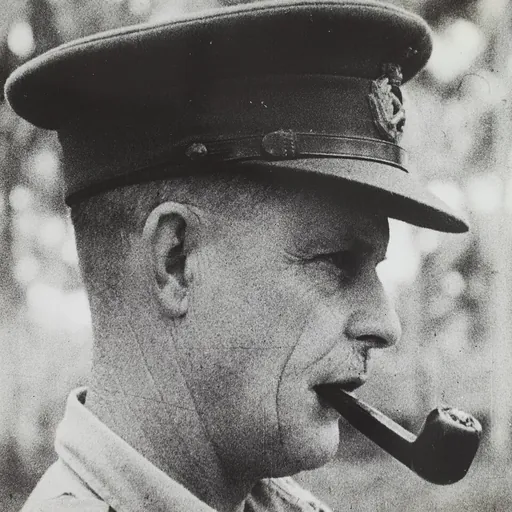
About Cyril Clowes
Lived 1892 – 1968 (aged 76). Cyril Clowes was an Australian military officer.
Lieutenant General Cyril Albert Clowes, (11 March 1892 – 19 May 1968) was an Australian soldier. He won the first land victory against the Japanese in the Second World War, at the Battle of Milne Bay, New Guinea. Like many other senior officers involved in the Papuan campaign, he was then transferred to a less important posting by General Sir Thomas Blamey.
Early life and First World War Clowes was born at Warwick in Queensland, and entered the Royal Military College, Duntroon in 1911.
Studio portrait of Australian officers posing with a toy sheep, pictured here in either 1915 or 1916. Major Cyril Clowes is sat third on the left in the front row.
On the Western Front during 1916, Clowes served as the 2nd Division's Trench Mortar Officer and was awarded the Military Cross. He received a promotion to major in January 1917 and the following year was awarded the Distinguished Service Order for his work at Villers-Bretonneux.
He returned to Australia in April 1919, by which time the war was over due to the armistice of 11 November 1918, and left the AIF in late June.
Although Greece fell and the campaign was a failure, Clowes' tactics minimised casualties in the withdrawal of the allied force. This battle saw the beginning of a problem that would dog Clowes' career – disputes between his superior General Sir Thomas Blamey, and Blamey's Chief of Staff, Colonel Sydney Rowell, a personal friend of Clowes. Clowes returned to Australia in January 1942, was promoted to temporary Major General, and given command of the 1st Division.
Initially a militia brigade was dispatched. As building progressed this was progressively reinforced with regular troops. Once buildup was complete, the garrison assumed the name Milne Force, and Clowes, now promoted to Major General, was given command. He reached Milne Bay and assumed command of the Australian troops there just four days before the Japanese began landing, beginning the Battle of Milne Bay.
Battle of Milne Bay
The Japanese made their initial landing on 25 August 1942 under Commander Yoshihide Hayashi. By dawn of 26 August, the Japanese had reached KB Mission. A counterattack by the 61st Militia Battalion drove the Japanese from KB Mission, however after six hours of intense fighting, the militia withdrew to the Gama River. Clowes ordered the Australian 2/10th Infantry Battalion to the Gama River, where they attacked. The Japanese troops and the supporting tanks inflicted severe casualties on the 2/10th, which was forced to retreat to north of No. 3 Strip (under construction), on 27 August. The 25th Battalion held the Japanese back and a two-day lull followed.
On 29 August 768 Japanese marine reinforcements were landed with Commander Minoru Yano, who took over from Hayashi. On 31 August at 3:00am, three banzai charges were repelled at No. 3 Strip with withering machine gun and mortar fire from Milne Force. The Australians launched a counter offensive at 9:00am on 31 August, and pushed the Japanese along the north coast of Milne Bay. By 4 September Japanese resistance was suicidal in intensity. That night most Japanese survivors were evacuated. Some, trying to reach the Japanese beachhead at Buna through the mountains, were intercepted and routed.
Difficulties at Milne Bay
Milne Bay is a very high rainfall area, and the all-pervading mud made transport a constant problem for Clowes. He had no barges or four-wheel drive vehicles for moving troops around. Milne Force included the highly trained 18th Infantry Brigade of the Australian 7th Division, but also the inexperienced and poorly-equipped 7th Militia Brigade. Of the total force of 8,824, only about 4,500 were infantry.
Several times during the battle, urgent signals arrived from MacArthur and Blamey, warning of imminent Japanese reinforcements, and urging him to pursue and exterminate the enemy landing force immediately. However, Clowes' original orders confirmed that his priority was holding the completed airstrip at Gili Gili. Clowes had no choice but to heed the new intelligence, and try to relocate his forces to deal with threats that in fact did not materialise.
At one point Rowell received orders from Blamey that the "landed force must be attacked with greatest vigor and destroyed as soon as possible".
Relieved of command MacArthur and Thomas Blamey determined that rather than being commended and rewarded for the victory, Clowes should be relieved of his command and sidelined for the duration of the war, for showing insufficient "vigour". Blamey wrote to Sydney Rowell, now Clowes' superior officer in Port Moresby:
Blamey subsequently sacked Rowell and shortly after, Rowell's friend Clowes.
He was known as "Silent" Cyril Clowes. In A Bastard of a Place: The Australians in Papua, Australian historian Peter Brune explained why;
Clowes died on 19 May 1968 at Repatriation General Hospital, Heidelberg, Melbourne.
Don’t just read it —
keep it.
Full-length biographies made to live with: read them, listen on the way to work, watch them tonight.
- E-book
- Audio
- Video
Instant download · yours to keep · every purchase keeps this site free
Important facts
People in Cyril Clowes's life
Named in this biography and alive at the same time

Related people
Same field, nearest in time


Contemporaries
People whose lives overlapped Cyril Clowes's






Frequently asked questions
Who was Cyril Clowes?
Australian army officer (1892-1968)
When was Cyril Clowes born?
Cyril Clowes was born on 1 March 1892 in Warwick.
When did Cyril Clowes die?
Cyril Clowes died on 19 May 1968 in Melbourne.
What was Cyril Clowes's occupation?
Cyril Clowes was a military officer.
What nationality was Cyril Clowes?
Cyril Clowes was Australian.
Sources & further reading
Cite this page
APA: Biography.guide. (2026). Cyril Clowes. https://biography.guide/cyril-clowes/
MLA: "Cyril Clowes." Biography.guide, https://biography.guide/cyril-clowes/.
Chicago: "Cyril Clowes." Biography.guide. https://biography.guide/cyril-clowes/.
Data last updated: 2026-09-23 · Spot an error? Report a correction.
Portrait: Wikimedia Commons · author & licence
Page generated 2026-09-27 05:06 UTC