
About Cyril Aldred
Lived 1914 – 1991 (aged 77). Cyril Aldred was a British egyptologist, art historian, archaeologist and egyptology.
Cyril Aldred (19 February 1914 – 23 June 1991) was an English Egyptologist, art historian, and author.
Early life Cyril Aldred was born in Fulham, London, the son of Frederick Aldred and Lilian Ethel Underwood, and the sixth of seven children.
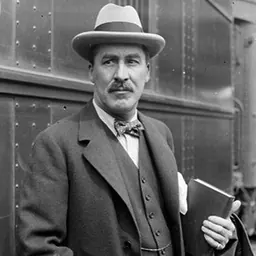
Aldred attended Sloane School, in Chelsea, and studied English at King's College London, and then art history at the Courtauld Institute of Art. While a student, he met Howard Carter, the archaeologist who discovered the intact tomb of Tutankhamen. Carter invited Aldred to work with him in Egypt, but Aldred instead pursued a university education. He graduated from the Courtauld Institute in 1936.
Career In 1937, he became an assistant curator at the Royal Scottish Museum, in Edinburgh, where he worked for the remainder of his professional life, rising to become Keeper of Art & Archaeology (1961–74). Aldred was appointed the Hon. Editor of the Scottish Anthropological and Folklore Society's Proceedings in 1938. He edited Volumes 3.1, 3.2, 3.3 and 4.1 of the journal, from 1938 until 1949.
During World War II, Aldred served in the Royal Air Force, returning to Edinburgh in 1946, to undertake a serious study of Egyptology.
In 1949, Aldred's book Old Kingdom Art in Ancient Egypt was published and was followed by volumes on the Middle and New Kingdoms in 1950 and 1952. These publications established his career as an Egyptologist and art historian. He also contributed essays on Egyptian furniture and woodwork as a part of the Oxford History of Technology in 1954 and 1956. In 1955, he worked as an associate curator for a year in the department of Egyptian art in the Metropolitan Museum of Art, New York, alongside curator William C. Hayes. During his time at the Met, Aldred used his artistic eye to dramatically improve the presentation of the exhibitions and helped identify and catalogue a number of previously overlooked artifacts in storage. In 1956, Aldred returned to the Royal Scottish Museum to enhance the Egyptology team and in 1961 he was promoted to keeper of art and archaeology, a post which he held until his retirement. During his time at the RSM, he not only gave lectures but also made significant purchases and helped the museum vastly improve not only the Egyptology displays but also the West African and South Sea's sections.
Aldred's book Akhenaten, Pharaoh of Egypt – a new study, was published in 1968. He had a keen interest in jewellery from ancient Egypt and his Jewels of the Pharaohs appeared in 1971, published by Thames and Hudson. This was a major contribution to the field. His most significant art-historical writing of the period, however, was the catalogue he wrote for the Brooklyn Museum exhibition, "Akhenaten and Nefertiti" in 1973.
Aldred retired in 1974, but his writing continued. In 1978 he was elected a Fellow of the Royal Society of Edinburgh. His proposers were John Cameron, Lord Cameron, Norman Tebble, Sir Norman Graham and Stuart Piggott.
Beginning in 1978, Aldred wrote studies for the French "L'univers des formes" surveys of Egyptian art (other volumes appearing in 1979 and 1980). In 1980, Aldred published Egyptian Art, although another intended book on Egyptian sculpture was never published. The Times Educational Supplement wrote of Egyptian Art, "His eloquent ability to weave facts, insights and interpretations into a compulsively readable account sets his book far above the clogged texts that too often pass for art history".
In 1988, he enlarged his 1968 text in Akhenaten, King of Egypt with later findings.
He died peacefully at his home in Edinburgh in 1991, and is remembered as one of the leading characters in improving archaeology in Scotland at the Burrell Collection in Glasgow.
Personal life Aldred married Jessie Kennedy Morton (b. 1909), a physiotherapist, in 1938.
Don’t just read it —
keep it.
Full-length biographies made to live with: read them, listen on the way to work, watch them tonight.
- E-book
- Audio
- Video
Instant download · yours to keep · every purchase keeps this site free
Important facts
People in Cyril Aldred's life
Named in this biography and alive at the same time





Related people
Same field, nearest in time

Contemporaries
People whose lives overlapped Cyril Aldred's


Frequently asked questions
Who was Cyril Aldred?
English egyptologist (1914–1991)
When was Cyril Aldred born?
Cyril Aldred was born on 19 February 1914 in Fulham, London.
When did Cyril Aldred die?
Cyril Aldred died on 23 June 1991 in Edinburgh.
What was Cyril Aldred's occupation?
Cyril Aldred was an egyptologist, art historian, archaeologist and egyptology.
What nationality was Cyril Aldred?
Cyril Aldred was British.
Sources & further reading
Cite this page
APA: Biography.guide. (2026). Cyril Aldred. https://biography.guide/cyril-aldred/
MLA: "Cyril Aldred." Biography.guide, https://biography.guide/cyril-aldred/.
Chicago: "Cyril Aldred." Biography.guide. https://biography.guide/cyril-aldred/.
Data last updated: 2026-09-20 · Spot an error? Report a correction.
Page generated 2026-09-27 05:17 UTC