About Cui Jian
Born 1961. Cui Jian is a Chinese singer, composer, actor, trumpeter, guitarist and film director.
1986–1988: The popularity of "Nothing to My Name" and collaboration with ADO Filling the World with Love and "Nothing to My Name"
In early 1986, coinciding with the International Year of Peace, Chinese musician Guo Feng organized the recording of the charity song "Filling the World with Love" and planned to hold a concert of the same name convening 100 popular singers in Chinese Mainland to change the stereotypes of popular music. At the recommendation of popular singer Wang Di, Cui Jian participated in the concert and applied for a solo segment. With the permission of Wang Kun, Cui was able to sing his song "Nothing to My Name" at the concert. The concert took place at Beijing Workers' Gymnasium on 9 May. That evening, the venue was packed to capacity, with "everyone wondering what was going to happen".
Two minutes before taking the stage, Cui felt his suit was "utterly stifling," so he switched to the dagua belonging to the father of Wang Di. Because of Cui's disheveled hair, cold look, and his apparel, which were different from the previous "gorgeously dressed" singers with "graceful singing", the audience became chaotic. However, the moment his "hoarse voice" rang out, the audience fell silent immediately. Then came applause and whistles, followed by continuous cheers. Music writer Andrew Jones describes this event with the words:
"Nothing to My Name" is considered by some to be the first indie song in China. The sampling inspiration for the song draws from Northwestern China's "Xintianyou" folk music. Cui Jian incorporated traditional instruments like the suona, guzheng, dizi, and xiao, while blending elements and rhythms from punk, jazz, Afro-pop, and rap. Professor of East Asian Studies Nimrod Baranovitch wrote that the song features a hybrid of folklore with strong, fast and modern disco and rock beats. Stefan Simons wrote for Der Spiegel that Cui's loud, aggressive tones blasted against "oily party" arias and "schmaltzy" pop music from Hong Kong and Taiwan, making the song the anthem of the alternative music and youth scene. The song is about a failed love affair, but widely read as a metaphor for the growing estrangement of Chinese youth from the political climate of China. BBC correspondent Henry Knight described the song as "individualism, experimentation and non-conformity". Hong Kong news website HK01 stated that this love song accurately and profoundly depicts the confusion experienced by China's younger generation amid the collapse of social values at the time, as well as their reflections on identity amidst dual material and spiritual hardships.
His performance has been seen as the moment heralding the birth of Chinese rock 'n' roll, , known as the Father of Taiwanese Folk Songs, thought "the younger generation in mainland China can now write their own songs" after hearing "Nothing to My Name". The song peaked at number one on the , and remains one of the most influential songs in the history of China.
Follow-up development Two months after the concert, "Nothing to My Name" CDs and cassettes hit the market. Cui soon became China's rock icon and enfant terrible. He was considered the only singer in mainland China at the time who could write lyrics, compose music, and perform his own songs, all by himself. Following the fashion style of Cui - long hair, jeans and boots - Chinese young fans cheered wildly and danced in the aisles when he performed this song. Peking University established the "Peking University Cui Jian Backup Group", the first fan club in mainland China. American sinologist Orville Schell said that "listening to Cui Jian's music after all the disco bands in the country is equivalent to listening to Bach after Barry Manilow". Under the strong endorsement of writer-musician Liu Sola and scholar , Cui and his song "Nothing to My Name" quickly captured the attention of China's cultural circles, with the "Cui Jian phenomenon" becoming a fiercely debated topic in academia. On 16 July 1988, People's Daily published a lengthy 1500-word commentary on Cui, which explains Cui's popularity and analyses his immense appeal to students, teachers, workers, and private entrepreneurs. This was the first time a rock singer was featured in China's mainstream media. Outside of China, Cui enjoyed international acclaim after a television appearance at the 1988 Olympics in Seoul. Former ADO members Eddie (left) and Liu Yuan (right) respectively served long-term as the lead guitarist and wind instrumentalist in Cui's backing band; the latter died in 2024. Cui participated in a series of benefit concerts for the restoration of Beijing's Marco Polo Bridge after the 100-Singer Concert of Year of International Peace. forcing him to perform underground during this period. Officials labeled Cui's rendition "red song sung in yellow fashion" , meaning that Cui's rock version of the song was a contamination of a sacred symbol. Linda Jaivin suggestsed in 1988 that "one reason for Cui's troubles was an internal document linking the student movement of late 1986 with the growing popularity of rock 'n roll". Entertainment journalist Steven Schwankert said that when Cui left the philharmonic, there was no real opportunity to make a living without the government lifeline of an apartment and a paycheck. Cui began playing regularly with a band, ADO. With ADO, Cui managed to support himself by playing at private parties for foreigners, in restaurants, bars, small hotels and the after-hours club at Beijing Maxim's restaurant. Cui made a guest appearance in the 1987 TV series Football Revelation, which depicts the 19 May Incident. In January 1988, Cui successfully staged his debut solo concert with ADO at Beijing's Zhongshan Music Hall. He signed with EMI in this year.
1989–1990: Rock 'N' Roll on the New Long March, Tiananmen Square Incident and banned from performing
On 23 March 2005, Cui released the album Show You Colour. He stated that this album is "more diverse, more independent, more cohesive... containing pop, rock, electronic, and hip-hop music", attempting the "maximalism" of music. China Daily described it as distinguished from "all of Cui's previous albums, and probably from any other rock album in China". Reviewers described the album as a "concept album", and pointed out that the album continues the musical style of The Power of the Powerless, incorporating genres including folk, hip-hop, funk, big beat, drum and bass, and digital hardcore. The album was well-received by media and critics. Cui won Best Rock Singer at the 6th Top Chinese Music Awards for the album.
You You, Cui Jian's manager, said that the problems of his performance permits sometimes being refused by local authorities had "gradually gone with time". Since 2005, all bans on Cui were lifted with the exception of the song "Last Shot". He did finally play with the Rolling Stones at the Shanghai Grand Stage on 8 April 2006, singing and playing "Wild Horses". He performed his first English song "Outside Girl" and played with Public Enemy at the 2007 Beijing Pop Festival.
After the 2008 Sichuan earthquake, Cui donated 51,200 RMB and organized a charity concert titled "Get Over That Day" with China's rock music community on 22 May, raising over 400,000 yuan in disaster relief funds. At the December 2009 Beijing Exhibition Center concert, "Rock 'N' Roll on the New Long March V21", Cui tied a red ribbon to call for attention to AIDS awareness. An ambassador for the annual Earth Hour campaign, Cui performed at an outdoor concert, Green Now, to celebrate the World Environment Day and encourage a low-carbon lifestyle at the Shanghai World Expo on 5 June 2010. From 31 December 2010 to 1 January 2011, Cui Jian collaborated with the Beijing Symphony Orchestra to stage the "Rock Symphony Live Concert" at Beijing Workers' Gymnasium, marking Asia's first integration of rock music with a symphonic orchestra performance. At the concert, he unexpectedly performed the banned anti-war song "Last Shot". October: The Rite of Spring, the first dance drama under Cui's full directorship, premiered in Tianjin in 2014.
In 2006, Cui directed the short film The Age of Repairing Virginity, which was selected for the feature and short film competition categories at that year's Vladivostok International Film Festival. He made a cameo appearance in Jiang Wen's film The Sun Also Rises. He also directed the "future" segment of the 2009 film Chengdu, I Love You. In October, he attended the Busan International Film Festival to promote the film. Following his attendance at the premiere of Chengdu, I Love You in Venice, Cui proceeded to Madrid to hold his debut solo concert in Spain. Bai Qiang produced a 3D concert film and documentary titled Transcendence about Cui Jian, which was screened in Beijing in May 2012 for an enthusiastic fan audience, though its prospects for mainstream release in China remain doubtful. The film ultimately grossed 370,000 yuan at the box office.
On 17 October 2014, Cui's feature film Blue Sky Bones was released. Xie Fei stated that the film was submitted to Chinese Film Bureau for review as early as 20 August 2012. However, due to its content touching on "Lin Liguo selecting concubines" and homosexual themes, the project has yet to receive approval. It won the Special Mention at the 8th Rome Film Festival and the Special Jury Prize at the 10th Jecheon International Music & Film Festival, earning Cui Best New Director at the 2015 Chinese Film Media Awards. Receiving mixed reviews, the film grossed 4.14 million yuan at the box office. He submitted a bid proposal to design the 2008 Summer Olympics opening ceremony to the Beijing Organizing Committee for the Olympic Games, but was eliminated after the first round of presentations. In November 2012, Cui announced plans to open a security guard company, citing dissatisfaction with the behavior of security guards at rock concerts in China. On 16 April 2013, Cui released his compilation album The 3rd Sound of China via global digital music platforms for the first time. On 17 April, Cui unveiled a custom "Blue Bone" smartphone to interact better with his fans. He is first artist to launch his own custom smartphone in China. Cui was invited to perform on the 2014 CMG New Year's Gala. It has been seen as the final stage of Cui's political rehabilitation. For this action, he was listed on the Human Rights Foundation's list of Outstanding Work in the Field of Human Rights. In September, Cui and fellow songwriters co-founded China's first musician-initiated copyright agency.
On 18 July 2006, Cui was awarded the "Hall of Fame Musician" accolade at the . He was invited to present himself at the 20th anniversary of the Goethe-Institut on 1 November 2008, where he was awarded the title of "Goethe Cultural Ambassador". Southern Weekly named him the "2012 Chinese Dream Practitioner". In 2013, Cui was honored with the Tenco Cultural Operator Award at the Premio Tenco ceremony in Italy, and collaborated with Francesco Baccini in a joint performance.
2015–present
In 2015, Cui was asked to act as one of the three judges on , a singing talent show broadcast on Dragon Television. On the show, Cui criticized Hong Kong singer Andy Hui for performing a Cantonese oldie, and expressed dissatisfaction that "no more modern or younger Hong Kong artists had appeared on mainland stages to showcase their voices". Initium Media commentator Zhang Miao stated that several Hong Kong media outlets had published false reporting and defamed Cui in their coverage of the incident. Hong Kong writer thought Cui's remarks were distorted by Hong Kong columnist Chip Tsao out of a pan-political bias stemming from Hong Kong separatism, ignoring Cui's admiration for Hong Kong singers like Tat Ming Pair. On 4 December, the China Star program team issued a statement demanding that Chip Tsao and Apple Daily publicly apologize for the false reporting about Cui.
On 25 December of the same year, Cui collaborated with Sony Music to release the album Frozen Light, regarded as his musical comeback. The single "Outside Girl" featured in the album, along with its same-titled music micro-film, premiered on YouTube on 24 December. Pre-orders for the album's digital version surpassed one million copies. It received mixed reviews from critics.
On 26 September 2016, Cui led a 953-person rock band from the Beijing Contemporary Music Academy to perform at a venue in Tianjin, earning certification from Guinness World Records as the largest performing rock band. On 30 September, Cui held the "Rolling 30" concert at Beijing Workers' Gymnasium to mark the 30th anniversary of his career. Chinese avant-garde architect Ma Yansong designed the stage. During the performance, Cui performed a Mandarin cover of Message in a Bottle, while Stewart Copeland, drummer of The Police, joined the show as a guest performer. Concurrently, he commenced the "Rolling 30" tour. In October, he made a donation to support a Trip.com Group-sponsored initiative for the music education of left-behind children. Cui served as the ambassador for the 2017 Croisements Festival, a cross-cultural event between China and France. On 23 August 2017, Cui released Rock Symphony Live Concert, containing the full recordings of the Rock Symphony Live Concert. On 4 November of the same year, Cui performed an electronic music concert as a DJ for the first time at the Chishui Valley Music Festival. He stated that this performance was a tribute to Igor Stravinsky, the original composer of The Rite of Spring.
On 27 August 2021, Cui released the album A Flying Dog. The public interpreted the album as the resurgence of his critical feature, although Cui noted he has never ceased being critical. Cui was nominated for Best Producer at the 2021 Asian Pop Music Awards for the album. It was also listed among the Top 20 Albums of the Year by the jury. The single "The B-Side of Time" became the highest-scoring rock song of the year on the 2021 TME Chart. Critic Li Wan believed the album represents a return to form for Chinese rock. Taiwanese audiences were generally surprised by this result. Chinese-language news magazine WHYNOT praised this decision reflects the confidence and courage of the jury.
An online "Keep Going Wild" concert held by Cui on 15 April 2022 drew 46 million views and 120 million likes, breaking the viewership record for online concerts. In August 2022, Cui published Poetry Collection of Cui Jian: 1986-2021, compiling 56 lyrics written over 35 years. On the 2023 world music collaborative album Police Beyond Borders by Stewart Copeland and Ricky Kej, Cui covered The Police's single "Tea in the Sahara". Cui staged the "Rolling Power" Snow Mountain Zhijiao Concert on 22 December 2023, drawing 36 million online viewers. Subsequently, the documentary Snow Mountain Music Revelation, which chronicles the 2002 Snow Mountain Music Festival, was released. As the sound director of Beijing's Sea Strings Restaurant, Cui has held the weekly "Electronic Music & Remix Gala Dinner" at the restaurant since 17 July 2025. His first theater work, S.M.A.X, which premiered at the 2026 Aranya Theater Festival in Qinhuangdao, Hebei, explores the "spiritual dilemmas of humanity in the age of technology".
Artistry Musical styles
A multi-instrumentalist who resists the mainstream music industry's tendency towards a division of labor, Cui writes his own music, lyrics, and arrangements, Chicago Tribune called it an "almost anarchic eclecticism". and borrowed much from the Chinese folk music in music forms. He explained that it isn't because he wants to broadcast or promote Chinese traditional art, but rather because when he uses those instruments, they help him express his true emotions. The Independent described his music as a "sometimes bewildering mix of styles that reflects his two biggest influences, Miles Davis and The Clash, and his classical background",
Cui pioneered the use of rap in the Chinese music scene, which sharply contrasted with the mainstream Hong Kong-Taiwan pop and campus folk songs of the time. He combined rap and hip-hop with northern folk music, free jazz, and reggae. In the late 90s Cui began to experiment on digital avant-rock with elements of rap music. Jeroen de Kloet wrote for UNESCO Courier that Cui carries on with the rapper's staccato precision. He also uses delay in some of his hip-hop works to make these tracks listen "less hip-hop". Maria Cheng from SFGate described him as a Beastie Boys-style rapper laden with Peking Opera-style recitation.
Cui considers electronic music "connected to the times, creative, belongs to the young". Influenced by The Chemical Brothers, starting with the album The Power of the Powerless, Cui incorporated electronic and MIDI elements into his music, independently producing the work at home using digital music technology. Cui always samples various quyi, as well as Chinese folk songs like Hua'er. Social environment soundscapes are often included. and draws influence from electronica and post-rock. To add Chinese timbres into his work, he connected guqin and pipa to effects units, transforming them into electronic versions. sound collages and electronic jazz. Taipei Times dubbed him "China's godfather of electric rock". In 2007, Cui collaborated with DJ Hyper, Hybrid and Sugar Daddy to remix some of his classic tracks from the '80s.
Themes and lyrics
Cui's music idea mainly revolves around rebellious and resistance, making introspection and irony to the tradition while exploring people's living condition. and questions to the nationalism and materialist Zeitgeist of post-1989 China. His songs were also the earliest in Chinese music to tackle the subject of sex, sometimes touching on topics of masturbation that "not many rock songs ever deal with, even in the U.S.". According to CNN correspondent Jaime FlorCruz, Cui's songs are "sometimes amusing, sometimes plaintive but often overtly political" and challenge "conventional Chinese ideas and attitudes". Jonathan Matusitz described Cui's music as "insurgent and anarchic", music whose lyrics denounce China's corruption, hypocrisy, outlandish "self-righteousness", and the rejection of idealism.
Cui said that the ratio of time he spends composing music versus writing lyrics is 20:1. His lyrics are nearly grammatically incoherent and are considered to be postmodernism, expressing the pursuit of idealism and identity, Conceptual metaphors are widely present in the lyrics of Cui's albums. According to Junru Huang of The Times, largely by writing ambiguous lyrics, Cui has skilfully become a symbol of freedom to many without becoming an Ai Weiwei-esque martyr of the arts. Italian rock musician Francesco Baccini believed that Cui's lyrics largely focus on marginalized communities and touch on politically sensitive topics. Besides, he was the earliest artist to use Chinese swear words like "qù nǐ māde" (fuck off) in song lyrics.
Cui's lyrics draw on the expressive techniques of modern Chinese poetry and influenced by the Misty Poetry movement. Some of his works feature frequent use of short sentence and simple sentence structures, while others employ a more colloquial style. He also used poetic devices such as repetition, rhyme, alliteration, and assonance. , a Fudan University professor, described Cui as "contemporary chief rock poet". Taiwanese poet Yu Kwang-chung called him China's "great poet like Lennon". Chinese writer Wang Shuo called Cui "contemporary China's greatest troubadour". Jianying Zha wrote that Cui's lyrics were "the best Chinese poetry of our time".
Cui performing in Beijing, 2009. His parody of political symbols in his works is regarded as deconstructive and subversive. Cui's works saturate political symbols like red flags, color red, (political) movements, the Long March, revolution, which he deconstructively parodies and ridicules from a personalized perspective. Such subversive "political parody" was often seen as disrespectful at the time. Cultural critic Rey Chow wrote that due to Cui's playful use of these symbols, the authorities negated his music, intending to impose a forced cultural memory to emphasize respect for the Communist predecessors.
The term "guniang" (girl) is frequently used in Cui's texts, signifying varied personas. Rachel DeWoskin of Words Without Borders also noted that Cui's songs inherit the "tried and true manner" of court poets and essayists from China's imperial past, appearing to be about love but actually about history and contemporary China. Music journalist Zhou Jian called it a "Spring and Autumn brushwork".
Vocal style
Cui sings in a pinched, hoarse voice with "guttural yet passionate" vocals, blending the folk singing techniques represented by Li Guyi with bel canto and breathy singing. He used mostly his modal voice from lower middle to high notes, with his delivery almost entirely in forte, and employed many short portamentos, vibratos and sighings. He can also sings in ascending falsettos. Believing that the four tones of the Putonghua impose an undue restriction on the rhythmization of the language, he has long experimented with rhythmizing Chinese language, using it as an instrument to make compound rhythms. Besides, he often uses non-lexical vocables such as ooh. His blurred enunciation marks a deliberate departure from 1990s pop music, which emphasized "precise articulation and polished vocals".
Daniel Southerland from The Washington Post described Cui's voice "sounds like a cross between Bob Dylan, Bruce Springsteen and Joe Strummer of the Clash". According to Jinan University professor Shuwen Qu, Cui's signature voice, constraining the vocal cords to make a husky and boorish sound, resembles that of the "cock rock" voice tradition. Of The Power of the Powerless, Larry Katz of Boston Herald compared his vocal to Kurt Cobain, and wrote that Cui snarls, spits and barks out his lyrics in a gruff voice seething with resentment. Taiwanese musician Li Pai-kang praised Cui for his "highly individualistic vocals and articulation" and his reinvention of vocal expression within Chinese rock music.
Videography and stage Chinese Sixth Generation filmmaker Zhang Yuan directed the music videos for "Piece of Red Cloth", "Wild on the Snow", "Last Shot", and "Flying". Zhang stated that he always filmed Cui as a hero, because in his perception, Cui was "a hero imbued with power". The video for "Piece of Red Cloth" won special mention at the Golden Gate Viewers awards ceremonies at the 1992 San Francisco Film Festival. The "Wild on the Snow" video won the International Viewer's Choice Award for MTV Asia in 1991. In 2005, Cui teamed up with Flash artist Lao Jiang to release the animated video for his song "Mr. Red". Cui held a negative view toward music videos in his later career. For his 2021 songs "A Flying Dog" and "The B-Side of Time", he filmed live-performance music videos blending genuine onstage performances with visual elements, aiming to "defend the inherent qualities of live music". Cui Jian at Workers' Gymnasium during his concert in 2008. He himself served as the artistic director. Cui Jian is described as frequently engaging in "intricate and dazzling experiments in musical craftsmanship" during his live performances. He said that the most wishful way of death for him is to die on the stage, not on the bed or sofa at home. In 2010, Cui became the first mainland Chinese musician to tour across China and stage over 1,000 live performances. He used to wear a green People's Liberation Army uniform jacket at live performances and in music videos. It has been interpreted as a "subversive sartorial recontexutalization" or an expression of nostalgia. In his 21st-century live performances, he has sometimes worn retro and introspective stage costumes, such as floral shirts and traditional Nakhi ethnic clothing, to create stark contrasts with the trendy electronic music he performed. In 2005, Beijing fashion designer Feng Ling designed a new stage jacket for him that featured green linen with red silk lining in 1960s style.
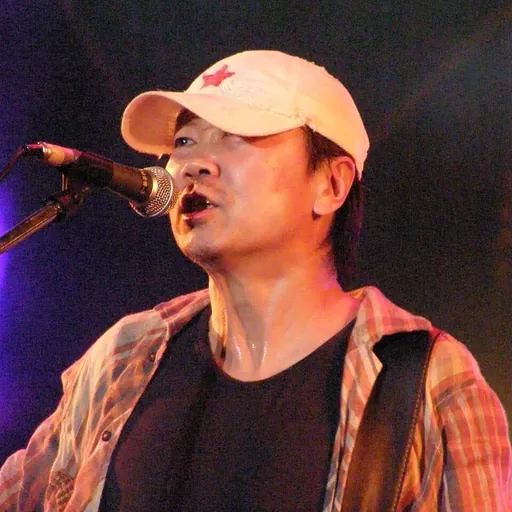
Cui often appears wearing a white baseball cap with a bright red star. Cui said he initially wore the hat because he wanted to control his exposure, and he can lower his head and no one can tell who him is. German journalist believed Cui reverses the colors of the Chinese flag, where the big yellow star on a red background stands for the Communist Party, appropriating and deconstructing the state symbol. He usually blindfolded himself with a piece of red cloth when performing his song "Piece of Red Cloth".
Legacy During Cui Jian's 1993 performance in Germany, the audience held up a banner reading "Long Live Cui Jian" . Some security guards giving the sign of the horns to Cui during his performance, Qinhuangdao, 2014.
Cui is credited with popularizing rock throughout China, and with being a trailblazer in Chinese progressive music. He's been called the "Father of Chinese Rock", "Grandfather of Chinese Rock", "Godfather of Chinese Rock", "Emperor of Chinese Rock", "Chinese King of Rock", and "China's God of Rock". In Western countries, Cui is often compared as the Chinese equivalent of John Lennon, Elvis Presley, Bob Dylan, Kurt Cobain, Bruce Springsteen, Prince, and Johnny Hallyday, and is recognized for his anti-establishment persona. British journalist Jasper Becker wrote in 1995 that Cui is usually known as China's greatest rock star. Billboard called him "the lone voice of originality in Chinese music". Matthew Corbin Clark of PBS described Cui as "a bizarre concoction of post-Communist celebrity, cross-cultural artistic transfer, David & Goliath political dynamics, and inspired musicianship". Die Tageszeitung named him the most successful Chinese rock musician of all time. Jo Ling Kent from CNN wrote that Cui led a "musical counterculture that is redefining what it means to be 'Made in China'". In Newsweek, Melinda Liu described him as the godfather of China's new music.
Public image Cui is recognized as a cultural icon, a teen idol, a fashion icon, an icon of the punk subculture, and one of the most famous iconic figures in contemporary Chinese art. He is seen as one of the most popular critical voices in the nation. Unlike Teresa Teng who occupied a liberated position after the Reform and opening up, Cui took on the role of a "rebel" in the 1980s. During the 1989 Tiananmen Square protests, his music evolved into anthems of self-determination. In 1990, The Washington Post said Cui is an "unauthorized hero" or "antihero" for many youths in China. Since 1991, South Korean media have consistently emphasized Cui's ethnic identity in reporting news. In response, Cui stated that he had never seriously considered his own ethnic identity, stressing that individuality matters more and that he is Chinese. Since the early 1990s Cui has been portrayed in numerous Western media as China's indomitable political conscience. Although "from any end of the left-wing or right-wing spectrum, Cui's presence is so striking that no power can ignore or incorporate him", In 2015, Cui said people view him more as "an old man" than a rebel, a familiar face on television but no longer influential. However, according to Japanese journalist , since the Xi Jinping era began, most singers and musicians have abandoned the pursuit of individuality and freedom to maintain their presence in the Chinese market, while Cui Jian, known for his "free-spirited" style, has regained prominence. A New York Times editorial pointed: His hairstyle became popular across China, empowering young men to grow long hair. With the release of Rock 'n' Roll on the New Long March, mainland China, Hong Kong, and Taiwan experienced a "Cui Jian Fever" . His music "profoundly shook" the cultural and social conduct across these regions in the 1980s and 1990s, and changed the status of Chinese indie music. In Taiwan, although his album was censored by the Government Information Office shortly after its release for "being incompatible with current politics", he still exerted a profound influence on Taiwanese underground rock scene. According to a 1994 report from The Chosun Ilbo, Cui's "powerful rock sound and melody, uniquely hoarse voice, and rich vocal abilities" combine to fuel his rising popularity in Japan.
According to OhmyNews, Cui is revered as a top musician who exerted profound influence on Chinese popular culture. Music critic Huang Liaoyuan wrote that Cui was "the first person in contemporary China to modernize the subject matter of popular music". Chinese singer Cheng Lin stated that Cui is "a banner in the history of music". Gong Linna remarked that Cui pioneered a form of "Chinese rock" that "dug into the roots of Chinese culture". Mongolian singer Daichin Tana called him the "backbone and gall of this land", and described his music as the "hope and despair of this country". Music critic Jin Zhaojun believed that the immense cultural impact generated by Cui stemmed from his "fundamental questioning" of the Chinese people's way of existence. Cui exerted a lasting influence on the creative production of rock music in mainland China. The Beijing News and Sixth Tone have noted that in the 1980s, Cui represented elite culture's resistance against mainstream culture, the production model which led to the successors of Chinese rock music retreating into increasingly marginalized subcultural circles. Music critic Yan Jun wrote: "Ever since Cui Jian, Chinese rock has been seen as an alternative, outsider's and Underground sound."
Many musicians and bands were influenced by him, such as Chang Chen-yue, Xu Wei, Liang Long, Pu Shu, Wowkie Zhang, Tang Dynasty, Black Panther, Wang Leehom, Tan Weiwei, Liang Bo, Gao Xiaosong, Deserts Chang, Lin Sheng Xiang, Khalil Fong, Yaksa, Li Zhi, Tengger, Qiu Ye, Mao Amin, Gao Qi, Emil Chau, Again, Vajara, and Dantès Dailiang. Chinese newspaper National Business Daily reported that in numerous variety talent shows, contestants paying tribute by performing Cui Jian's songs has become a common occurrence. The song "The Lost Season" inspired Ning Hao's film Guns and Roses.
A tribute album Who Is Cui Jian!? was released in 2005 by Scream Records, featuring 11 bands covering Cui's songs. Jon Campbell from South China Morning Post reviewed that the album "leaving much mediocrity", although he thought Reflector's pop-punk take on "Rock 'N' Roll on the New Long March" and Pao Pao Tang's reinvention of "Piece of Red Cloth" are highlights.
Archives and recognition Cui ranked 51rd on Forbes China Celebrity 100 list in 2004. He graced the cover of the first Chinese edition of Rolling Stone in March 2006. In 2007, Cui was included in the China Power List by openDemocracy and Chatham House. In 2009, in an online poll by China Internet Information Center, Cui ranked as the 6th most influential singer in China since 1949 and the 12th most influential celebrity overall, with 160,000 votes. The Chinese edition of L'Officiel Hommes listed him as one of the fashion legends since the founding of the People's Republic of China. In September, he ranked fifth in the 1990s category of Sohu's idol vote across decades. In a 2010 survey of Chinese university students, Cui ranked second among the symbolic figures in the Chinese entertainment world. A wax figure of Cui has been unveiled at Madame Tussauds Beijing in May 2013. In the same year, according to a market survey by , 60-70% of middle-class and above males had varying degrees of affinity to him. A booklet of the Arezzo Wave calls him "protagonist of the Chinese pop-rock scene".
Discography
Returning Wanderer (1984) Rock 'n' Roll on the New Long March (1989) Solution (1991) Balls Under the Red Flag (1994) The Power of the Powerless (1998) Show You Colour (2005) Frozen Light (2015) A Flying Dog (2021)
Filmography 1993 – Beijing Bastards (北京杂种; Beijing Zazhong), directed by Zhang Yuan, as himself 2003 – Roots and Branches (我的兄弟姐妹; Wo de xiongdi jiemei), directed by Yu Chung, as the father/music teacher 2007 – The Sun Also Rises (太阳照常升起; Taiyang zhaochang shengqi), directed by Jiang Wen, as Tang's friend in Beijing 2012 – Transcendence 3-D concert, directed by Bai Qiang 2013 – Promise, directed and written by himself 2013 – Blue Sky Bones
Books
Tours Rock 'N' Roll on the New Long March Tour (1990; 1991-1992) 1995 US tour (1995) 1999 US tour (1999) 2001 European tour (2001) Live Vocals Movement Tour (2002–2005) 2004 North American tour (2004) 2009 Concert Tour (2009) The Blue Bones Tour (2012–2015) Rolling 30 Tour (2016–2018) 2019 Australian tour (2019) A Flying Dog Tour (2021–2023) Keep Going Wild Tour (2024–2025)
Awards
Don’t just read it —
keep it.
Full-length biographies made to live with: read them, listen on the way to work, watch them tonight.
- E-book
- Audio
- Video
Instant download · yours to keep · every purchase keeps this site free
Important facts
People in Cui Jian's life
Named in this biography and alive at the same time




Related people
Same field, nearest in time


Contemporaries
People whose lives overlapped Cui Jian's



Frequently asked questions
Who is Cui Jian?
Chinese rock musician of Korean descent
When was Cui Jian born?
Cui Jian was born on 2 August 1961 in Beijing.
What is Cui Jian's occupation?
Cui Jian is a singer, composer, actor, trumpeter, guitarist and film director.
What nationality is Cui Jian?
Cui Jian is Chinese.
Sources & further reading
Cite this page
APA: Biography.guide. (2026). Cui Jian. https://biography.guide/cui-jian/
MLA: "Cui Jian." Biography.guide, https://biography.guide/cui-jian/.
Chicago: "Cui Jian." Biography.guide. https://biography.guide/cui-jian/.
Data last updated: 2026-09-21 · Spot an error? Report a correction.
Portrait: Wikimedia Commons · author & licence
Page generated 2026-09-27 05:00 UTC