
About Cristoforo Landino
Lived 1424 – 1498 (aged 74). Cristoforo Landino was an Italian philosopher, writer, poet and art historian.
Federico da Montefeltro with humanist writer Cristoforo Landino (right), by Sandro Botticelli, circa 1460. Cristoforo Landino (Latin: ; 1424 in Florence, Florence – 24 September 1498 in Borgo alla Collina, Casentino) was an Italian humanist and an important figure of the Florentine Renaissance.
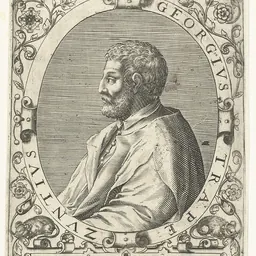
Biography From a family with ties to the Casentino, Landino was born in Florence in 1424. He studied law and Greek (under George of Trebizond). Against his father's will, he turned away from a career in the law and decided to study philosophy instead, a decision he would not have been able to make but for the patronage of Piero di Cosimo de' Medici. Landino's wife, Lucrezia, was a member of the Alberti family.
In 1458, Landino replaced Cristoforo Marsuppini as the chair of rhetoric and poetry at the Florentine Studio. His students, seeking a more renowned teacher, initially opposed Landino's appointment, but he nevertheless remained and became an important part of the cultural and intellectual life of Florence.
Landino was a member of the Platonic Academy founded by Marsilio Ficino in Florence. He was the tutor of Lorenzo de' Medici and his brother Giuliano. Landino also held public office, first as chancellor of the Guelf party (1467) and later as scriptor of public letters for the Signoria.
Landino died in 1498 in a villa in Borgo alla Collina, which he received as a gift from the Medici.
Works
Historia naturalis translated by Cristoforo Landino, 1489 edition.
Landino was a prolific writer. He championed the use of vernacular Italian.
He wrote three works framed as philosophical dialogues: De anima (1453), De vera nobilitate (1469), and the Disputationes Camaldulenses . In the Disputationes several humanists compare the merits of the active and the contemplative life.
As the lady "Xandra" Landino published three volumes of Latin poems. They were dedicated in 1458 to Piero de' Medici. He also prepared many letters and orations, which were published long after his death in Italian in Venice (1561).
Of special importance to the Renaissance, Landino prepared commentaries on the Aeneid (1478) and The Divine Comedy (1481). To promote the use of vernacular Italian, Landino held lectures on Petrarch and translated and published Pliny's Historia naturalis (1476) and Giovanni Simonetta's Latin life of Francesco Sforza (1490). Among his pupils was historian Andrea Cambini.
Don’t just read it —
keep it.
Full-length biographies made to live with: read them, listen on the way to work, watch them tonight.
- E-book
- Audio
- Video
Instant download · yours to keep · every purchase keeps this site free
Important facts
People in Cristoforo Landino's life
Named in this biography and alive at the same time




Related people
Same field, nearest in time


Contemporaries
People whose lives overlapped Cristoforo Landino's
Frequently asked questions
Who was Cristoforo Landino?
humanist, philosopher and writer from Italy
When was Cristoforo Landino born?
Cristoforo Landino was born on 8 February 1424 in Florence.
When did Cristoforo Landino die?
Cristoforo Landino died on 24 September 1498 in Borgo alla Collina.
What was Cristoforo Landino's occupation?
Cristoforo Landino was a philosopher, writer, poet and art historian.
What nationality was Cristoforo Landino?
Cristoforo Landino was Italian.
Sources & further reading
· Wikipedia: Cristoforo Landino
Cite this page
APA: Biography.guide. (2026). Cristoforo Landino. https://biography.guide/cristoforo-landino/
MLA: "Cristoforo Landino." Biography.guide, https://biography.guide/cristoforo-landino/.
Chicago: "Cristoforo Landino." Biography.guide. https://biography.guide/cristoforo-landino/.
Data last updated: 2026-09-20 · Spot an error? Report a correction.
Page generated 2026-09-27 05:19 UTC