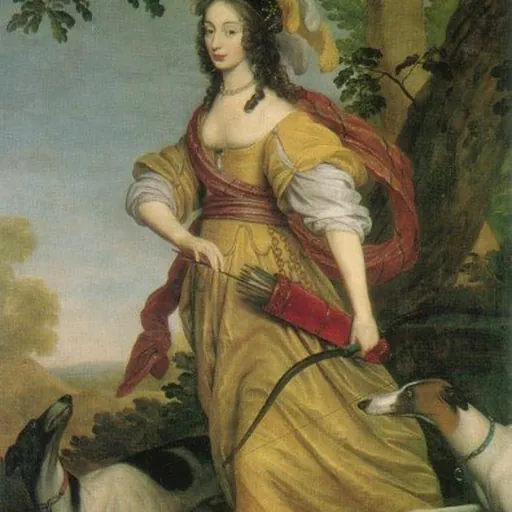
Countess Louise Henriette of Nassau
Electress Consort of Brandenburg
About Countess Louise Henriette of Nassau
Lived 1627 – 1667 (aged 39). Countess Louise Henriette of Nassau was a Dutch politician and philanthropist.
Louise Henriette of Nassau (, ; 7 December 1627 – 18 June 1667) was a Countess of Nassau, granddaughter of William I, Prince of Orange, "William the Silent", and an Electress of Brandenburg.
Biography
Louise Henriëtte was born in The Hague, the eldest daughter of Frederick Henry, Prince of Orange, and Amalia of Solms-Braunfels. She grew up at the court of her father, the Stadtholder of Holland, Zeeland, Utrecht, Guelders and Overijssel.
Marriage Louise Henriëtte had to abandon her love for Henri Charles de La Trémoille, Prince of Talmant, son of Henry de La Trémoille, as her mother had royal ambitions for her. However, attempts to conclude an engagement with King Charles II of England came to nothing. Finally she was forced to marry Frederick William, the Great Elector (1620-1688), "the Great Elector," at The Hague on 7 December 1646, her nineteenth birthday, on the proposal of the Brandenburg diplomat Joachim Friedrich von Blumenthal.
The Electorate of Brandenburg regarded this marriage as beneficial by reason of the connections with the Orange family it created in the hope of obtaining assistance for Brandenburg's struggle for influence in Pomerania.
Electress The couple lived in Cleves for the first years of their marriage, but they moved to Brandenburg, Frederick William's seat, in 1648. During her marriage, Louise Henriëtte followed her spouse and traveled between The Hague, Königsberg, Berlin and Cleves on campaigns, inspections, war and battle fields in Poland and Denmark. She acted as her husband's political adviser and was described as a pragmatist. She managed, through correspondence with the Queen of Poland, Marie Louise Gonzaga, to make an alliance with Poland in exchange for the Polish recognition of Prussia as a province of Brandenburg. It was said of her : "Few Electresses had been allowed so much influence".
In 1650 her husband gave her the Amt Bötzow, an electoral domain with large estates and numerous places and farmers that were subject to taxes. Louise Henriëtte had a new castle in Dutch style built in Bötzow in 1650-52 and called it Oranienburg Palace, after her family, the House of Orange-Nassau. It became the name for the entire town in 1653. She was also involved in the design and development of the Lustgarten in Berlin. In 1663, she installed the first porcelain cabinet in Europe. In 1665, she founded an orphanage with places for 24 children.
She was described as truly kind and gentle with a sharp intellect: her advice was vital for her spouse, and their marriage was considered a role model. During time of war, she made great efforts to soften the damages upon society.
A Protestant religious community known as the Luise-Henrietten-Stift in nearby Lehnin Abbey was named after her.
Children With Frederick William, the Great Elector, she had six children, only three of whom lived to adulthood: William Henry (1648-1649), died in infancy Charles (1655-1674) Frederick (1657-1713), the first King in Prussia Amalie (1664-1665), died in infancy Henry (1664-1664), died in infancy Louis (1666-1687), married Ludwika Karolina Radziwiłł
Luise Henriette also suffered many miscarriages.
Luise Henriette died in Berlin and was buried in the Berliner Dom.
Ancestry
Don’t just read it —
keep it.
Full-length biographies made to live with: read them, listen on the way to work, watch them tonight.
- E-book
- Audio
- Video
Instant download · yours to keep · every purchase keeps this site free
Important facts
Family & relationships
People in Countess Louise Henriette of Nassau's life
Named in this biography and alive at the same time

Related people
Same field, nearest in time
Contemporaries
People whose lives overlapped Countess Louise Henriette of Nassau's


Frequently asked questions
Who was Countess Louise Henriette of Nassau?
Electress Consort of Brandenburg (1627-1667)
When was Countess Louise Henriette of Nassau born?
Countess Louise Henriette of Nassau was born on 27 November 1627 in The Hague.
When did Countess Louise Henriette of Nassau die?
Countess Louise Henriette of Nassau died on 18 June 1667 in Cölln.
What was Countess Louise Henriette of Nassau's occupation?
Countess Louise Henriette of Nassau was a politician and philanthropist.
What nationality was Countess Louise Henriette of Nassau?
Countess Louise Henriette of Nassau was Dutch.
Sources & further reading
· Wikipedia: Countess Louise Henriette of Nassau
· DBpedia: Countess Louise Henriette of Nassau
Cite this page
APA: Biography.guide. (2026). Countess Louise Henriette of Nassau. https://biography.guide/countess-louise-henriette-of-nassau/
MLA: "Countess Louise Henriette of Nassau." Biography.guide, https://biography.guide/countess-louise-henriette-of-nassau/.
Chicago: "Countess Louise Henriette of Nassau." Biography.guide. https://biography.guide/countess-louise-henriette-of-nassau/.
Data last updated: 2026-09-25 · Spot an error? Report a correction.
Portrait: Wikimedia Commons · author & licence
Page generated 2026-10-04 10:07 UTC