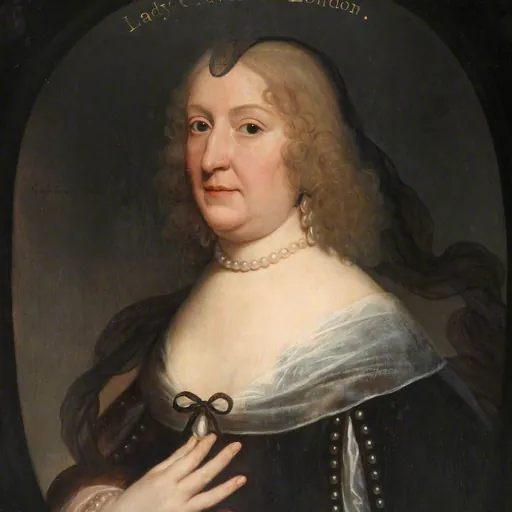
About Countess Amalie Elisabeth of Hanau-Münzenberg
Lived 1602 – 1651 (aged 49). Countess Amalie Elisabeth of Hanau-Münzenberg was a German ruler and aristocrat.
Amalie Elisabeth of Hanau-Münzenberg (28 January 1602– 18 August 1651) was Landgravine consort and Regent of Hesse-Kassel. She married the future William V, Landgrave of Hesse-Kassel in 1619 and became Landgravine upon his ascension to power in 1627. In 1637, military defeats forced her and William V into exile in East Frisia. Later that year, she became regent for their son William VI upon her husband's death. Through skillful diplomacy and military successes in the Thirty Years' War, she advanced the fortunes of Hesse-Kassel and influenced the Peace of Westphalia that brought the conflict to an end. She handed over an enlarged landgraviate to her son when she abdicated upon his majority in 1650. However, her health had deteriorated over the course of the war, and she died soon after her abdication in 1651.
Early life
Amalie Elisabeth was born between 2 and 3 o'clock in the afternoon of 28 January 1602 to Philip Louis II, Count of Hanau-Münzenberg and Countess Catharina Belgica of Nassau. Her mother was a daughter of William the Silent, making Amalie Elisabeth the niece of her contemporary Frederick Henry, Prince of Orange. Through her mother's numerous siblings, Amalie Elisabeth was also related to many of the other noble houses of Europe. These included the Reformation-minded Wittelsbachs in Heidelberg, where she lived for a while with her aunt, Countess Louise Juliana of Nassau, and her husband Frederick IV, Elector Palatine. After the early death of her father in 1612, she returned to Hanau. At the time she was engaged to Albrecht Jan Smiřický von Smiřice, one of the six Bohemian nobles at the Defenestration of Prague who threw the Emperor's representative from a window. However, Albrecht Johann Smiřický died later that year, before the couple could be married. However, because he was excluded from the general amnesty and because the Peace of Prague did not protect the rights of Calvinists, William V was one of the few princes who refused to make peace. Instead, he signed an alliance with the French, who now officially joined the war on the side of the Swedes. Although she was determined to retain control over the army, she did allow its command to remain in the hands of her late husband’s top general, Peter Melander, Count of Holzappel. Throughout her reign, Amalie Elisabeth asserted that she was one such woman, repeatedly claiming that God had placed her in this position and it was her responsibility to carry out his will.
Thirty Years' War After renewing Hesse-Kassel’s alliance with France, Amalie Elisabeth rejoined the war on the allied side. She soon agreed to support a joint allied offensive and in 1640 ordered General Peter Melander to link up with the armies of France and Sweden. Melander, however, did not support rejoining the war against the Emperor and strongly objected to serving under the Swedish Field Marshal Johan Banér, who had been given overall command of the allied army. In July 1640 Melander returned to Kassel and offered his resignation. Amalie Elisabeth, having had enough of Melander’s criticisms of her leadership, accepted the resignation. Because Amalie Elisabeth was one of the few German princes remaining at war with the Emperor, she sent diplomatic delegations to both Münster and Osnabrück.
Death Amalie Elisabeth’s efforts during the war and the burdens they brought with them had a lasting impact, and her health had steadily deteriorated through the war. In September 1650, she declared her intention to abdicate and transfer power to her son William VI, who had turned 21 earlier that year. On the 5th of October, she held an extravagant abdication ceremony, attended by her advisors and the Hessian estates, at which William VI was officially granted control over the court. Amalie Elisabeth returned to Kassel completely exhausted and with her condition much deteriorated. Four weeks later, on August 8, 1651, Amalie Elisabeth died in her sleep in Kassel. She was buried in the Martinskirche cemetery on September 30.
Legacy Amalie Elisabeth was remembered fondly among Calvinists for her efforts to preserve the Reformed faith in the Holy Roman Empire. When she visited Heidelberg in 1651, she was praised by the city’s inhabitants, who called her a second Deborah. In his 1901 book Women of the Reformed Church, James Isaac Good calls her both a “Reformed Deborah” and a “Reformed Joan of Arc." Her first biography was likely written by Christian Gottfried Körner and appeared as an appendix to the Representation of the Thirty Years War by Friedrich Schiller. Amalie Elisabeth was one of only four women accepted into King Ludwig I's Walhalla hall of fame during his lifetime (There are twelve women present today). Her bust was carved by Christian Friedrich Tieck.
Although Amalie Elisabeth’s reign was remembered for generations, modern scholarship on the Thirty Years’ War often pays little or no attention to her or her accomplishments. The foremost English-language biography on her is The Iron Princess: Amalia Elizabeth and the Thirty Years' War, written by Dr. Tryntje Helfferich and published in 2013. In her book, Dr. Helfferich argues that Amalie Elisabeth’s role in the Thirty Years’ War has been marginalized in modern works “largely because she was a woman, for her role in the Thirty Years War rivaled that of Bernhard of Saxe-Weimar, Cardinal Mazarin, or even King Gustavus Adolphus of Sweden." alt=Bust in the Walhalla by Christian Friedrich Tieck
Issue Amalie Elisabeth was constantly pregnant during her marriage, giving birth almost once a year: Agnes (24 November 1620 – 20 August 1626), died in childhood. Maurice (born and died 24 September 1621). Elisabeth (21 October 1623 – 13 January 1624), died in infancy. William (31 January 1625 – 11 July 1626), died in childhood. Emilie (11 February 1626 – 15 February 1693), married 15 May 1648 to Henri Charles de La Trémoille. Charlotte (20 November 1627 – 16 March 1686), married 12 February 1650 (div. 14 April 1657) to Charles I Louis of the Palatinate. William VI, Landgrave of Hesse-Kassel (23 May 1629 – 16 July 1663), married 9 July 1646 to Margravine Hedwig Sophie of Brandenburg. Philipp (16 June 1630 – 17 August 1638), died in childhood. Adolf (17 December 1631 – 17 March 1632), died in infancy. Karl (18/19 June 1633 – 9 March 1635), died in childhood. Elisabeth (23 June 1634 – 22 March 1688), Princess-Abbess of Herford. Stillbirth (8 February 1635). Luise (5 November 1636 – 6 January 1638), died in childhood. Stillbirth (28 May 1637).
Don’t just read it —
keep it.
Full-length biographies made to live with: read them, listen on the way to work, watch them tonight.
- E-book
- Audio
- Video
Instant download · yours to keep · every purchase keeps this site free
Important facts
Family & relationships
People in Countess Amalie Elisabeth of Hanau-Münzenberg's life
Named in this biography and alive at the same time







Related people
Same field, nearest in time






Contemporaries
People whose lives overlapped Countess Amalie Elisabeth of Hanau-Münzenberg's




Frequently asked questions
Who was Countess Amalie Elisabeth of Hanau-Münzenberg?
Regent of Hesse-Kassel (1602-1651)
When was Countess Amalie Elisabeth of Hanau-Münzenberg born?
Countess Amalie Elisabeth of Hanau-Münzenberg was born on 29 January 1602 in Hanau.
When did Countess Amalie Elisabeth of Hanau-Münzenberg die?
Countess Amalie Elisabeth of Hanau-Münzenberg died on 8 August 1651 in Kassel.
What was Countess Amalie Elisabeth of Hanau-Münzenberg's occupation?
Countess Amalie Elisabeth of Hanau-Münzenberg was a ruler and aristocrat.
What nationality was Countess Amalie Elisabeth of Hanau-Münzenberg?
Countess Amalie Elisabeth of Hanau-Münzenberg was German.
Sources & further reading
· Wikipedia: Countess Amalie Elisabeth of Hanau-Münzenberg
· DBpedia: Countess Amalie Elisabeth of Hanau-Münzenberg
Cite this page
APA: Biography.guide. (2026). Countess Amalie Elisabeth of Hanau-Münzenberg. https://biography.guide/countess-amalie-elisabeth-of-hanau-munzenberg/
MLA: "Countess Amalie Elisabeth of Hanau-Münzenberg." Biography.guide, https://biography.guide/countess-amalie-elisabeth-of-hanau-munzenberg/.
Chicago: "Countess Amalie Elisabeth of Hanau-Münzenberg." Biography.guide. https://biography.guide/countess-amalie-elisabeth-of-hanau-munzenberg/.
Data last updated: 2026-09-22 · Spot an error? Report a correction.
Portrait: Wikimedia Commons · author & licence
Page generated 2026-09-27 05:02 UTC