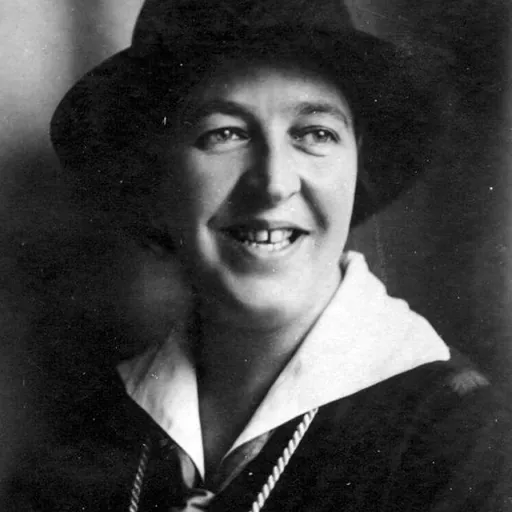
Corrie ten Boom
Dutch resistance hero and writer
About Corrie ten Boom
Lived 1892 – 1983 (aged 91). Corrie ten Boom was a Dutch writer, autobiographer, resistance fighter and watchmaker.
Cornelia Arnolda Johanna "Corrie" ten Boom (15 April 1892 – 15 April 1983) was a Dutch watchmaker and later a Christian writer and public speaker, who worked with her father, Casper ten Boom, her sister Betsie ten Boom and other family members to help many Jewish people escape from the Nazis during the Holocaust in World War II by hiding them in her home. They were caught, and she was arrested and sent to the Ravensbrück concentration camp. Her most famous book, The Hiding Place, is a biography that recounts the story of her family's efforts and how she found and shared hope in God while she was imprisoned at the concentration camp.
Early life
Corrie ten Boom was born on 15 April 1892 in Haarlem, Netherlands, the youngest child of Casper ten Boom, a jeweller and watchmaker, and Cornelia (commonly known as "Cor") Johanna Arnolda, née Luitingh, whom he married in 1884. She was named after her mother but known as Corrie all her life. Her three maternal aunts, Tante Bepa, Tante Jans, and Tante Anna, lived with the family.
The Ten Boom family lived above Casper's watch shop in what Corrie called "the Beje" (pronounced bay-yay), a house named for the Barteljorisstraat where they lived.
She trained to be a watchmaker herself, and in 1922, she became the first woman to be licensed as a watchmaker in the Netherlands. Over the next decade, in addition to working in her father's shop, she established a youth club for teenage girls, which provided religious instruction and classes in the performing arts, sewing, and handicrafts. – powerful motivation for the selfless rescue work she would later become involved in.
World War II
In May 1940, the Germans invaded the Netherlands. One of their restrictions was the banning of the youth club. A devoted reader of the Old Testament, he believed that the Jews were the "chosen people" and told the woman, "In this household, God's people are always welcome." Thus the Ten Booms created "The Hiding Place" (Dutch: De Schuilplaats). The secret room was in Corrie's bedroom behind a false wall and would hold 6 people. A ventilation system was installed for the occupants. A buzzer could be heard in the house to warn the refugees to get into the room as quickly as possible during security sweeps through the neighborhood. The group of six people hidden by the Ten Booms, made up of both Jews and resistance workers, remained undiscovered. Though the house was under constant surveillance after Ten Boom's arrest, police officers who were also members of the resistance group coordinated the refugees' escape. Ten Boom received a letter one day in prison, "All the watches in your cabinet are safe," meaning that the refugees had managed to escape and were safe.
Though the Gestapo soon released most of the 30 people they had captured that day, Corrie, Betsie, and their father Casper were held in prison. Casper died ten days later. Ten Boom defended her work by saying that in the eyes of God, a mentally disabled person might be more valuable "than a watchmaker. Or a lieutenant." Before she died, she told Corrie, "There is no pit so deep that He [God] is not deeper still." Twelve days later,
Life after the war After the war, Ten Boom remained in the Netherlands and set up a rehabilitation center in Bloemendaal. The refuge housed concentration-camp survivors and until 1950 exclusively sheltered jobless Dutch who had collaborated with the Germans during the Occupation, after which it accepted anyone in need of care. She returned to Germany in 1946 and met with and forgave two Germans who had been employed at Ravensbrück, one of whom had been particularly cruel to Betsie.
A sequel film, Return to the Hiding Place (War of Resistance), was released in 2011 in the United Kingdom and in 2013 it was released in the United States. The film was based on Hans Poley's book, which painted a broader picture of the circle of which she was a part.
Honors The Yad Vashem Remembrance Authority in Israel honored her by naming her Righteous Among the Nations on 12 December 1967. She was knighted by the Queen of the Netherlands in recognition of her work during the war.
Don’t just read it —
keep it.
Full-length biographies made to live with: read them, listen on the way to work, watch them tonight.
- E-book
- Audio
- Video
Instant download · yours to keep · every purchase keeps this site free
Important facts
Family & relationships
People in Corrie ten Boom's life
Named in this biography and alive at the same time


Related people
Same field, nearest in time



Contemporaries
People whose lives overlapped Corrie ten Boom's

Frequently asked questions
Who was Corrie ten Boom?
Dutch resistance hero and writer
When was Corrie ten Boom born?
Corrie ten Boom was born on 15 April 1892 in Amsterdam.
When did Corrie ten Boom die?
Corrie ten Boom died on 15 April 1983 in Placentia.
What was Corrie ten Boom's occupation?
Corrie ten Boom was a writer, autobiographer, resistance fighter and watchmaker.
What nationality was Corrie ten Boom?
Corrie ten Boom was Dutch.
Sources & further reading
Cite this page
APA: Biography.guide. (2026). Corrie ten Boom. https://biography.guide/corrie-ten-boom/
MLA: "Corrie ten Boom." Biography.guide, https://biography.guide/corrie-ten-boom/.
Chicago: "Corrie ten Boom." Biography.guide. https://biography.guide/corrie-ten-boom/.
Data last updated: 2026-09-22 · Spot an error? Report a correction.
Portrait: Wikimedia Commons · author & licence
Page generated 2026-09-27 05:03 UTC