
About Cornelis de Wael
Lived 1592 – 1667 (aged 74). Cornelis de Wael was a Belgian painter, printmaker, art dealer, postage stamp designer, designer and draftsperson.
Cornelis de Wael (Antwerp, 1592 – Rome, 1667) was a Flemish painter, engraver and merchant who was primarily active in Genoa in Italy. He is known for his genre paintings, battle scenes, history paintings and still lifes. Through his art work, support for Flemish painters working in Italy and role as an art dealer, he played an important role in the artistic exchange between Italy and Flanders in the first half of the 17th century. His work also had an influence on local painters such as Alessandro Magnasco, particularly through his scenes of despair and irony.
Life
Cornelis de Wael was born into an artistic family in Antwerp as the son of the painter Jan de Wael I (1558–1633). His mother Gertrude de Jode came from a family of artists: her father was the cartographer Gerard de Jode and her brother was the engraver Pieter de Jode I.
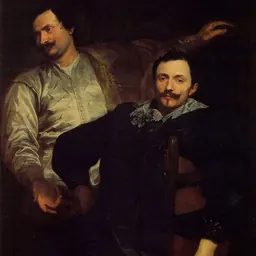
In 1619 he emigrated to Italy with his brother Lucas de Wael (1591–1661), also a painter. They spent time first in Genoa and then in Rome where they came into contact with the members of the Bentvueghels, an association of mainly Dutch and Flemish artists working in Rome. In 1627 Cornelis became a member of the Accademia di San Luca, the prestigious association of artists in Rome which had very strict admission criteria. Genoa was at the time an attractive destination for artists since the competition between artists there was less intense than in the leading cultural centres Rome, Florence and Venice, while Genoa was a thriving port city where a large number of potential customers and collectors lived.
The workshop of the brothers de Wael in Genoa became the centre of the colony of Flemish artists who resided in or passed through the city. These Flemish artists could take advantage of the work and artistic activity that their workshop attracted. The brothers provided a home, materials and tools, they assisted their compatriots with their local integration, passed on recommendations to clients and formulated competition rules. Some Flemish artists visiting Genoa became their collaborators. This is the case of the marine painter Andries van Eertvelt who is documented in Genoa from 1628 to 1630, where he lived with de Wael and became his collaborator. Van Eertvelt's pupil Gaspar van Eyck also who worked in Genoa from 1632 to 1640 and was de Wael's collaborator. When Anthony van Dyck visited Genoa, he stayed with the brothers. While it was formerly believed that Cornelis was one of van Dyck's closest collaborators in the city, recent scholarship has suggested that it is more likely that this role was played by the Flemish painter Jan Roos with whom signed collaborations have been preserved.
There was a great demand for the work of Cornelis de Wael. His patrons included the rich patricians of the Government of the Republic of Genoa as well as Philip III of Spain and Philippe-Charles, 3rd Count of Arenberg.
De Wael's pupils included his nephew Jan Baptist de Wael (the son of Lucas), the Flemish painter Jan Hovaert (also known as Giovanni Hovart, Giovanni di Lamberto, Giovannino del su Lamberto, Jan Lambertsz Houwaert) and Antonio Rinaldi.
He died in Rome in 1667. Contemporary reports describe an impressive funeral attended by about 400 Flemish artists that formed part the Roman painters' colony.
Cornelis de Wael was a specialist painter of battle scenes. A number of these paintings depicting battles on land (such as the Siege of Ostend, in the Museo del Prado) and sea (such as the Battle between Christians and Turks, in the Museo Poldi Pezzoli) have survived. The broad composition of some of his military works is close to that of the leading Flemish war artists Pieter Meulener and Adam Frans van der Meulen while their static quality recalls the work of Sebastiaen Vrancx. The Portrait of Luca Giustiniani, Doge of the Republic of Genoa (Musée de Bastia) that was formerly attributed to him has been re-attributed to his pupil Jan Hovaert.
He collaborated with van Dyck as well as with other Flemish artists such as the landscape painter Jan Wildens. Collaborations with local artists were also frequent. De Wael or someone from his circle painted the staffage in the landscapes of the Italian landscape painter Giovanni Battista Vicino.
He also left many drawings some of which are in the collections of the Louvre and the British Museum. The British Museum holds an album of 53 drawings dating from 1640 to 1650 which covers mainly military subjects. These drawings are generally direct and are often signed or inscribed. The Antwerp engraver Melchior Hamers frequently engraved after the designs of de Wael. The Antwerp engraver and publisher Alexander Voet the Elder published engravings made after designs by de Wael such as the series of the Four Seasons and the Five Senses.
Don’t just read it —
keep it.
Full-length biographies made to live with: read them, listen on the way to work, watch them tonight.
- E-book
- Audio
- Video
Instant download · yours to keep · every purchase keeps this site free
Important facts
more
Cornelio da Valle, Cornelio de Waal, C. de Wael, Cornelius von Voael, Corneille Wael, C. Wael, C. Dewaël, Cornelio della valle, Wael, DeWael, De Wall, Corneil de Wal, Corneille de Vall, de Wael, De Waal, C. De Waels, Cornelius Weele, Corneille Vael, Corneil Deval, Cornelio Vael, Cornelio de Valle, Cornille de Wael, Cornelius de Waal, Corneli Vael, Cornelio VallePeople in Cornelis de Wael's life
Named in this biography and alive at the same time


Related people
Same field, nearest in time
Contemporaries
People whose lives overlapped Cornelis de Wael's





Frequently asked questions
Who was Cornelis de Wael?
Flemish painter and engraver (1592-1667)
When was Cornelis de Wael born?
Cornelis de Wael was born on 7 September 1592 in Antwerp.
When did Cornelis de Wael die?
Cornelis de Wael died on 21 April 1667 in Rome.
What was Cornelis de Wael's occupation?
Cornelis de Wael was a painter, printmaker, art dealer, postage stamp designer, designer and draftsperson.
What nationality was Cornelis de Wael?
Cornelis de Wael was Belgian.
Sources & further reading
Cite this page
APA: Biography.guide. (2026). Cornelis de Wael. https://biography.guide/cornelis-de-wael/
MLA: "Cornelis de Wael." Biography.guide, https://biography.guide/cornelis-de-wael/.
Chicago: "Cornelis de Wael." Biography.guide. https://biography.guide/cornelis-de-wael/.
Data last updated: 2026-09-20 · Spot an error? Report a correction.
Page generated 2026-09-27 05:19 UTC