
Cornelia Connelly
American nun, foundress, venerable
About Cornelia Connelly
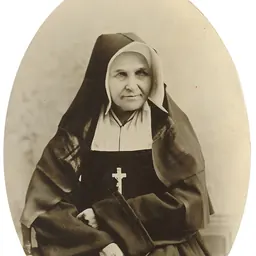
Lived 1809 – 1879 (aged 70). Cornelia Connelly was an American nun, founder, founder of Catholic religious community and author.
Cornelia Connelly, SHCJ (née Cornelia Peacock; January 15, 1809 – April 18, 1879) was an American-born educator who was the founder of the Society of the Holy Child Jesus, a religious congregation in the Roman Catholic Church. In 1846, she founded the first of many Holy Child schools in England. In 1992, Connelly was proclaimed as venerable by Pope John Paul II.
Early life
Cornelia Peacock was born in Philadelphia, Pennsylvania, on January 15, 1809, the daughter of Ralph William Peacock Sr. and Mary Swope. Swope's first husband was John Bowen Sr., a plantation owner from Jamaica. Together they had four children. However, only a daughter named Isabella and a son named John Jr., made it to adulthood. Peacock was raised a Presbyterian by her father Ralph.
When Peacock was age nine in 1818, Ralph died. Her mother died in 1823 when Peacock was age 14. She was then taken in by Isabella and her husband, Austin Montgomery. Peacock was educated by tutors at her half-sister's home.
Some time before 1831, Peacock met her future husband, Pierce Connelly, a young Episcopal priest. He was five years her senior and a graduate of the University of Pennsylvania in Philadelphia. Despite the protests of Isabella and Austin, Peacock accepted his marriage proposal. In 1831, at age 22, she was baptized into the Episcopal Church and wed to Pierce.
After the wedding, the couple moved to Natchez, Mississippi, where Pierce had accepted the position of rector at Trinity Episcopal Church. According to contemporary accounts, they were a happy couple and welcomed by their parishioners. Their first child, Mercer, was born in 1832. They were given an enslaved person as gift celebrating their son's birth. While living in Mississippi, they bought and sold other enslaved persons.
In 1835, Pierce was appointed chairman of the Episcopal Convention of the Southwest. That same year, the couple's second child, Adeline, was born. Pierce became wealthy from land investments and was in line for an appointment as an Episcopal bishop.
Family life
Conversion to Catholicism
In 1835, the Catholic population of the United States started increasing from a large wave of German and Irish immigration. In many cities, it triggered a backlash of Protestant fear and resentment. In Boston, Massachusetts, in 1834, a convent for a community of Ursuline nuns was burned down by a Protestant mob. Pierce became curious about Catholicism. He started wondering why a Catholic mission for African-Americans across the Cumberland River had become so successful while an Episcopal mission there had failed. He also wanted to see more discipline and authority in a church than that provided by the Episcopalians.
After arriving in Rome, Pierce became a celebrity, having been a prominent figure in the American Episcopal Church. The family resided in the palazzo of the English Catholic John Talbot, 16th Earl of Shrewsbury. Pope Gregory XVI granted Pierce a private audience. He was received into the Catholic Church in March 1836.
Desire for priesthood Following his conversion, Pierce wanted to be ordained as a priest. However, the Latin Church required its priests to be celibate and he was married, with another child expected soon. Some church advisors suggested he be ordained in one of the Eastern Catholic Churches, which did not require priestly celibacy. However, there were no Eastern Catholic parishes in the United States. In addition, Pierce wanted to become a bishop one day and celibacy was required for Eastern Catholic bishops.
Putting aside a decision on Pierce's priesthood, the family traveled to Vienna in the Austrian Empire, where their third child John Henry was born. However, the Panic of 1837 had hit Nashville, causing Pierce to lose a great deal of money. He was forced to bring the family back to the United States so he could get a job. He took a teaching position at the Jesuit St. Charles College in Grand Coteau, Louisiana, where he taught English. Cornelia taught music at a local academy for girls. In the summer of 1839, the Connellys' fourth child, Mary Magdalen, died six weeks after birth. In February 1840, John Henry died from burns after falling into a vat of boiling sugar. In early 1840, Cornelia made her first retreat of three days. The Connellys' fifth child, Frank, was born in the spring of 1841. However, the cardinal vicar of Rome assured her that she was under no obligation to become a religious sister. In June 1844, Pierce was ordained into the Catholic priesthood. He celebrated his first mass, giving Adeline her first holy communion. During the service, Cornelia sang in the choir.
Establishment of Society of the Holy Child Jesus
By the early 1840s, the British Government had started easing centuries-old restrictions on Catholic institutions in that nation. Bishop Nicholas Wiseman, the Vatican representative to Great Britain, quickly started establishing religious orders there to operate Catholic schools and other institutions.
Deeply saddened by her children leaving home, Cornelia agreed with Wiseman's terms. She then drew up a constitution for a new religious congregation, which she called the Society of the Holy Child Jesus. Its constitution was based on the Jesuit constitution and devolved on operating schools.
Wiseman assigned Cornelia to a large convent at St. Mary's Parish in Derby in 1846. Soon she was running a day school for 200 pupils, an evening school for female factory workers, and a popular Sunday school program. At the same time, she was training novices for the new Society of the Holy Child Jesus.
Later years
Attempts at control by Pierce After a few years as a Catholic priest, Pierce was beginning to regret his ordination and his forced separation from Cornelia. After not seeing her for a year, disregarding Wiseman's orders, Pierce appeared unannounced at Derby to see her. She was upset with his visit and told him not to come again. He wrote Cornelia a letter, reproaching her for her hostility. She replied, expressing her bitterness over his hypocrisy. She stated that his visit made it harder for her to overcome her feelings of physical attraction for him.
In December 1847, Cornelia took her perpetual vows as a religious sister and was installed as superior general of the Society of the Holy Child Jesus.
Pierce then went to Rome and presented himself to the Congregation for the Propagation of the Faith as the true founder of the Society of the Holy Child Jesus, again hoping to gain control over Cornelia. Once she learned about his scheme, she was able to thwart it. However, he remained registered as the society's co-founder, which caused considerable confusion in the future. Returning to England, Pierce arrived at the convent in Derby with a supposed gift from Pope Pius IX. However, she refused to see him unless he agreed to return Adeline.
St. Leonard's-on-Sea Wiseman, unable to meet expenses connected with the schools in Derby, moved Cornelia and her religious sisters to his district at St. Leonard's-on-Sea in Sussex.
Connelly vs. Connelly
By 1849, a disgruntled Pierce had renounced his ordination and left the Catholic Church. That same year, he sued Cornelia in the Arches Court, the ecclesiastic court for the Church of England parishes around London. Over the next four years, this lawsuit became a high publicized and divisive trial in England. At the beginning of the case, Lord Shrewsbury asked Cornelia to leave England to avoid scandalizing the Catholic Church, which had only recently recovered its legal rights in the kingdom. She refused to leave, believing that would betray her vows and her religious order. Wiseman supported her decision to fight the lawsuit and provided lawyers for her defense.
In court, Pierce portrayed himself as a husband suffering the loss of his conjugal rights because the Catholic Church was illegally keeping his wife from him. At no point in the trial did he mention being a Catholic priest or having converted to Catholicism. Living with her sorrows, Cornelia stated that the Society of the Holy Child was "founded on a breaking heart".
Over the next 27 years, the Society of the Holy Child Jesus established convents and schools throughout England and Europe. In 1862, Cornelia sent six sisters to establish their first convent and school in Towanda, Pennsylvania. As the order increased in size in the United States, they moved to other states. The religious sisters trained female teachers, taught in schools themselves and helped with whatever needed to be done in their areas.
Cornelia Connelly died at age 70 on April 18, 1879, at St Leonards-on-Sea. At her request, she was buried there. .
Veneration In 1992, the Catholic Church proclaimed Cornelia as venerable. It closed in 2019.
Don’t just read it —
keep it.
Full-length biographies made to live with: read them, listen on the way to work, watch them tonight.
- E-book
- Audio
- Video
Instant download · yours to keep · every purchase keeps this site free
Important facts
People in Cornelia Connelly's life
Named in this biography and alive at the same time


Related people
Same field, nearest in time



Contemporaries
People whose lives overlapped Cornelia Connelly's





Frequently asked questions
Who was Cornelia Connelly?
American nun, foundress, venerable (1809-1879)
When was Cornelia Connelly born?
Cornelia Connelly was born on 15 January 1809 in Philadelphia.
When did Cornelia Connelly die?
Cornelia Connelly died on 18 April 1879 in St Leonards.
What was Cornelia Connelly's occupation?
Cornelia Connelly was a nun, founder, founder of Catholic religious community and author.
What nationality was Cornelia Connelly?
Cornelia Connelly was American.
Sources & further reading
· Wikipedia: Cornelia Connelly
Cite this page
APA: Biography.guide. (2026). Cornelia Connelly. https://biography.guide/cornelia-connelly/
MLA: "Cornelia Connelly." Biography.guide, https://biography.guide/cornelia-connelly/.
Chicago: "Cornelia Connelly." Biography.guide. https://biography.guide/cornelia-connelly/.
Data last updated: 2026-09-20 · Spot an error? Report a correction.
Page generated 2026-09-27 05:30 UTC