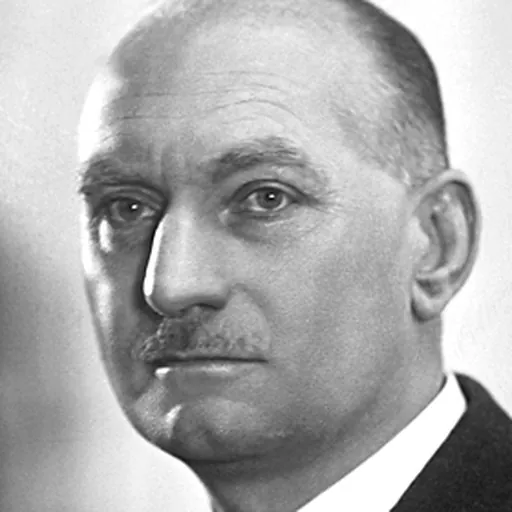
About Corneille Heymans
Lived 1892 – 1968 (aged 76). Corneille Heymans was a Belgian physician, university teacher, pharmacologist, physiologist and toxicologist.
Corneille Jean François Heymans (28 March 1892 – 18 July 1968) was a Belgian physiologist. He studied at the Jesuit College of Saint Barbara and then at Ghent University, where he obtained a doctor's degree in 1920.
Heymans won the Nobel Prize for Physiology or Medicine in 1938 for showing how blood pressure and the oxygen content of the blood are measured by the body and transmitted to the brain.
Early life and education After graduation Heymans worked at the Collège de France (under Prof. E. Gley), the University of Lausanne (under Prof. M. Arthus), the University of Vienna (under Prof. H. H. Meyer), University College London (under Prof. E. H. Starling) and Case Western Reserve University School of Medicine (under Prof. C. F. Wiggers).
He was the Editor-in-Chief of Archives Internationales de Pharmacodynamie et de Thérapie for many years. His memberships included the Pontifical Academy of Sciences, the Académie des Sciences, and the Royal Society of Arts.
The group of physiopharmacologists working under Heymans at Ghent University were looking for the anatomical basis of the respiratory reflex at the carotid sinus. It was necessary that the Spanish neurohistologist Fernando de Castro Rodríguez (1898–1967) described in detail the innervation of the aorta-carotid region, circumscribing the presence of baroreceptors to the carotid sinus, but that of chemoreceptors to the carotid body, for the Belgian group to move their focus from the first to the very small second structure to physiologically demonstrate the nature and function of the first blood chemoreceptors. The contribution of the young De Castro, maybe the last direct disciple of Santiago Ramón y Cajal (1852–1934; awarded the 1906 Nobel prize in Physiology or Medicine) was overlooked at the time, but it was later recognized that he deserved to share the Nobel Prize with Heymans, his colleague and friend.
Personal life
Heymans married Berthe May (1892–1974), an ophthalmologist, in 1929 and had five children. He died in Knokke from a stroke. He was Catholic.
Honours and awards Heymans (crater) on the Moon Nobel Prize for Physiology or Medicine (1938) Member, American Philosophical Society (1962)
Don’t just read it —
keep it.
Full-length biographies made to live with: read them, listen on the way to work, watch them tonight.
- E-book
- Audio
- Video
Instant download · yours to keep · every purchase keeps this site free
Important facts
People in Corneille Heymans's life
Named in this biography and alive at the same time


Related people
Same field, nearest in time

Contemporaries
People whose lives overlapped Corneille Heymans's





Frequently asked questions
Who was Corneille Heymans?
Belgian physiologist (1892-1968)
When was Corneille Heymans born?
Corneille Heymans was born on 28 March 1892 in Ghent.
When did Corneille Heymans die?
Corneille Heymans died on 18 July 1968 in Knokke-Heist.
What was Corneille Heymans's occupation?
Corneille Heymans was a physician, university teacher, pharmacologist, physiologist and toxicologist.
What nationality was Corneille Heymans?
Corneille Heymans was Belgian.
Sources & further reading
· Wikipedia: Corneille Heymans
Cite this page
APA: Biography.guide. (2026). Corneille Heymans. https://biography.guide/corneille-heymans/
MLA: "Corneille Heymans." Biography.guide, https://biography.guide/corneille-heymans/.
Chicago: "Corneille Heymans." Biography.guide. https://biography.guide/corneille-heymans/.
Data last updated: 2026-09-22 · Spot an error? Report a correction.
Portrait: Wikimedia Commons · author & licence
Page generated 2026-09-27 05:03 UTC