
About Constantine of Strathclyde
Lived 570 – 640 (aged 69–70). Constantine of Strathclyde was a monarch.
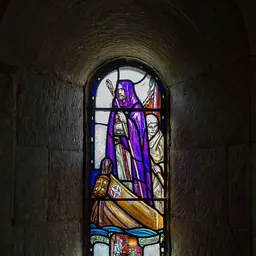
Constantine was reputedly the son and successor of King Riderch Hael of Alt Clut, the Brittonic kingdom later known as Strathclyde. (The modern English name of Alt Clut is Dumbarton Rock.) He appears only in the Life of St. Kentigern by Jocelyn of Furness, which regards him as a cleric, thus connecting him with the several obscure saints named Constantine venerated throughout Britain.
According to Jocelyn, Constantine was the son of Riderch and his queen Languoreth. He succeeded his illustrious father upon his death, but later stepped down to become a clergyman. It also states that he was guided to Christianity by Saint Columba, became a missionary of the faith in England and Ireland, and died around 640.
St Constantine of Strathclyde and Govan is a saint recognised by the Greek Orthodox Church. Whilst there are no robust historical records of his existence, the available legend narrates that he abdicated the throne of Strathclyde in 612 AD to become a monk, and later a priest. It is also said that he was Christianised by St Columba. Notwithstanding the lack of reliable information, the date 612 AD would be in a time range that would be contemporary with the date of Christian occupation of the Govan church yard, where archaeological investigation has confirmed Christian use from the 5th and 6th centuries. However, the sarcophagus commonly believed to have housed his relics occupies a stylistic date range of the 9th to 10th centuries. This does not exclude the possibility that the sarcophagus was created at a later date to house the remains or part of the remains of the earlier saint, as such a practice was common during the Medieval age of relic cults across Christendom. There are three later Scottish kings known by the name Constantin(e), who all reigned several centuries after the legendary figure associated with Riderch Hael of Alt Clut.
Matters become further confused as there is a Cornish St Constantin(e) associated with the Dark Age kingdom of Dumnonia, which itself is very similar in culture and origin to the British Kingdom which centred on Strathclyde, then known as Damnonii/Damnonia. With the current lack of original sources there is a divided scholarly opinion as to whether Constantine of the British Kingdoms was the same figure, or examples where one figure was fabricated in emulation of the other, or whether there was indeed several who were named at birth popularly as Constantin(e). Further scholarship and archaeological investigation would be required to establish further conclusions.
Don’t just read it —
keep it.
Full-length biographies made to live with: read them, listen on the way to work, watch them tonight.
- E-book
- Audio
- Video
Instant download · yours to keep · every purchase keeps this site free
Important facts
People in Constantine of Strathclyde's life
Named in this biography and alive at the same time
Related people
Same field, nearest in time


Contemporaries
People whose lives overlapped Constantine of Strathclyde's



Frequently asked questions
Who was Constantine of Strathclyde?
Son and successor of King Riderch Hael of Alt Clut
When was Constantine of Strathclyde born?
Constantine of Strathclyde was born in 570.
When did Constantine of Strathclyde die?
Constantine of Strathclyde died in 640 in Glasgow, Govan.
What was Constantine of Strathclyde's occupation?
Constantine of Strathclyde was a monarch.
What nationality was Constantine of Strathclyde?
Constantine of Strathclyde's recorded nationality: Kingdom of Strathclyde.
Sources & further reading
· Wikipedia: Constantine of Strathclyde
· DBpedia: Constantine of Strathclyde
Cite this page
APA: Biography.guide. (2026). Constantine of Strathclyde. https://biography.guide/constantine-of-strathclyde/
MLA: "Constantine of Strathclyde." Biography.guide, https://biography.guide/constantine-of-strathclyde/.
Chicago: "Constantine of Strathclyde." Biography.guide. https://biography.guide/constantine-of-strathclyde/.
Data last updated: 2026-09-20 · Spot an error? Report a correction.
Page generated 2026-09-27 05:31 UTC