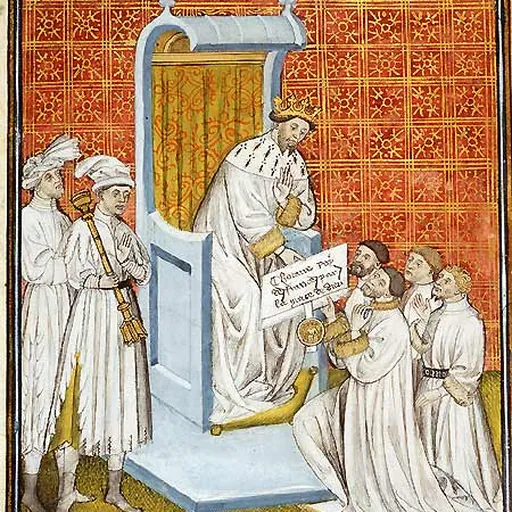
About Chlothar II
Lived 584 – 629 (aged 44–45). Chlothar II was a monarch.
Chlothar II, sometimes called "the Young" (French: le Jeune), (May/June 584 – 18 October 629) was king of the Franks, ruling Neustria (584–629), Burgundy (613–629) and Austrasia (613–623).
The son of Chilperic I and his third wife, Fredegund, he started his reign as an infant under the regency of his mother, who was in an uneasy alliance with Chlothar's uncle King Guntram of Burgundy, who died in 592. Chlothar took power upon the death of his mother in 597; though rich, his realm was one of the smallest portions of Francia. He continued his mother's feud with Queen Brunhilda with equal viciousness and bloodshed, finally achieving her execution by dismemberment in 613, after winning the battle that enabled Chlothar to unite Francia under his rule. Like his father, he built up his territories by seizing lands after the deaths of other kings.
His reign was long by contemporary standards, but saw the continuing erosion of royal power to the French nobility and the church against a backdrop of feuding among the Merovingians. The Edict of Paris in 614, concerned with several aspects of appointments to offices and the administration of the kingdom, has been interpreted in different ways by modern historians. In 617 he made the mayor of the Palace a role held for life, an important step in the progress of this office from being first the manager of the royal household to the effective head of government, and eventually the monarch, under Pepin the Short in 751. Chlothar was forced to cede rule over Austrasia to his young son Dagobert I in 623.
Unusually for a Merovingian monarch, he practised monogamy, though early deaths meant that he had three wives. He was generally an ally of the church and, perhaps inspired by the example of his uncle Guntram, his reign seems to lack outrageous acts of murder, the execution of Brunhilda excepted.
Background
Frankish territories in the sixth century The kingdom of Chlothar at the start of his reign (yellow). By 613 he had inherited or conquered all of the coloured portions of the map. The domain of Clothar II was located in the territorial and political framework derived from the Frankish kingdom present at 561 at the death of Clothar, son of Clovis and grandfather of Clothar II.
On the death of Clovis in 511, four kingdoms were established with capitals at Reims, Soissons, Paris, and Orléans, Aquitaine being distributed separately. In the year 550, Clothar I, the last survivor of four brothers reunited the Frankish kingdom, and added Burgundian territory (Burgundia) by conquest.
In 561, the four sons of Clothar I followed the events of 511 similarly and split the kingdom again: Sigebert I in Reims, Chilperic I in Soissons, Charibert I in Paris, and Guntram in Orleans, which then included the Burgundian kingdom territory (Burgundia). They divided Aquitaine separately again. Very quickly, Sigebert moved his capital from Reims to Metz, while Guntram moved his from Orléans to Chalon. On the death of Charibert in 567, the land was again split between the three survivors, of greatest importance Sigebert (Metz) received Paris and Chilperic (Soissons) received Rouen. The names Austrasia and Neustria seem to have appeared as the names of these kingdoms for the first time at this point.
Ambitions of Fredegund In 560, Sigebert and Chilperic married two sisters, daughters of the Visigoth king of Spain Athanagild; princesses Brunhilda, and Galswintha respectively. However Chilperic was still very much attached to his lover and consort, Fredegund, causing Galswintha to wish to return to her homeland in Toledo. In 568 she was murdered and within days, after a brief period of grieving, Chilperic officially married Fredegund and elevated her to a queen of a Frankish kingdom. "After this action his brothers thought that the queen mentioned above had been killed at his command..."
Chilperic agreed, at first, to pay a sum of money to end the feud, but not soon after decided to embark on a series of military operations against Sigebert. This was the beginning of what is called the "royal feud " which did not end until Brunhilda died in 613. The main episodes until the assassination of Chilperic in 584 were as follows: the assassination of Sigebert (575), the imprisonment of Brunhilde and her marriage to a son of Chilperic, and the return of Brunhilda to her son Childebert II, successor of Sigebert.
Moreover, Fredegund strove to ensure her position, since she was from lower origins, by eliminating the sons that Chilperic had with his previous wife Audovera: Merovech and Clovis. Her own children, however, died at a very young age and appeared to be by foul play. When Fredegund had a son in the spring of 584, he would have been the future successor of Chilperic I, if he had lived long enough.
Don’t just read it —
keep it.
Full-length biographies made to live with: read them, listen on the way to work, watch them tonight.
- E-book
- Audio
- Video
Instant download · yours to keep · every purchase keeps this site free
Important facts
Family & relationships
People in Chlothar II's life
Named in this biography and alive at the same time

Related people
Same field, nearest in time



Contemporaries
People whose lives overlapped Chlothar II's




Frequently asked questions
Who was Chlothar II?
King of Neustria
When was Chlothar II born?
Chlothar II was born in 584.
When did Chlothar II die?
Chlothar II died on 18 October 629.
What was Chlothar II's occupation?
Chlothar II was a monarch.
What nationality was Chlothar II?
Chlothar II's recorded nationality: Francia.
Sources & further reading
Cite this page
APA: Biography.guide. (2026). Chlothar II. https://biography.guide/chlothar-ii/
MLA: "Chlothar II." Biography.guide, https://biography.guide/chlothar-ii/.
Chicago: "Chlothar II." Biography.guide. https://biography.guide/chlothar-ii/.
Data last updated: 2026-09-21 · Spot an error? Report a correction.
Portrait: Wikimedia Commons · author & licence
Page generated 2026-09-27 05:00 UTC