
About Constant Tonegaru
Lived 1919 – 1952 (aged 32). Constant Tonegaru was a Romanian poet.
Constant Tonegaru (common rendition of Constantin Tonegaru; February 26, 1919 – February 10, 1952) was a Romanian avant-garde and Decadent poet, who ended his career as a political prisoner and victim of the communist regime. Known for his bohemianism, he was the author of celebrated escapist and individualist poems, characteristic for the World War II generation in Romanian literature, and closely related to the works of his friends Geo Dumitrescu, Dimitrie Stelaru, and Ion Caraion. Together with them, Tonegaru stands for one of the last waves to pass through Sburătorul, a modernist literary society formed around literary critic Eugen Lovinescu.
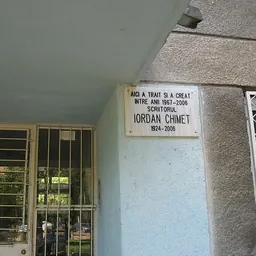
At the same time an anti-fascist and anti-communist, Tonegaru participated in culturally subversive activities against the authoritarian Ion Antonescu regime, and contributed to Dumitrescu's magazine until it was closed down by Antonescu's censorship apparatus. Before 1945, he was also affiliated with Vladimir Streinu's Kalende magazine, and completed work on his volume Plantații ("Plantations"), a large portion of which is dedicated to shocking images of war on the Eastern Front. After the Soviet Union began its occupation of Romania, Tonegaru was also an outspoken critic of cultural persecution, and, with fellow writers Streinu, Pavel Chihaia, and Iordan Chimet, created the Mihai Eminescu Association, a charitable organization and cultural forum whose goal was providing help to marginalized authors.
Implicated in a trial of anti-communist resistance fighters, Constant Tonegaru was sentenced to a two-year term, and sent to Aiud Prison, where the dire living conditions resulted in a severe lung disease. He died soon after his release, and was fully recovered as a poet only after the Romanian Revolution of 1989, largely owing to the care of his friends and confidants Chimet, Chihaia, and . Tonegaru's biography is often described as symbolic of the fate of his entire generation, which was decimated by communist persecution and prevented from affirming itself culturally.
Biography
Early life Born into a middle-class family from the Danube port of Galați, Tonegaru was the son of a lawyer, ship captain and amateur poet, who cultivated his taste for literature and whom he accompanied on sailing trips to Greece, Turkey, and Egypt. Although he was an exceptionally tall man, the young Tonegaru was also plagued with health problems, and was born with mitral stenosis. He debuted as a journalist at the age of 17, when he had several articles published in Nicolae Iorga's magazine. His work became more experimental, and he came to concentrate on writing poems. He was also close to actor Tudorel Popa. They worked together on Dumitrescu's rebellious magazine , which the Antonescu regime banned after a number of issues.
In late 1944, after the pro-Allies August 23 Coup overthrew Antonescu, Tonegaru and Stelaru became dominant figures of a bohemian society centered on restaurants in Gara de Nord area, creating links between them and students of the Bucharest Art Academy. Sculptor Ovidiu Maitec, who was distantly acquainted with members of this circle, recalled: "One of [the poets] was in love with a female colleague of ours. Stories of suicide attempts. We amused ourselves. They would be around for a while, then they would disappear. [...] Back then, bohemianism [...] was the pursuit of liberation, of a splash of sincerity, and not total hypocrisy. Such was the need for bohemianism. Not necessarily that of a marginalized or impoverished type. They thought they were much freer, much more sincere, much more authentic toward their condition, toward their creation. There were charming guys, like Tonegaru or Stelaru, charming by means of their intelligence and spiritual games during nights of drunkenness, during which they would lose themselves, but would communicate." The project also involved Streinu and the French Roman Catholic cleric and Nunciature Secretary Marie-Alype Barral, as well as Todorel Popa's father, scientist Grigore T. Popa. Once their implication in the Association's activities was suspected by the secret policemen, both Chihaia and Chimet were forced out of professional life, and spent the following decade on the margin of society. Historian Keith Hitchins notes the writers' connection to the "inter-war effervescence [through] individualism and aesthetics". This he contrasts with communist-endorsed "conformity", but also with the verse of ideological rival Mihai Beniuc, whom he sees as the one "authentic and refined poetic temperament" among the Socialist Realists of the late 1940s. The young bohemian poets were all influenced by Symbolism, from its French forerunners Arthur Rimbaud and Paul Verlaine to the George Bacovia, the last doyen of Romania's Symbolist movement. as well as the left-wing writers at Orizont review (Vladimir Colin and Nina Cassian among them). Vighi detects in this the influence of Romania's avant-garde herald Urmuz. In autumn I would play truant by the anemic trees; it's quite likely someone once said: —Look, there's Tonegaru, the decadent poet; he writes about ghosts, constellations and other devilries, but people don't realize he's flunking Romanian Language.
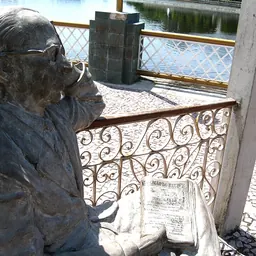
Escapism and political symbols The political themes explored by Tonegaru and his bohemian group were underlined by Italian academic Roberto Merlo, who placed their presence in wartime poems in connection with their radical call for aesthetic innovation: "[theirs was] the poetry of revolt, against both the horrors of war and earlier forms of poetry". This is foremost illustrated by concise metaphors such as Luna ca un ficat însângerat ("The Moon like a bloody liver") and obsesia mea din clasa a patra primară: rețeaua de sârmă ghimpată ("my obsession during the fourth grade primary cycle: the barbed wire network"), but also developed in more complex sequences: Verse translation| Critics have also drawn a direct comparison between them and Poland's "Generation of Columbuses". Political developments influenced differently the lives of all three generational heroes. This process was discussed by literary historian , who emphasized that, while Tonegaru's early choice for "freedom and democracy" made him a victim of "horrible sufferings", both Caraion and Dumitrescu adapted themselves to communism. Tonegaru is also seen as the mentor of Stelaru, Cioculescu, and Radu Teculescu. The Romanian poet's work has had its echoes outside Romania: Tonegaru is the subject of a concretist poem by Brazilian author Manuel Bandeira, titled Homanagem a Tonegaru ("Homage to Tonegaru").
After the Romanian Revolution overthrew communism, Tonegaru's work became the focus of more public attention, and several accounts of his biography were published, including ones by his friends Chihaia and Chimet. In 2003, Cioculescu edited another volume of his friend's selected works, titled after Plantația de cuie. While periodic exhumations in Sfânta Vineri have made tracking down Tonegaru's remains an impossible task, he is honored by the Museum of Romanian Literature with a bust in his likeness, and, on the occasion of his 90th birthday in 2009, was the subject of a special exhibit in his native Galați.
Don’t just read it —
keep it.
Full-length biographies made to live with: read them, listen on the way to work, watch them tonight.
- E-book
- Audio
- Video
Instant download · yours to keep · every purchase keeps this site free
Important facts
People in Constant Tonegaru's life
Named in this biography and alive at the same time




Related people
Same field, nearest in time


Contemporaries
People whose lives overlapped Constant Tonegaru's


Frequently asked questions
Who was Constant Tonegaru?
Romanian writer
When was Constant Tonegaru born?
Constant Tonegaru was born on 26 February 1919 in Galați.
When did Constant Tonegaru die?
Constant Tonegaru died on 10 February 1952 in Bucharest.
What was Constant Tonegaru's occupation?
Constant Tonegaru was a poet.
What nationality was Constant Tonegaru?
Constant Tonegaru was Romanian.
Sources & further reading
· Wikipedia: Constant Tonegaru
Cite this page
APA: Biography.guide. (2026). Constant Tonegaru. https://biography.guide/constant-tonegaru/
MLA: "Constant Tonegaru." Biography.guide, https://biography.guide/constant-tonegaru/.
Chicago: "Constant Tonegaru." Biography.guide. https://biography.guide/constant-tonegaru/.
Data last updated: 2026-09-20 · Spot an error? Report a correction.
Page generated 2026-09-27 05:21 UTC