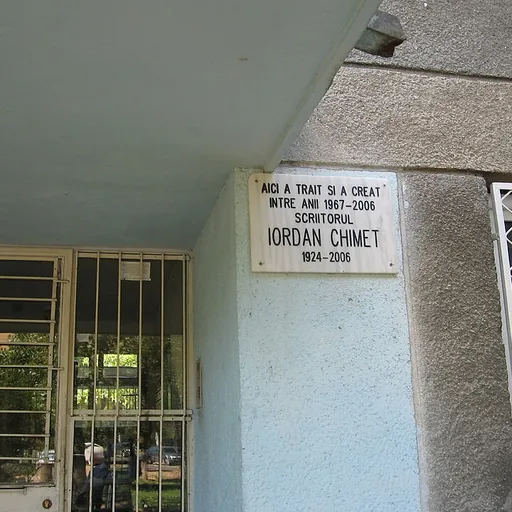
About Iordan Chimet
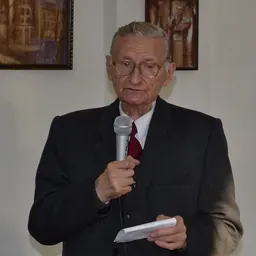
Lived 1924 – 2006 (aged 81). Iordan Chimet was a Romanian linguist, writer, literary historian, literary critic, biographer and children's writer.
Iordan Chimet (November 18, 1924 – May 23, 2006) was a Romanian poet, children's writer and essayist, whose work was inspired by Surrealism and Onirism. He is also known as a memoirist, theater, art and film critic, book publisher and translator. Chimet, who was an opponent of totalitarianism in general and of the Communist regime in particular, was persecuted by the latter as a dissident, and lived much of his life in obscurity. His experience as an employee of the cooperative society Centrocoop also made him one of the first professional copywriters in his country.
The poems, fantasy works and fairy tales he authored, although largely ignored locally upon being published, have since drawn acclaim for their accomplished style, and are considered by many unique in Romanian literature. They explored the themes of innocence and melancholy, and have themselves been seen as a venue for a discreet advocacy of disobedience. Chimet was also the author of critical essays on Latin American studies and Western or popular culture, and a publisher of anthologies on some of the major themes in Romanian society. In addition, he collected and published material on the life and legacy of playwright Mihail Sebastian, as well as on the history of the Romanian avant-garde.
Chimet had a lifelong friendship with Gheorghe Ursu, a dissident who was killed by the Securitate secret police in 1985, and with science fiction author Camil Baciu. He was also a friend of the German writer Michael Ende and the Greek poet Odysseas Elytis, with whom he kept in touch in spite of the difficulties posed by their living on different sides of the Iron Curtain.
Biography Born in Galați, Chimet belonged to a family of middle-class intellectuals. His first works of poetry were published by the magazine Vremea when he was still in high school. Politically active while still a teenager during World War II, he was part of an anti-fascist group in his native city. The cell, which opposed Ion Antonescu's rule and Romania's alliance to the Axis powers (see Romania during World War II), also included Ursu and Baciu. Other people involved in this project were the authors Pavel Chihaia, Vladimir Streinu, and Constant Tonegaru (aided by the French Catholic cleric Marie-Alype Barral). According to Chihaia: "We realized, from the very beginning, what the new ideology imposed on us, as an adversary to the traditional culture, to the freedom of thought, attempting to compromise the values in which we believed and which we professed, really meant." At the time, he met the art and literary critic Petru Comarnescu, who helped him publicize his works.
He was allowed to publish beginning in the late 1960s, with the liberalization coinciding with the early years of Nicolae Ceaușescu's leadership. At the time, Chimet also found employment as a lecturer at the "Friends of Film" club at the Cinemateca film archive, where he kept company with film critics such as Paul Barbăneagră, Tudor Caranfil, Eugen Schileru, and D. I. Suchianu. His works of criticism touched aspects of Western culture that he intended to popularize in Romania: two of them were dedicated, respectively, to the American-born Western genre (Western. Filmele Vestului îndepărtat—"Western. The Films of the Far West") and to the American cinema in general (Eroi, fantome, șoricei—"Heroes, Ghosts, Little Mice");
While his work was ignored at home, it brought Chimet a measure of success abroad. His essays on American culture were generally not distributed in Romania, but were translated in other Eastern bloc countries, where they became appreciated for their subversive undertones. In parallel, his works of children's literature were translated into several languages, and became known in America, as well as in Western and Central Europe, on both sides of the Iron Curtain. He was selected to be part of the jury for the University of Oklahoma's Neustadt International Prize for Literature (the only Romanian to enjoy this appointment), but the communist authorities' hostility prevented him from honoring the request. The same year, Chimet braved ongoing Securitate surveillance and attended Ursu's funeral. In 2004, he published a volume of essays, titled Cele două Europe, cele două Românii ("The Two Europes, The Two Romanias"). He attempted to replicate the experience of interwar authors, who, as he himself argued, practiced "art as an exercise in admiration, as a statement of love, as a manifestation of the artist's solidarity with beings forgotten by history."
Steinhardt argues that his fellow writer had helped the public make comparisons between the tenets of Surrealism and the natural tendencies in folk art: "The conclusion, I do believe, is unavoidable: surreality exists, only people call it reality. By vesting the most modest of realities with the prestige and the charm of fairy tales and poetry, Chimet invites (and compels) us to admit them as situated at an energetic and incantational level by no means inferior to the most delicate fantasies and the least bound reveries of Surrealism." He adds: "The world reveals itself [to Chimet] in its entirety, in its rich coloring, in the unending complexity of its textures, in the steady and calm rhythm of various activities and contemplations synchronized with the individual's psychosomatic foundations. Nature […], the inanimate world […], even costumes or musical instruments […] evoke in him human activities, while the energies of matter are interpreted in a human sense and joined up with aspirations and sorrows found the human soul." The critic also proposed that such images in Vechiul drum were superior to a separate chapter on film history "from Fantômas to Fellini and Hatari": "No matter how much Iordan Chimet is enchanted by the screen, no matter how contagious his cinemaphile passion may be, it is not in this area that he is truly at ease and worthy of being called a discoverer and unveiler of poetry. He earns these qualifiers mostly when he takes hold […] of a traveler's cane, setting off to the country's villages, workshops, establishments and hidden corners in order to set before our eyes […] the treasures of a reality on whose shoulders time sets itself with old age [Steinhardt's italics], but who has lost neither courage, nor warm wisdom or a charm renewed with each fresh gaze."
Political views As a political essayist, in addition to his critique of totalitarian systems both left- and right-wing, Chimet was noted for his rejection of all forms of racism, and for being an outspoken critic of antisemitism. According to essayist Michaël Finkenthal, Chimet "spent the last years of his life in a ceaseless battle to retrieve a past that some have forgotten and others have preferred, for various reasons, to neglect." Finkenthal also defined Chimet's message as: "before incriminating, before accusing, research the facts carefully. When man is in chains, when speaking is replaced by yelling, [man] is weak and can be easily tempted by the devil."
Published volumes
Children's literature Lamento pentru peștișorul Baltazar, 1968 Cîte-o gîză, cîte-o floare, cîte-un fluture mai mare, 1970 Închide ochii și vei vedea Orașul, 1970, definitive edition, 1979
Essays Western. Filmele Vestului îndepărtat, 1966 Comedia burlescă, 1967 Teatrul de păpuși în România (with Letiția Gîtză, Valentin Silvestru), 1968 Eroi, fantome, șoricei, 1970 Baladă pentru vechiul drum, 1976 America latină. Sugestii pentru o galerie sentimentală, 1984 A Trilingual Exercise in Translation (originally in English; with Ioana Belcea), 1995 Cele două Europe, cele două Românii, 2004
Other ExiL, poetry, 1948 Cele 12 luni ale visului. O antologie a inocenței, anthology, 1972 Grafica americană: un portret al Americii, album, 1976 Dreptul la memorie, anthology, 1992 Cică niște cronicari, duceau lipsă de șalvari, anthology, 1999 Împreună cu Elli în Imaginaria (with Michael Ende), memoir, 1999 Dosar Mihail Sebastian, biography, 2001 Scrisori printre gratii (with Odysseas Elytis, Michael Ende, Maria Marian), memoir, 2004 Cartea prietenilor mei (with Vasile Igna), memoir, 2005
Don’t just read it —
keep it.
Full-length biographies made to live with: read them, listen on the way to work, watch them tonight.
- E-book
- Audio
- Video
Instant download · yours to keep · every purchase keeps this site free
Important facts
People in Iordan Chimet's life
Named in this biography and alive at the same time

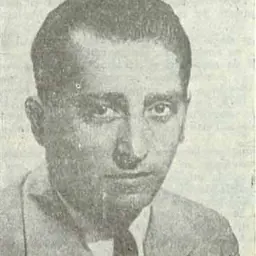

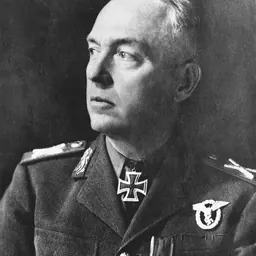




Related people
Same field, nearest in time
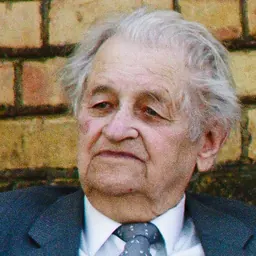




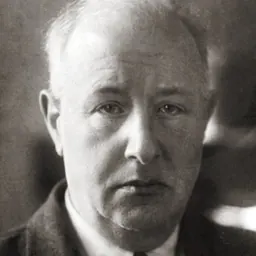
Contemporaries
People whose lives overlapped Iordan Chimet's

Frequently asked questions
Who was Iordan Chimet?
Romanian writer; poet (1924-2006)
When was Iordan Chimet born?
Iordan Chimet was born on 18 November 1924 in Galați.
When did Iordan Chimet die?
Iordan Chimet died on 23 May 2006 in Bucharest.
What was Iordan Chimet's occupation?
Iordan Chimet was a linguist, writer, literary historian, literary critic, biographer and children's writer.
What nationality was Iordan Chimet?
Iordan Chimet was Romanian.
Sources & further reading
Cite this page
APA: Biography.guide. (2026). Iordan Chimet. https://biography.guide/iordan-chimet/
MLA: "Iordan Chimet." Biography.guide, https://biography.guide/iordan-chimet/.
Chicago: "Iordan Chimet." Biography.guide. https://biography.guide/iordan-chimet/.
Data last updated: 2026-09-23 · Spot an error? Report a correction.
Portrait: Wikimedia Commons · author & licence
Page generated 2026-09-27 05:06 UTC