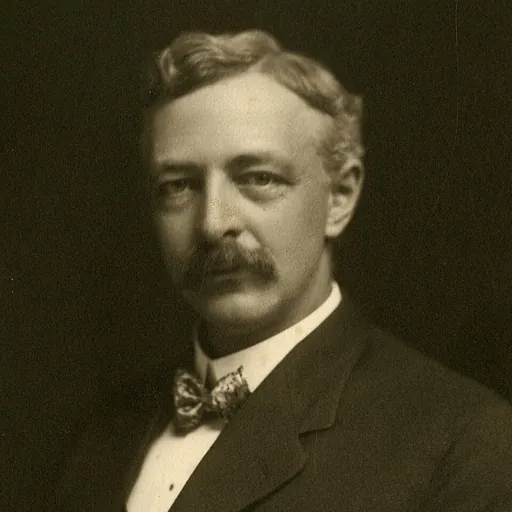
About Clifton Fremont Hodge
Lived 1859 – 1949 (aged 89–90). Clifton Fremont Hodge was a naturalist.
Clifton Fremont Hodge (16 October 1859 – 1949) was an American professor of physiology who worked at Clark University. An educator and a keen experimental biologist, he took great interest in natural history, animal behavior, and public understanding of biology, taking an active role in public debates on vivisection, experimentation on animals, conservation, and evolution. He opposed a bounty offered for specimens of the last few passenger pigeons which was eventually withdrawn. His textbook Civic Biology was the last biology text dealing with evolution before the anti-evolution movement began in 1920.
Biography Hodge was born in Janesville, Wisconsin on 16 October 1859 to Mary (Merrill) and Nelson Wellington. He graduated with a BA from Ripon College in 1882, and worked as a civil engineer in Montana and Wyoming before joining Johns Hopkins University in 1886. Receiving a Ph.D. in 1889 he also worked in the university museum as a curator and was a fellow in biology. He worked as a naturalist on the USFC Fish Hawk and then joined Clark University where he worked on neurobiology while also promoting biological education at all levels including sex education in high schools. He demonstrated fatigue in nerve cells by continuous stimulation of sympathetic and spinal ganglia of frogs. He conducted experiments on the effect of alcohol to rats, cats and dogs as part of the Committee of Fifty and its subcommittee on physiology under H. P. Bowditch of Harvard, J. S. Billings, R. H. Chittenden and W. H. Welch. His students worked on a variety of topics including a study of crayfish by Floyd Chidester and fungi by W. A. Matheny. He then moved to the University of Wisconsin. From 1913 he served as professor of biology at the University of Oregon. He studied problems related to nuisance insects and worked on efficient traps.
Hodge was an advocate of animal experiments and opposed the arguments of anti-vivisectionists. In 1896, he commented that "after conscientiously reading their literature for the past five years I feel warranted in saying that science has little to fear from the efforts of the antivivisection societies." His textbook Civic Biology (1919) coauthored with Jean Dawson (who was later his wife) was among the last pro-evolution texts to be published prior to the 1920s anti-Darwinian movement.
He became a professor of extension at the University of Florida around 1919, taking an interest in applied biology, including local problems relating to flies and mosquitoes.
Hodge was a keen naturalist, outdoors educator, and a member of the American Ornithologists' Union (AOU). At the 1909 meeting of the AOU he raised issue with the $100 reward being offered by Colonel Anthony Kuser for fresh specimens of the passenger pigeon and stated that he would not shoot a pigeon for even $1000. Kuser subsequently changed the reward to $300 for evidence of breeding. Hodge was also interested in animal as well as human behavior and introduced the idea of the ball and field test which was developed by his student Lewis M. Terman more formally and used in psychology studies.
Personal life
He married Thekla Johanna Eversz (1858–1930), of Wesel, Germany in 1888 and they had two children. He married Jean Dawson (1872-24 April 1928 ) in 1915 and settled in Sebring, Florida where he died.
Selected publications
The Bobwhite (1890) A Microscopical Study of Changes Due to Functional Activity in Nerve Cells (1892) The Vivisection Question (1896) Experiments on the Physiology of Alcohol Made Under the Auspices of the Committee of Fifty (1897) Nature Study. Our Common Birds. (1899) Nature Study and Life (1902) Civic Biology (1918)
Don’t just read it —
keep it.
Full-length biographies made to live with: read them, listen on the way to work, watch them tonight.
- E-book
- Audio
- Video
Instant download · yours to keep · every purchase keeps this site free
Important facts
People in Clifton Fremont Hodge's life
Named in this biography and alive at the same time

Related people
Same field, nearest in time



Contemporaries
People whose lives overlapped Clifton Fremont Hodge's

Frequently asked questions
Who was Clifton Fremont Hodge?
American naturalist (1859–1949)
When was Clifton Fremont Hodge born?
Clifton Fremont Hodge was born in 1859.
When did Clifton Fremont Hodge die?
Clifton Fremont Hodge died in 1949.
What was Clifton Fremont Hodge's occupation?
Clifton Fremont Hodge was a naturalist.
Sources & further reading
· Wikipedia: Clifton Fremont Hodge
Cite this page
APA: Biography.guide. (2026). Clifton Fremont Hodge. https://biography.guide/clifton-fremont-hodge/
MLA: "Clifton Fremont Hodge." Biography.guide, https://biography.guide/clifton-fremont-hodge/.
Chicago: "Clifton Fremont Hodge." Biography.guide. https://biography.guide/clifton-fremont-hodge/.
Data last updated: 2026-09-22 · Spot an error? Report a correction.
Portrait: Wikimedia Commons · author & licence
Page generated 2026-09-27 05:03 UTC