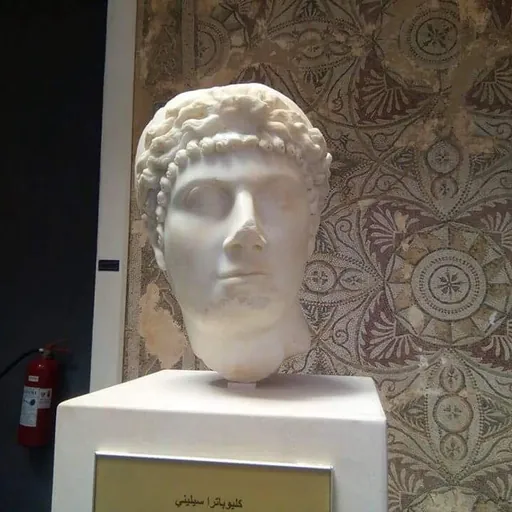
About Cleopatra Selene II
Lived 40 BC – 5 BC (aged 34–35). Cleopatra Selene II was a monarch.
Early life Childhood
Cleopatra Selene was born approximately 40 BC in Egypt, as Queen Cleopatra VII's only daughter. Her second name ("moon" in Ancient Greek) is the counterpart to the second name of her fraternal twin brother, Alexander Helios ("sun" in Ancient Greek). She was raised and highly educated in Alexandria in a manner appropriate for a Ptolemaic princess. The twins were formally acknowledged by their father, Triumvir Mark Antony, during a political meeting with their mother in 37 BC. Their younger brother, Ptolemy Antony Philadelphos, was born approximately a year later. Their mother most likely planned for Selene to marry the latter's older half-brother Caesarion, son of Cleopatra by Julius Caesar, after whom he was named.
Over the next two years, Antony bestowed a great deal of land on Cleopatra and their children under his triumviral authority. In 34 BC, during the Donations of Alexandria, huge crowds assembled to witness the couple sit on golden thrones on a silver platform with Caesarion, Cleopatra Selene, Alexander Helios, and Ptolemy Philadelphus sitting on smaller ones below them. Antony declared Cleopatra to be Queen of Kings, Caesarion to be the true son of Julius Caesar and King of Egypt, and proceeded to bestow kingdoms of their own upon Selene and her brothers. She was made ruler of Cyrenaica and Libya. Neither of the children were old enough to assume control of their lands, but it was clear that their parents intended they should do so in the future. This event, along with Antony's marriage to Cleopatra and divorce of Octavia Minor, older sister of Octavian (future Roman Emperor Caesar Augustus), marked a turning point that led to the Final War of the Roman Republic.
In 31 BC. during a naval battle at Actium, Antony and Cleopatra were defeated by Octavian. By the time Octavian arrived in Egypt in the summer of 30 BC, the couple had sent the children away. Caesarion went to India, but en route he was betrayed by his tutor, intercepted by Roman forces and executed. Cleopatra Selene, Alexander Helios, and Ptolemy Philadelphos were sent south to Thebes, but were apprehended by Roman soldiers en route and brought back to Alexandria. Meanwhile, their parents committed suicide as Octavian and his army invaded Egypt. The deaths of their mother Cleopatra VII and older half-brother Caesarion left Selene and Alexander as the nominal heirs to the throne of Egypt until the kingdom was officially annexed by the Roman Empire two weeks later, bringing the Ptolemaic Dynasty and the entirety of pharaonic Egypt to an end.
Life in Rome When Octavian returned to Rome he brought the captured Cleopatra Selene and her surviving brothers with him as captives. During his triumph celebrating his conquest of Egypt, he paraded the twins dressed as the moon and the sun in heavy golden chains, behind an effigy of their mother clutching an asp to her arm. The chains were so heavy that the children were unable to walk in them, eliciting unexpected sympathy from many of the Roman onlookers.
Once Egypt had ceased to exist as an independent kingdom, there remained the question of what to do with Selene and her brothers. In the absence of any surviving relative, responsibility for the children passed to Augustus, who in turn gave the siblings to Octavia to be raised in her household on the Palatine Hill. They were members of an extended family that included their half-brother Iullus Antonius (their father's son with his late wife Fulvia), their half-sisters, both called Antonia (daughters of their father with Octavia), and Octavia's older children from a previous marriage, Marcus Claudius Marcellus and his two sisters Claudia Marcella Major and Claudia Marcella Minor. Cleopatra Selene is the only known surviving member of the Ptolemaic dynasty. Her brothers are not recorded in any further historical accounts and are presumed to have died, possibly from either illness or assassination.
Marriage and issue
Octavia arranged for Cleopatra Selene to marry the intellectual King Juba II, whose father had committed suicide in 46 BC. He was sent to be raised in Caesar's household however upon Caesar's death in 44 BC custody passed to Octavian, the future Augustus. The marriage likely took place in 25 BC, when Cleopatra Selene was of proper age and Juba II was sent to rule Mauretania, and was commemorated in an epigram that survives in its entirety:
This poem suggests that Cleopatra and Juba were regarded as joint rulers of Mauretania. Ptolemy of Mauretania born in 10 BC. He was named after his mother's dynasty and her younger brother. In naming her son, Cleopatra created a distinct Greek-Egyptian tone and emphasized her role as heiress of the Ptolemies in exile. A daughter of Juba, whose name has not survived, is mentioned in an inscription. She is presumed to be a child of Selene, as Juba's second marriage was short-lived and apparently childless. She was suggested to be Drusilla, the first wife of Antonius Felix, who was recorded to be "granddaughter of Cleopatra", which would make her a daughter of Selene. However it is more likely that they were separate individuals and Drusilla was rather a great-granddaughter of Cleopatra through Ptolemy instead.
A hoard of Selene's coins has been dated at 17 AD. It is traditionally believed that she was alive to mint them, but this would mean that her husband married Princess Glaphyra of Cappadocia during Selene's lifetime. Historians generally assume that Juba wouldn't have taken a second wife as a thoroughly Romanized king, arguing that if he married Glaphyra before 4 AD, then his first wife must have already been dead.
Queen of Mauretania
In 25 BC, Augustus decided to make Juba II and Selene co-rulers Through the couple's influence, the Mauretanian kingdom flourished.
She brought the cult of Isis to Caesarea. She also had many sculptures and artifacts imported from Egypt to Numidia.
One of the statues was that of the last High priest of Ptah to serve under Ptolemies, Imhotep-Pedubast. This likely reflects a personal connection rather than an interest in Egyptian artifacts. Duane W Roller suggests he may have been a favorite of the 10-year old princess when she was in Egypt.
Death The Royal Mausoleum of Mauretania, a tomb of Cleopatra Selene II and Juba II in Tipaza, Algeria. The couple ruled Mauretania for almost two decades until Cleopatra's death at the age of 35. Controversy surrounds her exact date of death. The following epigram by Greek epigrammatist Crinagoras of Mytilene is considered to be her eulogy:
If this poem isn't simply literary license, Selene's death seems to have coincided with a lunar eclipse. If so, astronomical correlation then can be used to help pinpoint the date of her death: Lunar eclipses occurred in 9, 8, 5 and 1 BC and in AD 3, 7, 10, 11 and 14. The event in 5 BC most closely resembles the description given in the eulogy. However, the date of her death is not ascertainable with any certainty. Zahi Hawass, former Director of Egyptian Antiquities, believes Cleopatra died in 8 AD.
Selene was placed in the Royal Mausoleum of Mauretania in modern Algeria, built by her and Juba east of Caesarea and still visible. Juba died in 23 AD and was buried in the same tomb. There is a fragmentary inscription dedicated to the couple as the "King and Queen of Mauretania". Their remains have not been found at the site, perhaps due to tomb raids, possibly shortly after the mausoleum's construction; or because the structure was meant to serve as a memorial and not as a place of burial.
Legacy
An ancient Roman bust of Cleopatra Selene's only son, Ptolemy of Mauretania, in the Archaeological Museum of Cherchell, Algeria.
Cleopatra was survived by her husband and their son Ptolemy, who ruled Mauretania together until Juba's death in AD 23. Ptolemy then reigned until 40, when he was executed by Emperor Caligula, his mother's great nephew, who was probably jealous of Mauretania's wealth. Caligula's successor, Emperor Claudius, took advantage of Ptolemy's lack of heirs and assumed control of Mauretania, turning it into the Roman provinces of Mauretania Caesariensis and Mauretania Tingitana. Thereafter, Cleopatra, Juba and Ptolemy were mostly forgotten. Cleopatra Selene is a major character in "The Daughters of Pallatine Hill", by Phyllis T. Smith (2016) Though identified simply as the daughter of the most famous Cleopatra, a character calling herself Patra appears in the third Night Huntress book as a vampire living in modern times, and is the novel's antagonist. Cleopatra Selene is the subject of the episode "Cleopatra's Daughter" in the docudrama television series Queens of Ancient Egypt which aired in 2023 on Sky History in the U.K. and Curiosity Stream in the U.S. She is portrayed as a child and adult by Fatima Ezzahra Fatih and Daiana Madeira, respectively.
Don’t just read it —
keep it.
Full-length biographies made to live with: read them, listen on the way to work, watch them tonight.
- E-book
- Audio
- Video
Instant download · yours to keep · every purchase keeps this site free
Important facts
Family & relationships
People in Cleopatra Selene II's life
Named in this biography and alive at the same time

Related people
Same field, nearest in time




Contemporaries
People whose lives overlapped Cleopatra Selene II's

Frequently asked questions
Who was Cleopatra Selene II?
queen consort of Mauretania from 25 to 5 BC
When was Cleopatra Selene II born?
Cleopatra Selene II was born in 40 BC in Alexandria.
When did Cleopatra Selene II die?
Cleopatra Selene II died in 5 BC in Cherchell.
What was Cleopatra Selene II's occupation?
Cleopatra Selene II was a monarch.
Sources & further reading
· Wikipedia: Cleopatra Selene II
· DBpedia: Cleopatra Selene II
Cite this page
APA: Biography.guide. (2026). Cleopatra Selene II. https://biography.guide/cleopatra-selene-ii/
MLA: "Cleopatra Selene II." Biography.guide, https://biography.guide/cleopatra-selene-ii/.
Chicago: "Cleopatra Selene II." Biography.guide. https://biography.guide/cleopatra-selene-ii/.
Data last updated: 2026-09-22 · Spot an error? Report a correction.
Portrait: Wikimedia Commons · author & licence
Page generated 2026-09-27 05:02 UTC