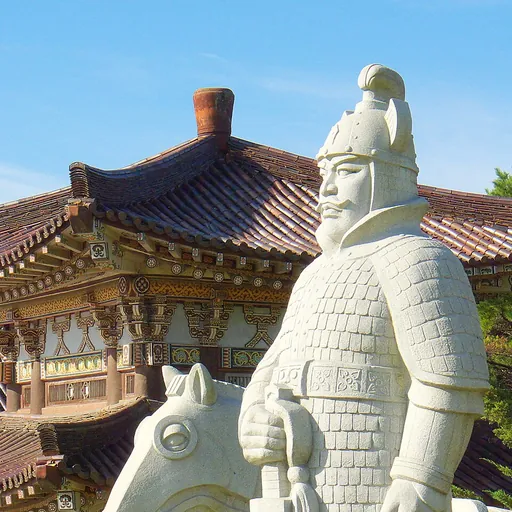
About King Dongmyeong of Goguryeo
Lived 58 BC – 19 BC (aged 38–39). King Dongmyeong of Goguryeo was a monarch.
Dongmyeong of Goguryeo , personal name Ko Chumong , was the founding monarch of the kingdom of Goguryeo, and was worshipped as a god-king by the people of Goguryeo and Goryeo. King Dongmyeong was also an important figure for the kingdom of Baekje, as the father of its founding monarch, King Onjo.
Names Chumong, originally Buyeo slang for an excellent archer, was his personal name. He was commonly recorded as Chumong by various Chinese sources, including history books written by Northern Qi and Tang. This name became dominant in future writings including the Samguk sagi and the Samguk yusa. At some point in time prior to the compilation of the Samguk sagi (1145), he was given the posthumous name of Dongmyeong , literally translating to the Brilliant Saintly King of the East.
In the earliest Goguryeo sources, such as the Gwanggaeto Stele and Tomb Epitaph of Moduru, refer to Dongmyeong by his personal name, Ch'umo . Moduru's epitaph refers to Dongmyeong as King Ch'umo the Divine .
His other names include Ch'umong , Chungmo , Nakamu, or Tomo. In the Samguk sagi, he was recorded as Chumong with the surname Ko, and was also known as Chunghae or Sanghae .
Life and myth The records of Dongmyeong are often regarded as semi-legendary, and the extent to which the records are historical or mythological is debated. Much of the legend of King Dongmyeong of Goguryeo is appropriated from an earlier legend about the founding monarch of Buyeo, the similarly named . The origin myth of Buyeo's founding king was appropriated by Goguryeo monarchy in the 4th century AD to boost their own pedigree.
The founding myths of Goguryeo are told in ancient writings, including the Gwanggaeto Stele. The best-known versions of Chumo's life are found, with slight variations, in the Samguk sagi, Samguk yusa, and the "Dongmyeongwang" chapter of the Dongguk Yi Sangguk jip.
Birth Hae Buru, the king of Buyeo, performed religious ceremonies in hope of having a son, as he was getting old without an heir. When he arrived at Gonyeon (or Gon Pond; ), he noticed his horse was shedding tears in front of a large rock. The king issued an ordered to remove the rock, and there he found a young boy who looked like a golden frog. The king treated the boy as a gift from heaven and named him Geumwa.notetag|Korean translation of golden frog is geumwa . A frog is also used to metaphorically describe Buyeo and Goguryeo and is related to water. It can be phonetically translated as goma or gom (bear).
Rule In 37 BC, in the first year of his reign, Dongmyeong launched a preemptive strike on the Mohe near the border, fearing raids from them. The Mohe surrendered after the fight. In October of 32 BC, Dongmyeong sent Oi and Bu to Bunno , and conquered Haenginguk (or State of Haengin; ), which is located southeast of Taebaek Mountain. In November of 18 BC, the king ordered Bu Wiyeom to attack the Northern Okjeo , and Bu Wiyeom successfully made the Northern Okjeo submit to Goguryeo.
In August of 24 BC, Yuhwa died in Eastern Buyeo. A funeral was held, and a shrine was built to her as the dowager of Geumwa. In October, Dongmyeong sent an envoy along with regional products to Buyeo as a token of gratitude for the virtue and generosity shown by Geumwa.
In April of 19 BC, Dongmyeong's son, Yuri, and his mother fled from Buyeo, arriving at Goguryeo. Dongmyeong appointed Yuri as the crown prince of Goguryeo. In September, Dongmyeong, at the age of 39, mounted a dragon and ascended into Heaven and did not come back, according to the Gwanggaeto Stele. With only his whip left behind, it was buried at Yongsan (or Yong Mountain; ) in the place of his body. In the 15th century Joseon dynasty text, Tongguk yŏji sŭngnam, the author would change Dongmyeong's mount from a dragon to an "unicorn horse". In the Samguk sagi, the Confucian Kim Pusik understood the legend of Dongmyeong's ascension to heaven as metaphorical not literal. He wrote that Dongmyeong died and was buried at Yongsan and was posthumously given the title Dongmyeong.
Comparison and controversies + Comparison between other myths and records
A maid (or concubine) claimed to be impregnated by a holy spirit. She gave birth to an egg. A king attempted to kill the boy, but was protected by animals. The king became jealous of Dongmyeong's archery skill, so he attempted to kill Dongmyeong. Dongmyeong ran southward, arriving at Yieomsu (or Yieom River; ). He shot an arrow into the river with a bow, then the fish and softshell turtles created a bridge for him to cross. His pursuers were forced to return. A maid (or concubine) claimed to be impregnated by a holy spirit. She gave birth to an egg. A king attempted to kill the boy, but was protected by animals. The king became jealous of Dongmyeong's archery skill, so attempted to kill him. Dongmyeong ran southward, arrived at Eomchesu (or Eomche River) . He shot an arrow into the river with a bow, then fish and softshell turtles created a bridge for him to cross. Chumo was son of Heaven and Lady Habaek (daughter of river god). He was born from an egg. He was ordered to go (presumably by his mother) and arrived at Eomridaesu (or the Great Eomri River) of Buyeo. He issued a command to the river, then reeds and turtles made a bridge for him. He arrived at Holbon in Biryugok (or Biryu Valley), and built the capital on the mountain. The daughter of Habaek was impregnated by sunlight. She gave birth to an egg. The king attempted to crack the egg, but it was protected by animals. A boy was born from the egg. The people of Buyeo became jealous of Jumong's archery skill, and his mother insisted that he run away. Jumong ran southeastward with two companions, and arrived at the river. He issued a command to the river, then fish and softshell turtles created a bridge for him to cross. His pursuers were forced to return. Jumong arrived to Bosulsu (or Bosul river; ) and found three people each wearing a different outfit. Jumong and his followers established Goguryeo at Heulseunggolseong (or Heulseunggol Castle; ), and he changed surname to Go. Dongmyeong, compelled by Spirit, crossed Sacheon (or Sa Stream; ), and established the nation. Jumong, embracing the Sun, arrived at Paesu (or Pae River) , and built the capital. Sobyeoldori saw a horse sitting and crying between some trees. When he approached, the horse disappeared but left behind an egg. He cracked the egg, and found Hyeokgeose. Hae Buru went to the pond, then his horse shed tears in front of the rock. He removed the rock and found Geumwa. Silla recognized the history of Goguryeo as 800 years old in 670 AD. (indicating a founding date around 130 BC) Tang recognized the history of Goguryeo as 900 years old in 668 AD. (indicating a founding date around 232 BC)
According to Gwanggaeto Stele, Gwanggaeto the Great was the 17th generation (世孫) after Dongmyeong, while Samguk sagi recorded him as the 13th generation after Dongmyeong. The animation contains the contents of Jumong, when he brings small countries of the same family together and builds up Goguryeo into a powerful nation. It deals with the history from the time when the parents Hae Mo-su and Yuhwa established their family until the birth of Jumong. In the first ten parts, Jumong tells the story of Buyeo, where he was born, and escaped. The first episode was broadcast on January 1, 2017, and so far 24 episodes have been broadcast. South Korean netizens were surprised at the quality development of the North Korean animation.
Actors who have played King Dongmyeong Portrayed by Song Il-kook in the 2006–2007 MBC TV series Jumong. Portrayed by Lee Deok-hwa in the 2010–2011 KBS1 TV series The King of Legend. Portrayed by Jo Jang-ho in the 2017 KBS TV series Chronicles of Korea.
Don’t just read it —
keep it.
Full-length biographies made to live with: read them, listen on the way to work, watch them tonight.
- E-book
- Audio
- Video
Instant download · yours to keep · every purchase keeps this site free
Important facts
Related people
Same field, nearest in time
Contemporaries
People whose lives overlapped King Dongmyeong of Goguryeo's


Frequently asked questions
Who was King Dongmyeong of Goguryeo?
Founder of the Goguryeo Empire (37–19 BC)
When was King Dongmyeong of Goguryeo born?
King Dongmyeong of Goguryeo was born in 58 BC in Buyeo.
When did King Dongmyeong of Goguryeo die?
King Dongmyeong of Goguryeo died in 19 BC.
What was King Dongmyeong of Goguryeo's occupation?
King Dongmyeong of Goguryeo was a monarch.
What nationality was King Dongmyeong of Goguryeo?
King Dongmyeong of Goguryeo's recorded nationality: Goguryeo.
Sources & further reading
· Wikipedia: King Dongmyeong of Goguryeo
· DBpedia: Dongmyeong of Goguryeo
Cite this page
APA: Biography.guide. (2026). King Dongmyeong of Goguryeo. https://biography.guide/king-dongmyeong-of-goguryeo/
MLA: "King Dongmyeong of Goguryeo." Biography.guide, https://biography.guide/king-dongmyeong-of-goguryeo/.
Chicago: "King Dongmyeong of Goguryeo." Biography.guide. https://biography.guide/king-dongmyeong-of-goguryeo/.
Data last updated: 2026-09-28 · Spot an error? Report a correction.
Portrait: Wikimedia Commons · author & licence
Page generated 2026-10-05 04:08 UTC