
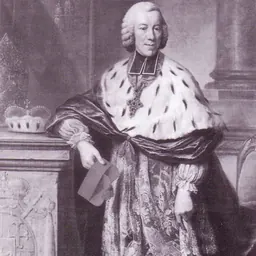
Clemens von Westphalen
German chamberlain
About Clemens von Westphalen
Lived 1753 – 1818 (aged 65). Clemens von Westphalen was a German german Minister of State and envoy extraordinary and minister plenipotentiary.
Clemens August, Freiherr von Westphalen zu Fürstenberg (Reichsgraf from 1792; 12 January 1753 – 26 December 1818) was a German aristocrat who held numerous offices in various North-West German Bishoprics and served as Minister of State of the Electorate of Mainz and Imperial Envoy.
Early life Westphalen was born on 12 January 1753 in Paderborn into the von Westphalen zu Fürstenberg family, a Westphalian noble family. From that marriage, he had a half-sister, Maria Anna von Westphalen zu Fürstenberg (wife of Baron Clemens August Bruno von Mengersen, Privy Councillor and Lord Marshal of the Princes of Hildesheim and Paderborn).
Career In the Bishoprics of Hildesheim, Paderborn and Osnabrück, he held the Hereditary honorary offices of Hereditary Butler (Cupbearer) and Hereditary Master of the Hunt. He was a Wirklicher Geheimer Rat (equivalent to Active Privy Councillor in the Russian Empire) and Master of the Horse in Hildesheim and Paderborn. He was also a representative of the state parliament of the Bishopric of Paderborn. In this territory, he was the Landdrost and Drost of the Liebenburg and Hunnesrück offices. He was also the Minister of State of the Electorate of Mainz and, as such, the second Ambassador in the 1790 imperial election following the death of Emperor Joseph II. He was also responsible for General Imperial, District, Judicial and Police Affairs.
Clemens August was also Imperial and Royal Chamberlain and Privy Councillor. For many years he was Imperial Envoy with the rank of Minister Plenipotentiary at the Courts of the Electors of Cologne and Trier as well as at the Lower Rhenish–Westphalian Circle. At the beginning of the Coalition Wars, he tried in vain to urge the Imperial Circle to actively prepare for war. In 1792, Emperor Leopold II elevated him to the rank of Imperial Count for his services. In 1801, he brought the Aachen Imperial Regalia, Coronation Gospels, St. Stephen's Purse and Charlemagne's Sabre from Aachen to Vienna.
Property and estates
Westphalen took over the family estates in 1778 and was able to increase the family's wealth considerably, as he was the sole heir of the Prince-Bishops Wilhelm Anton von der Asseburg, his great-uncle on his mother's side, and Friedrich Wilhelm von Westphalen, his uncle on his father's side. The latter left behind a fortune of 900,000 thalers. He expanded the property by purchasing land including the Rixdorf estate near Eutin.
From 1779, he was Burgmann at the Imperial Castle in Friedberg. From 1783 Regimental Burgmann and, from 1805, the last Burgrave of the Burgraviate of Friedberg and Grand Prior of the Order of St. Joseph. In 1801, he acquired the Reinhartshausen Castle and winery in Erbach and parts of Mariannenaue, the largest Rhine island on the Middle Rhine between Erbach and Hattenheim. The estate had been owned by the Rhenish noble family Langwerth von Simmern (who had acquired it from the Knights of Allendorf of 1797). Westphalen had the Knight's seat demolished and built the Castle, which survives today. From 1801 he had the castle built in its current form. who married his brother's widow, Countess Elisabeth von Thun und Hohenstein.
Count von Westphalen died on 26 December 1818 in Frankfurt am Main.
Don’t just read it —
keep it.
Full-length biographies made to live with: read them, listen on the way to work, watch them tonight.
- E-book
- Audio
- Video
Instant download · yours to keep · every purchase keeps this site free
Important facts
People in Clemens von Westphalen's life
Named in this biography and alive at the same time
Contemporaries
People whose lives overlapped Clemens von Westphalen's






Frequently asked questions
Who was Clemens von Westphalen?
German chamberlain (1753-1818)
When was Clemens von Westphalen born?
Clemens von Westphalen was born on 12 January 1753 in Paderborn.
When did Clemens von Westphalen die?
Clemens von Westphalen died on 26 December 1818 in Frankfurt.
What was Clemens von Westphalen's occupation?
Clemens von Westphalen was a german Minister of State and envoy extraordinary and minister plenipotentiary.
What nationality was Clemens von Westphalen?
Clemens von Westphalen was German.
Sources & further reading
· Wikipedia: Clemens von Westphalen
· DBpedia: Clemens August von Westphalen
Cite this page
APA: Biography.guide. (2026). Clemens von Westphalen. https://biography.guide/clemens-von-westphalen/
MLA: "Clemens von Westphalen." Biography.guide, https://biography.guide/clemens-von-westphalen/.
Chicago: "Clemens von Westphalen." Biography.guide. https://biography.guide/clemens-von-westphalen/.
Data last updated: 2026-09-20 · Spot an error? Report a correction.
Page generated 2026-09-27 05:21 UTC