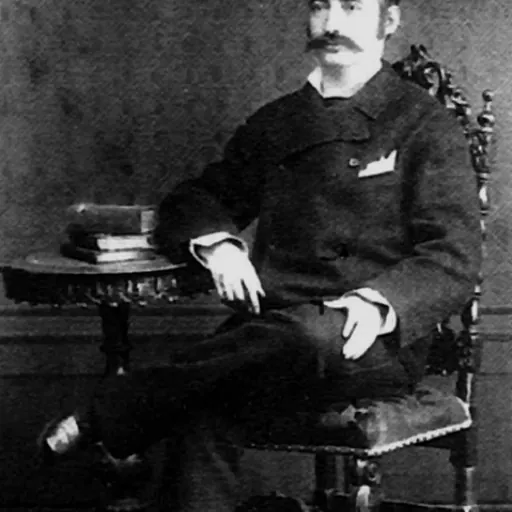
About Claymoor
Lived 1842 – 1903 (aged 60–61). Claymoor was a Romanian film critic and journalist.
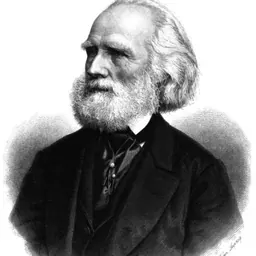
Mișu or Mihail Ion Văcărescu (Francized Michel Vacaresco; 1842 or 1843 – June 12, 1903), most commonly known as Claymoor, was a Wallachian, later Romanian fashion journalist and gossip columnist, the son of poet Iancu Văcărescu. A retired cavalry officer in the Romanian Land Forces, he began writing in his late twenties or early thirties, reaching his fame as a contributor to the Francophone daily L'Indépendance Roumaine. He was widely respected for his verdicts on fashion, and, as an arbiter of taste, contributed to his paper's renown; however, people of his day also ridiculed him for his florid literary style, his political involvement with the Conservative Party, and his homosexuality.
Claymoor's period of prominence, at the height of the Belle Époque, ended with his sudden death. By that time, he had also left a mark as one of Romania's first film critics. Although his almanac was still published, he himself was largely forgotten in the Kingdom of Romania by the end of World War I. Traces of his memory are preserved in disguised portrayals and parodies by writers such as Ion Luca Caragiale and Petru Dumitriu.
Biography
Early life and debut Văcărescu's exact birth date remains unknown. However, he died at the age of 60 or 61, meaning that he was born in 1842 or 1843. It also certain that he was of aristocratic upbringing, from the Văcărescu family, and directly related to other prominent families of Wallachian boyars; unlike them, he had inherited little wealth. He was the son of the more famous Wallachian poet Iancu (Ioan) Văcărescu, and as such grandson of Alecu and grandnephew of Ienăchiță Văcărescu. His great-grandfather Ianache Văcărescu had served Prince Constantin Brâncoveanu during the Pruth River Campaign, and had been executed alongside him. Other ancestors of the journalist had been in constant conflict with the Phanariote princes who succeeded Brâncoveanu: Ienăchiță and his brothers were most likely poisoned, while Alecu was imprisoned under false charges. Iancu was also a dissident during the Regulamentul Organic regime. Arrested for various intervals, he had his land confiscated by Prince Alexandru II Ghica. After Ghica's downfall, he ran in the first princely election, winning just 21 votes from 179. His aunt, Marițica Văcărescu-Ghica, went on to marry the winner of that race, Gheorghe Bibescu, after a years-long scandal. She was also a poet, although her work remained unpublished.
Mihail's mother Ecaterina (1819–1891), also a boyaress, descended from the Cantacuzino family through a Moldavian offshoot, and claimed ownership of an estate in Pașcani. Despite her generous dowry, the family faced bankruptcy and, during Mihail's infancy, had to go into real estate as landlords. She had eight other children with Iancu, six of whom survived into adulthood: Eufrosina m. Greceanu (1837–1870), a homemaker and courtesan; Ioan (1839–1914), a career soldier and father of writer Elena Văcărescu; Maria m. Fălcoianu (1841–1912); Ecaterina m. Lahovary (1846–1917); Alexandrina m. Darvary (1851–1899); Constantin (1850–1899). Claymoor's cousins also included Theodor C. Văcărescu, the diplomat and historian. The clan had acquired a bad reputation in social circles. Novelist and diplomat Duiliu Zamfirescu notes that, by 1890, the Văcărescus were "not an attractive spectacle", especially with their "collateral female relatives." As reported by the boyar memoirist Constantin Argetoianu, all surviving Văcărescus formed a vicleim (masquerade): Alexandrina was "the only bright one" among Iancu's children, but, like them, was cradled into "vice and filth". Argetoianu thus notes that her Darvary home doubled as a gambling den, where cheating aristocrats and their accusers would engage in fistfights.
A graduate of Lycée Henri-IV in Paris, Mihail Văcărescu always endured as a "great friend of France", according to his colleagues at Le Figaro. His first calling was the army, and he reached a Captain's rank in the cavalry corps of the United Principalities, later retiring to take up work for the Bucharest daily press. According to several accounts, he was by then openly gay, or, as historian Ion Bulei writes, "a notorious pederast"; Zamfirescu portrays him as "an unbelievable type, who wore bracelets like a woman, pink nail polish, a tuft of hair which supposedly hid his bald spot, and who was rumored to be of the ticklish kind." Around 1890, he was involved in a legal conflict with a Major Baldovici, and rumor spread in the rival press that he had tried to seduce him and other army subordinates.
Văcărescu's first experience with Francophone journalism was at La Roumanie daily (1873–1876), where he used the pen name Velréas. During November 1881, he covered Sarah Bernhardt's Romanian tour, giving it an enthusiastic appraisal. He also skirted controversy by defending Bernhardt's method of using stooges for increased exposure in the press. Simultaneously, as Babylas, he was writing for La Roumanie Ilustrée.
These early chronicles coincided with the introduction of electric lighting, which, from , allowed open-air night parties to become fashionable. Claymoor's regular chronicle was the Carnet du High-life, which later spawned an Almanach du High-Life.
Arbiter of fashion Claymoor soon became one of the regulars at the journalists' hangout, Casa Capșa, frequenting a society that also included Nicolae Filipescu and N. T. Orășanu. Memoirist Constantin Bacalbașa recalls him as "perfectly collegial", "a very decent man". However, he also cautions that Claymoor "was a journalist, but by no means was he one of the journalistic world; he lived inside the boyar society that had spawned and raised him". Claymoor was depicted as a political client of the ruling Conservative Party. Reports of that have it that he was also considered for the Prefecture of Constanța County by the Theodor Rosetti cabinet. A local correspondent for Telegraphul noted, tongue-in-cheek: "High-society ladies are in favor of [his] appointment, and so is the Muslim population, especially now [in August 1888] that we are celebrating Bayram." The concept was criticized by anti-elitists. In 1912, the left-wing George Ranetti argued that Carnet du High-life would have been "more or less justified in a city like Paris", but asked: "what point could it serve in Romania?" In the absence of an aristocratic culture, Claymoor only "fed the vanities" of a commercial "plutocracy". Similarly, Bulei sees the Carnet as copying from Le Figaro and Le Gaulois, "but with its Dâmbovița relish." He suggests that some of the chronicles—for instance one describing Zoe Sturdza, wife of the politician D. A. Sturdza—were unintentionally amusing. Yet, as Bacalbașa notes, Claymoor's writings made him "a tiny celebrity": "for 24 years Bucharest has had its Claymoor epoch." According to Crutzescu: "not being cited by Claymoor [...] was a catastrophe, an insult that equated social death. Which is why Claymoor's home was always full of diverse gifts, from ladies who wished not to be forgotten, or overlooked." Văcărescu's recommendations were such "that all fashionable society would adopt both the seamstress and the attire." his critique was itself judged negatively by later critics, who see O scrisoare as a lasting milestone in Romanian theater. Repeatedly included in retrospectives as one of Caragiale's detractors, he also criticized Caragiale and Paul Gusty for adapting and staging an anti-war play in 1888. However, he applauded their production of Wilbrandt's Tochter des Herrn Fabricius. His competence in the field was doubted early on by columnist Dimitrie Rosetti-Max. When, in 1887, it was announced that Claymoor would be staff critic for a French troupe touring Bucharest, Rosetti-Max remarked: "This leads me to suspect that the troupe doesn't even have costumes yet, and that Claymoor [...] is there to assess whether the artistes' corsages pass midnight inspection".
Claymoor earned more respect as a pioneer cinema critic: in 1896–1897, he was among the first to chronicle the earliest Romanian film shows and, as film historian Dinu-Ioan Nicola argues, had "surprising critical intuitions." Having been present at a screening of Paul Menu's "Romanian vistas" in May 1897, Claymoor prophesied that "cinema will reestablish truth and the sincerity of our lives will be transmitted over the ages, beyond ourselves. To us it is entertainment. To future generations, it will be a priceless document". As argued by one anonymous witness, Claymoor was personally involved in film promotion, making excuses for the technical difficulties and delays. His Carnet, "I believe, has reached the peak of its glory during these days."
Having contributed directly to L'Indépendance Roumaines success (it became the second-most popular newspaper by 1897), Claymoor made a return trip to Paris in 1899. he actually did so at his sister's home. The ultimate cause of death was a peptic ulcer. Claymoor was buried at Bellu cemetery, Plot 17. His objets d'art were auctioned off by January 1904, but the Almanach du High-Life continued to be published over the following years. Nevertheless, according to Ranetti, his "aping of the Paris press" created a school of party chroniclers, or "Claymoorlings". These journalists, Ranetti noted, were even active at Adevărul, a nominally working-class paper. Claymoor also endured as the hero of "so many anecdotes" relating to his lifestyle and his alleged vanities. By the end of his life, he was completely bald, but was hiding it. One such story claims that his wig came off while bathing on the Romanian littoral and he went chasing for it in the water. Anton Bacalbașa also refers to Claymoor as the favorite writer of Moș Teacă's ignorant wife, and gives him a brief role in one of his sketches (where Claymoore's homosexuality is again hinted at). Claymoor is more famous as the target of satires by Caragiale, in his Momente și schițe series—one of his favorite techniques here was to pastiche Claymoor's "pirouettes-and-colored-ribbons" prose. Caragiale's sketch "High-life", first published on Christmas Eve 1899, is entirely dedicated to Claymoor, who appears as "Edgar Bostandaki" or "Turturel" ("Turtledove"), chronicler for the fictional Voice of the Aurochs. A licentious typo subverts his description of a high-society dame as an "indefatigable sylphid", and he has to deal with her husband's wrath (readers were left unsure as to what the hinted typo was). Author Radu Cernătescu believes that Claymoor is the character "Poponel", appearing in Craii de Curtea-Veche—Mateiu's 1929 novel. This contradicts other accounts, according to which "Poponel" is based on another Romanian aristocrat, who was still alive in 1936. As noted by historian Matei Cazacu, the younger Caragiale had probably never met Claymoor, but was perhaps acquainted with his sisters. Cazacu identifies Alexandrina and Ecaterina Văcărescu as Mima and Tita Arnoteanu, who are prominently featured, and mocked, in his Craii. Caragiale Jr was also publicly friends with a gay man, Count Ferdinand de Montesquiou-Fézensac. A distant relative of Claymoor's, the Count had died nine years before Craiis publication. As noted by Angelo Mitchievici, Montesquiou-Fézensac is turned into a Bostandaki-like caricature in Caragiale's novel.
Such tropes also appeared at a later stage in literature, during the period of communist rule (1948–1989). During the 1950s, Petru Dumitriu referred to Claymoor (as "Michel Ipsilanti-Seymour"), and to the Bostandaki–typo sketch, in his own novel, Family Chronicle. Also then, Mircea Ștefănescu wrote a play about actor Matei Millo, with Claymoor as one of the secondary characters, set out to "destroy" Caragiale; in the 1953 production, he was played by Mihai Berechet. Upon reviewing this staging, Contemporanul journal referred to Claymoor himself as a "cosmopolitan critic" of Caragiale, and also as a "house servant" of the upper classes. During the later stages of communism, there were also more lenient verdicts: in 1970, writer Petru Vintilă made a short note on Claymoor's life, as part of his "Bucharest Engravings" column. The piece mentioned a "tiny, stupefying mythology" that had surrounded Claymoor, and repeated rumors about his writing having been secretly sponsored by couturiers.
Don’t just read it —
keep it.
Full-length biographies made to live with: read them, listen on the way to work, watch them tonight.
- E-book
- Audio
- Video
Instant download · yours to keep · every purchase keeps this site free
Important facts
People in Claymoor's life
Named in this biography and alive at the same time





Related people
Same field, nearest in time


Contemporaries
People whose lives overlapped Claymoor's

Frequently asked questions
Who was Claymoor?
Romanian journalist (c. 1842–1903)
When was Claymoor born?
Claymoor was born in 1842.
When did Claymoor die?
Claymoor died on 12 June 1903 in Bucharest.
What was Claymoor's occupation?
Claymoor was a film critic and journalist.
What nationality was Claymoor?
Claymoor was Romanian.
Sources & further reading
· DBpedia: Claymoor (Mișu Văcărescu)
Cite this page
APA: Biography.guide. (2026). Claymoor. https://biography.guide/claymoor/
MLA: "Claymoor." Biography.guide, https://biography.guide/claymoor/.
Chicago: "Claymoor." Biography.guide. https://biography.guide/claymoor/.
Data last updated: 2026-09-20 · Spot an error? Report a correction.
Portrait: Wikimedia Commons · author & licence
Page generated 2026-09-27 04:57 UTC