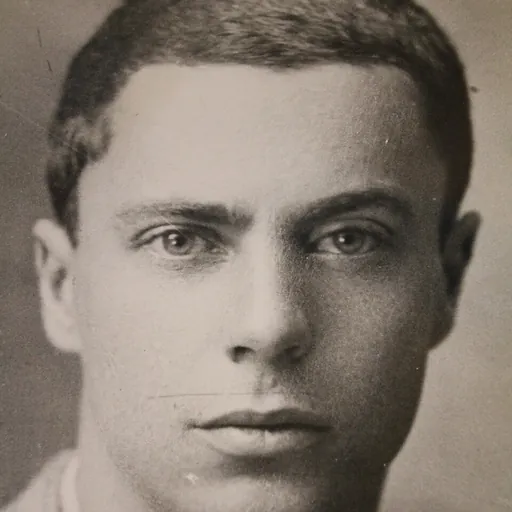
About Claude Simon
Lived 1913 – 2005 (aged 91). Claude Simon was a French writer and novelist.
Claude Eugène Henri Simon (; 10 October 1913 – 6 July 2005) was a French novelist and recipient of the 1985 Nobel Prize in Literature.
Biography
Claude Simon was born in Tananarive on the isle of Madagascar. His parents were French, and his father was a career officer who was killed in the First World War. He grew up with his mother and her family in Perpignan in the middle of the wine district of Roussillon. Among his ancestors was a general from the time of the French Revolution.
After secondary school at Collège Stanislas in Paris, he took courses in painting at André Lhote's academy. Simon began writing in 1936. In 1937 he travelled extensively through Spain, Germany, the Soviet Union, Italy, Greece, and Turkey. In 1985 he was awarded the Nobel Prize in Literature with the citation "who in his novel combines the poet's and the painter's creativeness with a deepened awareness of time in the depiction of the human condition."
Claude Simon lived in Paris and used to spend part of the year at Salses in the Pyrenees. To the end of his life Simon insisted on that his profession should be recorded as that of a viticulteur and not a writer, thinking grape farming was a more genuinely remedial trade than writing novels, and toning down the act of writing as no different to what manual workers do.
Style and influences Simon is often identified with the nouveau roman movement exemplified in the works of Alain Robbe-Grillet and Michel Butor, and while his fragmented narratives certainly contain some of the formal disruption characteristic of that movement (in particular Histoire, 1967, and Triptyque, 1973), he nevertheless retains a strong sense of narrative and character.
In fact, Simon arguably has much more in common with his Modernist predecessors than with his contemporaries; in particular, the works of Marcel Proust and William Faulkner are a clear influence. Simon's use of self-consciously long sentences (often stretching across many pages and with parentheses sometimes interrupting a clause which is only completed pages later) can be seen to reference Proust's style, and Simon moreover makes use of certain Proustian settings (in La Route des Flandres, for example, the narrator's captain de Reixach is shot by a sniper concealed behind a hawthorn hedge or haie d'aubépines, a reference to the meeting between Gilberte and the narrator across a hawthorn hedge in Proust's À la recherche du temps perdu).
The Faulknerian influence is evident in the novels' extensive use of a fractured timeline with frequent and potentially disorienting analepsis (moments of chronological discontinuity), and of an extreme form of free indirect speech in which narrative voices (often unidentified) and streams of consciousness bleed into the words of the narration. The ghost of Faulkner looms particularly large in 1989's L'Acacia, which uses a number of non-sequential calendar dates covering a wide chronological period in lieu of chapter headings, a device borrowed from Faulkner's The Sound and the Fury.
Themes Despite these influences, Simon's work is thematically and stylistically highly original. War is a constant and central theme (indeed it is present in one form or another in almost all of Simon's published works), and Simon often contrasts various individuals' experiences of different historical conflicts in a single novel; World War I and the Second World War in L'Acacia (which also takes into account the impact of war on the widows of soldiers), the French Revolutionary Wars and the Second World War in Les Géorgiques.
In addition, many of the novels deal with the notion of family history, those myths and legends which are passed down through generations and which conspire in Simon's work to affect the protagonists' lives. In this regard, the novels make use of a number of leitmotifs which recur in different combinations between novels (a technique also employed by Marguerite Duras), in particular, the suicide of an eighteenth-century ancestor and the death of a contemporary relative by sniper-fire. Finally, almost all of Simon's novels feature horses; Simon was himself an accomplished equestrian and fought in a mounted regiment during World War II (the ridiculousness of mounted soldiers fighting in a mechanised war is a major theme of La Route des Flandres and Les Géorgiques).
Simon's principal obsession, however, is with the ways in which humans experience time (another Modernist fascination). The novels often dwell on images of old age, such as the decaying 'LSM' or the old woman (that 'flaccid and ectoplasmic Cassandra') in Les Géorgiques, which are frequently seen through the uncomprehending eyes of childhood. Simon's use of family history equally attempts to show how individuals exist in history—that is, how they might feel implicated in the lives and stories of their ancestors who died long ago.
Criticism In his book, Orwell's Victory, essayist Christopher Hitchens criticised Simon's deconstruction in Les Géorgiques of George Orwell's account of the Spanish Civil War, pointing out that Orwell had fought alongside POUM, while Simon had fought "on the side of the Stalintern forces". Hitchens' criticism has itself been criticised by historian Roseanna Webster.
Seminars
Contemporary literature workshop with Marc Avelot, Philippe Binant, Bernard Magné, Claudette Oriol-Boyer, Jean Ricardou during the writing of Les Géorgiques (The Georgics) (Cerisy, France, 1980).
Jean Ricardou (Director) : Nouveau roman : hier, aujourd'hui, Cerisy (France), 1971. Claude Simon : analyse, théorie, Cerisy (France), 1974. Pour une théorie matérialiste du texte, Cerisy (France), 1980.
Works
Novels Le Tricheur (1946). The Cheat La Corde raide (1947). The Tightrope Gulliver (1952) Le Sacre du Printemps (1954). The Rite of Spring Le Vent : tentative de restitution d'un rétable baroque (1957). The Wind, trans. Richard Howard (Braziller, 1959) L'Herbe (1958). The Grass, trans. Richard Howard (Braziller, 1960) La Route des Flandres (1960). The Flanders Road, trans. Richard Howard (Braziller, 1961) Le Palace (1962). The Palace, trans. Richard Howard (Braziller, 1963) Histoire (1967). Histoire, trans. Richard Howard (Braziller, 1968) La Bataille de Pharsale (1969). The Battle of Pharsalus, trans. Richard Howard (Braziller, 1971 Orion aveugle (1970). Blind Orion Les Corps conducteurs (1971). Conducting Bodies, trans. Helen R. Lane (Viking Press, 1974) Triptyque (1973). Triptych, trans. Helen R. Lane (Viking Press, 1976) Leçon de choses (1975). The World About Us, trans. Daniel Weissbort (Ontario Review Press, 1983) Les Géorgiques (1981). The Georgics, trans. Beryl and John Fletcher (Riverrun Press, 1989) L'Invitation (1987). The Invitation, trans. Jim Cross (Dalkey Archive, 1991) L'Acacia (1989). The Acacia, trans. Richard Howard (Pantheon, 1990) Le Jardin des plantes (1997). The Jardin des Plantes, trans. Jordan Stump (Northwestern University Press, 2001) Le Tramway (2001). The Trolley, trans. Richard Howard (New Press, 2002)
Other works
La Separation (1963; play, adapted from the novel L'Herbe). The Separation Femmes : sur 23 peintures de Joan Miró (1966; republished as La Chevelure de Bérénice, 1984). Berenice’s Golden Mane, trans. Simon Green (Alyscamps, 1998)
Collected edition in French Œuvres (Bibliothèque de la Pléiade): Tome I (Gallimard, 2006), including Le Vent: Tentative de restitution d'un retable baroque, La Route des Flandres, Le Palace, La Bataille de Pharsale, La Chevelure de Bérénice (Reprise du texte Femmes), Triptyque, Le Jardin des Plantes, and other writings. Tome II (Gallimard, 2013), including L'Herbe, Histoire, Les Corps conducteurs, Leçon de choses, Les Géorgiques, L'Invitation, L'Acacia, Le Tramway, and other writings.
Awards and honors
1960: Prix de l'Express, for La Route des Flandres 1967: Prix Médicis, for Histoire 1985: Nobel Prize in Literature
Don’t just read it —
keep it.
Full-length biographies made to live with: read them, listen on the way to work, watch them tonight.
- E-book
- Audio
- Video
Instant download · yours to keep · every purchase keeps this site free
Important facts
People in Claude Simon's life
Named in this biography and alive at the same time





Related people
Same field, nearest in time


Contemporaries
People whose lives overlapped Claude Simon's




Frequently asked questions
Who was Claude Simon?
French writer (1913–2005)
When was Claude Simon born?
Claude Simon was born on 10 October 1913 in Antananarivo.
When did Claude Simon die?
Claude Simon died on 6 July 2005 in 5th arrondissement of Paris.
What was Claude Simon's occupation?
Claude Simon was a writer and novelist.
What nationality was Claude Simon?
Claude Simon was French.
Sources & further reading
Cite this page
APA: Biography.guide. (2026). Claude Simon. https://biography.guide/claude-simon/
MLA: "Claude Simon." Biography.guide, https://biography.guide/claude-simon/.
Chicago: "Claude Simon." Biography.guide. https://biography.guide/claude-simon/.
Data last updated: 2026-09-22 · Spot an error? Report a correction.
Portrait: Wikimedia Commons · author & licence
Page generated 2026-09-27 05:04 UTC