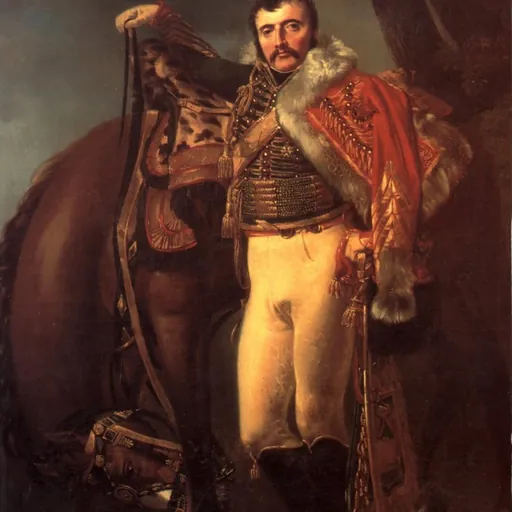
Claude-Étienne Guyot
French cavalry general during the Napoleonic Wars
About Claude-Étienne Guyot
Lived 1768 – 1837 (aged 69). Claude-Étienne Guyot was a French military officer and chamberlain (office).
Claude-Étienne, comte Guyot ( , ; 1768–1837) was a French general of the French Revolutionary Wars and Napoleonic Wars, noted for commanding cavalry.
Early career during the Revolutionary Wars Joining the army in November 1790 as a mere trooper of the chasseurs-à-cheval of Brittany, he subsequently served in the Army of the Rhine and of the Moselle, then in the Vendée, in Italy and in Germany, during the French Revolutionary Wars. In 1802 he became a captain of the first Regiment of chasseurs-à-cheval of the Consular Guard. A colonel in the Imperial Guard in 1807, he was created a baron of the Empire the next year and six weeks later he led a famous charge at the battle of Wagram. This action would bring him the rank of brigadier general. A Chamberlain of Emperor Napoleon I from March 1810, he was subsequently sent to Spain, where he won a promotion to general of division in 1811. During the Russian campaign and subsequent War of the Sixth Coalition, Guyot would serve as commander of the Guard chasseurs-à-cheval. In the 1813 campaign in Saxony, he was wounded at the battle of Lützen and led a brilliant charge at the battle of Bautzen, before being made prisoner at the battle of Kulm, in August. Released after an exchange of prisoners, Guyot took part to the epic battle of Leipzig, before being created a count of the Empire in November of that year. The 1814 campaign in France saw general Guyot at the heart of the action, commanding cavalry at La Rothière, Champaubert and Craonne.
After Napoleon's abdication, Guyot was named commander of the 'Royal Corps of Cuirassiers', formerly Grenadiers à Cheval de la Garde Impériale. Nevertheless, during the Hundred Days, Guyot rallied to Napoleon's cause and he was again given the command of the Guard heavy cavalry division, at the head of which he charged at Waterloo, where he was wounded twice. After the fall of the Empire, he was placed on the retired list at his own request, returning to active service briefly between 1830 and 1833 to command the 10th military division.
Recognition The name Guyot is inscribed under the Arc de Triomphe in Paris.
Don’t just read it —
keep it.
Full-length biographies made to live with: read them, listen on the way to work, watch them tonight.
- E-book
- Audio
- Video
Instant download · yours to keep · every purchase keeps this site free
Important facts
People in Claude-Étienne Guyot's life
Named in this biography and alive at the same time
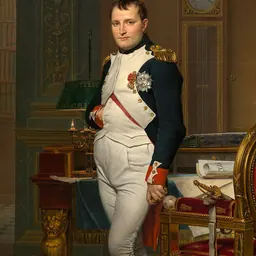
Related people
Same field, nearest in time

Contemporaries
People whose lives overlapped Claude-Étienne Guyot's






Frequently asked questions
Who was Claude-Étienne Guyot?
French cavalry general during the Napoleonic Wars (1768–1837)
When was Claude-Étienne Guyot born?
Claude-Étienne Guyot was born on 5 September 1768 in Villevieux.
When did Claude-Étienne Guyot die?
Claude-Étienne Guyot died on 28 November 1837 in Paris.
What was Claude-Étienne Guyot's occupation?
Claude-Étienne Guyot was a military officer and chamberlain (office).
What nationality was Claude-Étienne Guyot?
Claude-Étienne Guyot was French.
Sources & further reading
· Wikipedia: Claude-Étienne Guyot
· DBpedia: Claude-Étienne Guyot
Cite this page
APA: Biography.guide. (2026). Claude-Étienne Guyot. https://biography.guide/claude-etienne-guyot/
MLA: "Claude-Étienne Guyot." Biography.guide, https://biography.guide/claude-etienne-guyot/.
Chicago: "Claude-Étienne Guyot." Biography.guide. https://biography.guide/claude-etienne-guyot/.
Data last updated: 2026-09-20 · Spot an error? Report a correction.
Portrait: Wikimedia Commons · author & licence
Page generated 2026-09-27 04:57 UTC