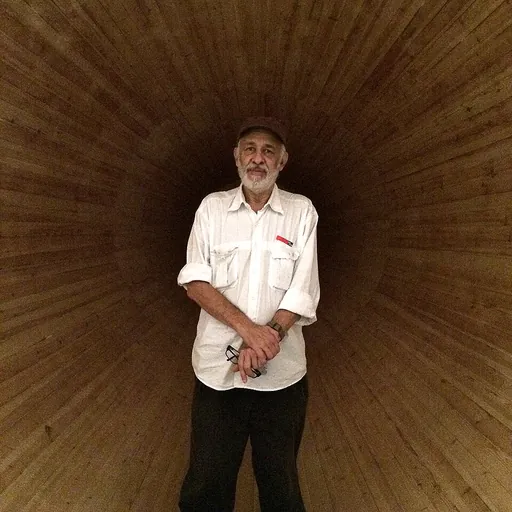
About Cildo Meireles
Born 1948. Cildo Meireles is a Brazilian sculptor, painter, conceptual artist, printmaker, installation artist and performance artist.
Cildo Meireles (born 1948) is a Brazilian conceptual artist, installation artist and sculptor. He is noted especially for his installations, many of which express resistance to political oppression in Brazil. These works, often large and dense, encourage a phenomenological experience via the viewer's interaction.
Life Meireles was born in Rio de Janeiro in 1948. From an early age, Meireles showed a keen interest in drawing and spatial relations. He was especially interested in how this has been explored in animated film. His father, who encouraged Meireles' creativity, worked for the Indian Protection Service and their family traveled extensively within rural Brazil.
In an interview with Nuria Enguita, Meireles described a time when he was "seven or eight" and living in the countryside that had a huge impact on him. He said that he was startled by an impoverished man wandering through the trees. The next day, the young Meireles went to investigate, but the man was gone and only a small but perfect hut the man had apparently made the night before remained. Meireles said that this hut "was perhaps the most decisive thing for the path [he] followed in life...The possibility one has of making things and leaving them for others."
During his time in rural Brazil, Meireles learned the beliefs of the Tupi people which he later incorporated into some of his works in order to highlight their marginalization in, or complete disappearance from, Brazilian society and politics. Installations which contain allusions to the Tupi include Southern Cross (1969–70) and Olvido (1990). Meireles cites Orson Welles' 1938 radio broadcast The War of the Worlds as one of the greatest works of art of the 20th century because it "seamlessly dissolved the border between art and life, fiction and reality." In the late 1960s, Meireles discovered the work of Hélio Oiticica and Lygia Clark, thereby introducing him to the Brazilian Neo-Concrete movement. These artists, as well as Meireles, were all concerned with blurring the boundary between what is art and what is life, and responding to current political situations within their pieces. Meireles found ways to create art that was subversive but subtle enough to make public by taking inspiration from Dadaist art, which he notes had the ability to seem "tame" and "ironic."
In 1999, Meireles was honoured with a Prince Claus Award and in 2008 he won the Velazquez Plastic Arts Award, presented by the Ministry of Culture of Spain.
Key works
Red Shift (1967–1984) A large-scale, three-room exploration of an entirely red environment. The title of the installation refers both to the scientific concept of chromatic shift (or chromatic aberration) as well as to the idea of a "shift" as a displacement or deviation.
The first room, called Impregnation, is approximately 50 m2 and filled with a number of everyday, domestic objects in a variety of different shades of red. The effect is an overwhelming visual saturation of the color. Upon entering the room, the participant experiences an initial shock from the visual inundation of red. Dan Cameron writes that "one's gaze is literally thwarted in an effort to gain a purchase on the specificity of things." Because of its lack of chromatic differentiation, the environment appears to lack depth. Cameron argues that the longer a participant stays in the room the more aware they become of the color's negative, unsettling psychological impact on them. Like most of Meireles' other artworks, Red Shift takes on political undertones when examined in light of Brazil's military dictatorship which lasted throughout the creation and exhibition of this piece. Each half of the tiny 9mm by 9mm by 9mm cube is made of pine and oak. These two types of wood are considered sacred by the Tupi people of Brazil. The title refers to an unofficial geographical (and metaphysical) region that lies to the west of Tordesillas. According to Meireles in a statement he made about the artwork in 1970, this region is "the wild side, the jungle in one's head, without the lustre of intelligence or reason...our origins." It is a place where "there are only individual truths." The goal of Insertions... was to literally insert some kind of counter-information or critical thought into a large system of circulated information. Meireles inserted something that is physically the same, though ideologically different, into a pre-existing system in order to counteract the original circuit without disrupting it. The project was achieved by printing images and messages onto various items that were already widely circulated and which had value discouraging them being destroyed, such as Coca-Cola bottles (which were recycled by way of a deposit scheme) and banknotes. Meireles screen-printed texts onto the Coca-Cola bottles that were supposed to encourage the buyer to become aware of their personal role in a consumerist society. Mieireles also wrote critiques of the Brazilian government on the banknotes, such as "Who killed Herzog?" (in reference to journalist Vladimir Herzog), "Yankees go home!" and "Direct elections." The maze is composed of "velvet museum ropes, street barriers, garden fences, blinds, railings, and aquariums" and in the center of it is a three-meter ball of cellophane. Meireles notes that an essential part of Through is the sense of psychological unease that comes from the participant's realization of the different sensory capacities and capabilities between the eyes and the body. . The materials used were unique. Those materials include banknotes, animal bones, and candles . The audience is able to experience with both materials and senses, visual, hearing, and smell . The materials used in the installation were metaphors of political and social issues. The artwork is an indication of the environmental disaster caused by the development and deforestation in the Amazon region and the damage to the Indigenous communities .
Babel (2001) A tower of hundreds of radios, each just audible and tuned to stations of different languages to evoke resonances of the Tower of Babel in the Bible. In the story, before the destruction of the Tower of Babel by God, every person on Earth spoke the same language. Meireles' Babel acknowledges the multiplicity of language that resulted from the Tower's destruction in the story. The artwork contradicts the notion of one universal language, emphasizing that the pursuit of commonality is futile. Paul Herkenhoff points out that Babel also has autobiographical meaning for Meireles, as radio was a common method of widespread communication in Brazil during the artist's youth. The work also speaks to globalization. Meireles parallels the unity of humanity before the fall of the Tower of Babel with the present-day unity which has resulted from globalization despite numerous language barriers.
Exhibitions Meireles considers his first exhibition to have taken place in 1965, when one of his canvases and two of his drawings were accepted by the Segundo Salão Nacional de Arte Moderna in Brasília. Another important retrospective took place at SESC Pompeia from September 2019 to February 2020. In the exhibition entitled "Entrevendo" (Glimpsing) many of his most noteworthy installations were on display and an important catalogue was created for the exhibition.
In 2026, his work was featured in This Is America: Selections from PAMM's Collection, at the Pérez Art Museum Miami, Florida. Meireles's work was included alongside works by Coco Fusco and Alfredo Jaar, among others.
Don’t just read it —
keep it.
Full-length biographies made to live with: read them, listen on the way to work, watch them tonight.
- E-book
- Audio
- Video
Instant download · yours to keep · every purchase keeps this site free
Important facts
People in Cildo Meireles's life
Named in this biography and alive at the same time




Related people
Same field, nearest in time





Contemporaries
People whose lives overlapped Cildo Meireles's





Frequently asked questions
Who is Cildo Meireles?
Brazilian conceptual artist (born 1948)
When was Cildo Meireles born?
Cildo Meireles was born on 9 February 1948 in Rio de Janeiro.
What is Cildo Meireles's occupation?
Cildo Meireles is a sculptor, painter, conceptual artist, printmaker, installation artist and performance artist.
What nationality is Cildo Meireles?
Cildo Meireles is Brazilian.
Sources & further reading
Cite this page
APA: Biography.guide. (2026). Cildo Meireles. https://biography.guide/cildo-meireles/
MLA: "Cildo Meireles." Biography.guide, https://biography.guide/cildo-meireles/.
Chicago: "Cildo Meireles." Biography.guide. https://biography.guide/cildo-meireles/.
Data last updated: 2026-09-20 · Spot an error? Report a correction.
Page generated 2026-09-27 05:09 UTC