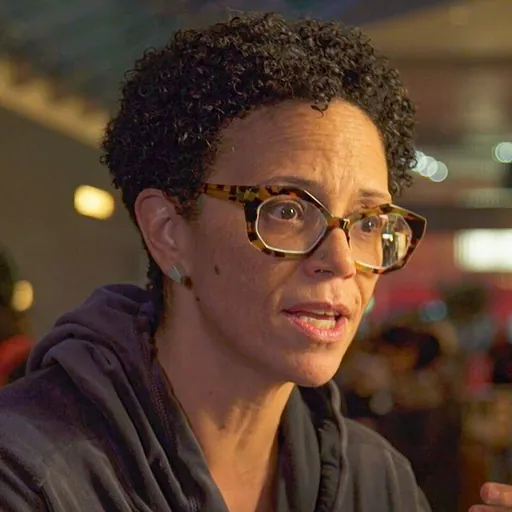
About Coco Fusco
Born 1960. Coco Fusco is an American and Cuban writer, performance artist, visual artist, video artist, artist and cultural studies scholar.
Coco Fusco (born Juliana Emilia Fusco Miyares; June 18, 1960) is a Cuban-American interdisciplinary artist, writer, and curator whose work has been widely exhibited and published internationally. Fusco's work explores gender, identity, race, and power through performance, video, interactive installations, and critical writing.
Early life and education Fusco was born in 1960 in New York City. Her mother was a Cuban exile who had fled the Cuban revolution that year.
Fusco received a B.A in Semiotics from Brown University in 1982, an M.A. in Modern Thought and Literature from Stanford University in 1985 and a Ph.D. in Art and Visual Culture from Middlesex University in 2007.
Career After finishing graduate school in 1985, Fusco met a group of Cuban artists, including José Bedia, who were visiting the US. She began traveling to Cuba and participating in the visual arts scene there, until in the mid-1990s she withdrew as a result of post-Cold War political and cultural changes in the country. She is the recipient of the 2016 Greenfield Prize in Visual Art, a 2014 Cintas Fellowship, a 2013 Guggenheim Fellowship, a 2013 Absolut Art Writing Award, a 2012 US Artists Fellowship, and a 2003 Herb Alpert Award in the Arts, as well as grants from the Rockefeller Foundation, the NEA and NYFA.
Much of Fusco's interdisciplinary art practice over the last several decades has been concerned with the themes of colonialism, power, race, gender, and history. Her exploration of these themes has culminated in staged performances that concern the embodied experiences of these phenomena, in an effort to destabilize their meanings. She locates her own body not only as the site of their merging but also as their immediate product. She presents and communicates this through her actual performances themselves. In them, she creates and takes on multiple identities to destabilize those identities that have been historically imposed on bodies along colonial, racial, and gendered lines. Fusco also engages with legacies of Cuban exile in her work, as in some of her earlier performances where she stages Catholic rituals and experiences of dislocation. The performance was filmed as part of the documentary The Couple in the Cage, directed by Paula Heredia. The work was a critique of colonialism, specifically of the role played by the scientific institutions in which it was performed, and a response to the global quincentenary celebrations of Christopher Columbus's arrival in the Americas. Better Yet... was performed twice by Fusco, first in Canada, and again in Colombia, for several hours each day during the three to four day run of the piece. In the performance, Fusco laid silently in a coffin, surrounded by roses and satin. In this performance, she carefully controlled her breathing and movements so as to appear like an actual corpse. At the threshold of the room where she laid, a sign was posted that bore the name of the performance's title, which refers to the unfulfilled "last wish" of Fusco's own grandmother, as well as many other Cuban exiles, to return to Cuba to be buried. The piece makes a link between historical references to cannibalism and contemporary geopolitical relationships. Stuff was commissioned by Highway Performance Space and London's Institute of Contemporary Arts, and premiered at the National Review of Live Art in Glasgow before touring internationally. Rights of Passage (1997) was created for the Johannesburg Biennale. Fusco performed dressed as a South African policewoman to explore themes of race, identity, and the legacy of apartheid in South Africa. Bare Life Study #1 (2005), and A Room of One's Own: Women and Power in the New America (2005) were created in response to the "war on terror" used performance to examine the expanding role of women in the US military and the use of torture in its operations. In Observations of Predation In Humans: A Lecture by Dr. Zira, Animal Psychologist (2013), Fusco performed as the primate Dr. Zira from Planet of the Apes, using the perspective of the non-human character to comment on human behavior. The performance was commissioned by The Studio Museum in Harlem and premiered in December 2013.
Writing and teaching
As a writer, Coco Fusco has focused on gender, race, colonialism, and power structures in Latin America and around the world. Her body of work includes interviews, critical essays, and six published books. Dangerous Moves: Performance and Politics in Cuba (2015) is a history of public space, performance, and identity in Cuba. A Field Guide for Female Interrogators (2008), a companion volume to her performance A Room of One's Own: Women and Power in the New America (2005), examines the sexualized role of women in US military interrogations. A Field Guide for Female Interrogators was shortlisted for the Index on Censorship T. R. Fyvel Book Award. Only Skin Deep: Changing Visions of the American Self (2003, edited with Brian Wallis), is the catalogue for a photography exhibition of the same name, curated by Fusco and Wallis at the International Center of Photography, which looked at racial imagery in photography and the representation of racial attitudes in the United States. The Bodies that Were Not Ours and Other Writings (2001) is a collection of essays and interviews investigating the legacy of colonialism. Corpus Delecti: Performance Art of the Americas (2000) is a scholarly work surveying Latinx and Latin American performance art. In it, Fusco centers the aesthetic and cultural value of artistic expression and works against notions of reducing Latin American performance to "the political". English Is Broken Here: Notes on Cultural Fusion in the Americas (1995) was her first collection of interviews and essays, for which she won the 1995 Critics' Choice award.
Fusco has taught on the arts faculties of Temple University, Columbia University, Parsons School of Design, and MIT. In 2014 she received a Fulbright appointment and served as the Distinguished Chair in the Visual Arts at Fundação Armando Alvares Penteado in São Paulo, Brazil, for one year. Fusco currently serves as the Andrew Banks Endowed Chair at the College of the Arts at University of Florida.
Fusco a recipient of a 2018 Rabkin Prize for Art Criticism.
Selected exhibitions 1987 Havana Postmodern: The New Cuban Art, KCET Latino Consortium and for WNET's Hispanic 1990 Norte:Sur, the Mexican Museum, San Francisco 1991 La Chavela Realty Company, Brooklyn Academy of Music, Brooklyn, NY 1992 Smithsonian Institution, Washington, D.C. 1992 Field Museum of Natural History, Chicago, IL 1993 The Whitney Biennial, The Whitney Museum of American Art, New York, NY Fundacion Banco Patricios, Buenos Aires, Argentina 1999 Third International Performance Art Festival, Odense, Denmark Washington State University Museum, Pullman, WA 1999 Stuff, Rhode Island School of Design, Providence, RI 2000 El Evento Suspendido, El Espacio Aglutinador, Havana, Cuba 2003 House of World Cultures, Berlin, Germany 2003 The Incredible Disappearing Woman, ICA, London, UK 2003 Shanghai Biennial, Shanghai Art Museum, Shanghai, China 2005 Collection Remixed: Learning to Read, Bronx Museum, New York, NY 2005 Black Panther, Jack Shainman Gallery, New York, NY 2006 My Country, The Hungarian Cultural Center, New York, NY 2006 A Room of One's Own: Women and Power in the New America, Performance Space 122, New York, NY 2007 Killing Time, Exit Art, New York 2008 The Project, New York, NY 2008 The Whitney Biennial, The Whitney Museum of American Art, New York, NY 2012 Art Basel Miami, Miami, FL 2012 Contemporary Arts Museum, Houston, Houston, TX 2013 Studio Museum in Harlem, New York, NY 2013 New Museum, New York, NY 2014 Walker Art Center, Minneapolis, MN 2015 Venice Biennale, Venice, Italy 2016 Alexander Gray Associates, New York, NY 2025 I Learned to Swim on Dry Land, MACBA Museu d'Art Contemporani de Barcelona, Barcelona, Spain 2025 Coco Fusco: Tomorrow I Will Become an Island, El Museo del Barrio, New York, NY 2025 Coco Fusco: Your Eyes Will Be an Empty Word, Art Institute of Chicago, Chicago, IL 2026 This is America: Selections from PAMM's Collection, Pérez Art Museum Miami, FL
Awards Anonymous Was A Woman Award (2021) American Academy of Arts and Letters Arts Award (2021) Free Speech Defender Award (2023)
Public collections (selection) Pérez Art Museum Miami Museum of Modern Art, New York
Selected videos Coco Fusco works distributed by the Video Data Bank include: La Botella al Mar de María Elena (The Message in a Bottle from María Elena) (2015) 44:00, color, sound. La Confesion (2015), 30:00, color, sound. Operation Atropos (2006), 59:00 min, color, sound a/k/a Mrs. George Gilbert (2004), 31:00 min, B&W, sound Pochonovela: A Chicano Soap Opera (1996), 26:38 min, color, sound The Couple in the Cage: Guatianaui Odyssey (1993), 31:00 min, B&W and color, sound
Don’t just read it —
keep it.
Full-length biographies made to live with: read them, listen on the way to work, watch them tonight.
- E-book
- Audio
- Video
Instant download · yours to keep · every purchase keeps this site free
Important facts
People in Coco Fusco's life
Named in this biography and alive at the same time




Related people
Same field, nearest in time

Contemporaries
People whose lives overlapped Coco Fusco's



Frequently asked questions
Who is Coco Fusco?
American artist (born 1960)
When was Coco Fusco born?
Coco Fusco was born on 18 June 1960 in New York City.
What is Coco Fusco's occupation?
Coco Fusco is a writer, performance artist, visual artist, video artist, artist and cultural studies scholar.
What nationality is Coco Fusco?
Coco Fusco is American and Cuban.
Sources & further reading
Cite this page
APA: Biography.guide. (2026). Coco Fusco. https://biography.guide/coco-fusco/
MLA: "Coco Fusco." Biography.guide, https://biography.guide/coco-fusco/.
Chicago: "Coco Fusco." Biography.guide. https://biography.guide/coco-fusco/.
Data last updated: 2026-09-20 · Spot an error? Report a correction.
Page generated 2026-09-27 05:09 UTC