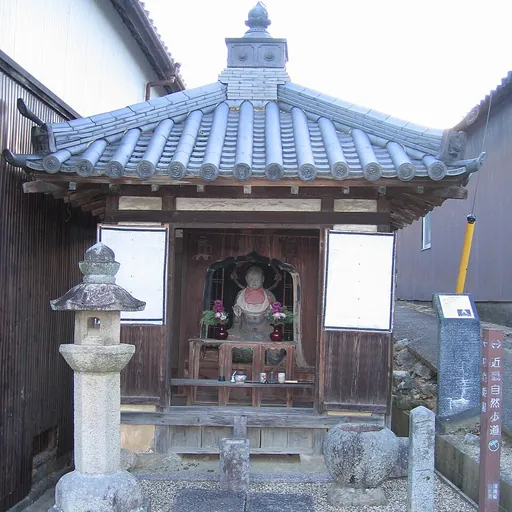
About Chūjō-hime
Lived 753 – 781 (aged 27–28). Chūjō-hime was a Japanese lady-in-waiting and buddhist nun.
(also written Chūjō Hime or Hase-Hime) (c. 753?–781?) was by most accounts a daughter of the court noble Fujiwara no Toyonari who escaped persecution at the hands of her stepmother by becoming a nun at the Taima-dera in Nara. There she took on the name Zenshin-ni or the Dharma name Honyo (法如). She has become a folk heroine, the subject of numerous Japanese folktales which celebrate her filial piety. She is sometimes called the Japanese Cinderella.
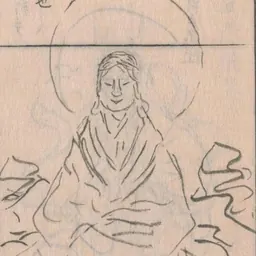
Folklore Amitābha welcomes Chūjō-hime to the Western Paradise. Japan, 16th century. She is said to be the daughter of an imperial minister of the Fujiwara clan and a royal princess. Different stories disagree on her date of birth: most place it in the 8th century, during Emperor Shōmu's reign, and suggest she was the daughter of Fujiwara no Toyonari; however, a few state she was the daughter of Fujiwara no Toyoshige, a century earlier. It is said that the childless couple had appealed to Kannon and been granted a daughter in exchange for the life of one parent. When Chūjō-hime is three, therefore, her mother dies; her father subsequently remarries.
In some versions of the story, her stepmother then orders her taken into the mountains and abandoned to die. In others, she remains at home and makes copies of the Buddhist sutras for her mother's salvation, and this devotion earns the enmity of her stepmother. In either case, she is rescued by the Buddhist nuns of Taima-dera and becomes a nun herself. As a nun, she lives an austere and meditative life, and comes to be known as a "living Buddha." Other beliefs hold that she was herself an incarnation of Kannon. She is then mentioned by name in the pictorial and calligraphic work Ippen Hijiri-e, dated 1299. This text also identifies Chūjō-hime as "an incarnation of a Buddhist deity."
During the late fourteenth and early fifteenth centuries, new themes were added to Chūjō-hime's story, particularly regarding her life before becoming a nun.
Relics
Besides the mandala, there are many purported relics of Chujō-hime that traveled across the Yamato region during the 15th century, mostly by accounts of monk Yūzen. These included handscrolls, ink brushes and statues that were attributed to Chujō-hime. Statues of Chujō-hime as a nun are mostly dated to the 17th century, however there are regional claims that some were carved by Chujō-hime herself. One such statue, housed at Seirenji in Uda-gun, Nara prefecture became the principal object of worship at this Pure Land sect convent.
In popular culture There is a 1911 short silent film, starring Matsunosuke Onoe, based upon Chūjō-hime's legend.
She is cast as the main female character in the 1939 novel Shisha no sho by Shinobu Orikuchi.
In the late Muromachi period the Chujō-hime tale was also used to popularize the gynecological patent medicine known as Chūjōtō which was produced by the pharmaceutical drug company, Tsumura Juntendō. In the otogizōshi versions of the Chujō-hime tale, her concern with her dead mother's salvation is what allowed her character to rise to the status of sainthood. Marketing for Chūjōtō focused on the connection between menstruation and sin.
Don’t just read it —
keep it.
Full-length biographies made to live with: read them, listen on the way to work, watch them tonight.
- E-book
- Audio
- Video
Instant download · yours to keep · every purchase keeps this site free
Important facts
People in Chūjō-hime's life
Named in this biography and alive at the same time
Related people
Same field, nearest in time






Contemporaries
People whose lives overlapped Chūjō-hime's

Frequently asked questions
Who was Chūjō-hime?
Japanese politician
When was Chūjō-hime born?
Chūjō-hime was born in 753.
When did Chūjō-hime die?
Chūjō-hime died in 781.
What was Chūjō-hime's occupation?
Chūjō-hime was a lady-in-waiting and buddhist nun.
What nationality was Chūjō-hime?
Chūjō-hime was Japanese.
Sources & further reading
Cite this page
APA: Biography.guide. (2026). Chūjō-hime. https://biography.guide/chujo-hime/
MLA: "Chūjō-hime." Biography.guide, https://biography.guide/chujo-hime/.
Chicago: "Chūjō-hime." Biography.guide. https://biography.guide/chujo-hime/.
Data last updated: 2026-09-21 · Spot an error? Report a correction.
Portrait: Wikimedia Commons · author & licence
Page generated 2026-09-27 05:00 UTC