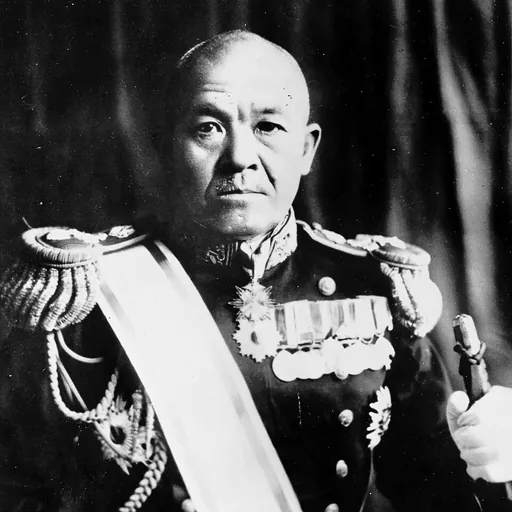
About Chūichi Nagumo
Lived 1887 – 1944 (aged 57). Chūichi Nagumo was a Japanese naval officer.
Early life
Nagumo was born in the city of Yonezawa, Yamagata Prefecture, in northern Japan in 1887. He graduated from the 36th class of the IJN Academy in 1908, with a ranking of 8 out of a class of 191 cadets. As a midshipman, he served in the protected cruisers and and the armored cruiser . After his promotion to ensign in 1910 he was assigned to cruiser .
After attending torpedo and naval artillery schools, he was promoted to sub-lieutenant and served in the battleship , followed by the destroyer . In 1914, he was promoted to lieutenant and was assigned to the battlecruiser , followed by the destroyer . He was assigned his first command, the destroyer , on 15 December 1917.
Nagumo graduated from the Naval War College and was promoted to lieutenant commander in 1920. His specialty was torpedo and destroyer tactics.
From 1920 to 1921, he was captain of the destroyer , but was soon sent to shore duty with various assignments by the IJN General Staff. He became a commander in 1924. From 1925 to 1926, Nagumo accompanied a Japanese mission to study naval warfare strategy, tactics, and equipment in Western Europe and the United States.
After his return to Japan, Nagumo was assigned to duties in Chinese territorial waters. He was appointed captain of the river gunboat from 20 March 1926 to 15 October 1926, followed by the gunboat from 15 October 1926 to 15 November 1927. He then served as an instructor at the IJN Academy from 1927 to 1929. Nagumo was promoted to captain in November 1929 and assumed command of the light cruiser and from 1930 to 1931 was commander of the 11th Destroyer Division. After serving in administrative positions from 1931 to 1933, he assumed command of the heavy cruiser from 1933 to 1934, and the battleship from 1934 to 1935. He was promoted to Rear Admiral on 1 November 1935.
As a Rear Admiral, Nagumo commanded the 8th Cruiser Division to support Imperial Japanese Army movements in China from the Yellow Sea. As a leading officer of the militaristic Fleet Faction, he also received a boost in his career from political forces.
From 1937 to 1938, he was commandant of the Torpedo School, and from 1938 to 1939, he was commander of the 3rd Cruiser Division. Nagumo was promoted to vice admiral on 15 November 1939. From November 1940 to April 1941, Nagumo was commandant of the Naval War College.
World War II
On 10 April 1941, Nagumo was appointed commander-in-chief of the 1st Air Fleet, the IJN's main carrier battle group, largely due to his seniority. Many contemporaries and historians have doubted his suitability for this command, given his lack of familiarity with naval aviation. Nagumo's friend and fellow admiral Nishizō Tsukahara would say that: "He (Nagumo) was wholly unfitted by background, training, experience, and interest for a major role in Japan’s naval air arm." Nagumo was appointed by the Navy General Staff. There were ongoing friction between the General Staff and Admiral Isoroku Yamamoto, with the General Staff being in general less excited about aviation, and more excited about surface warfare, so the thought was that having Nagumo, a surface warfare officer, in place would help counterbalance Yamamoto. Yamamoto unsuccessfully made the case to have Vice-admiral Jisaburō Ozawa in charge of First Air Fleet instead.
Despite his limited experience, he was a strong advocate of combining sea and air power, although he was opposed to Admiral Yamamoto's plan to attack the United States Navy Naval Station Pearl Harbor. While commanding the First Air Fleet, Nagumo oversaw the attack on Pearl Harbor, but he was later criticized for his failure to launch a third attack, which might have destroyed the fuel oil storage and repair facilities. This could have rendered the most important U.S. naval base in the Pacific useless, especially as the continued operation of the submarine base and the use of the intelligence station at the installation were critical factors in Japan's defeat in the Pacific War.
Nagumo was surrounded by able lieutenants such as Minoru Genda and Mitsuo Fuchida. He also fought well in the early 1942 campaigns, obtaining success as a fleet commander at the Bombing of Darwin and at the Indian Ocean raid on the Eastern Fleet, the latter of which sank an aircraft carrier, two cruisers, and two destroyers, and caused Admiral Sir James Somerville to retreat to East Africa.
Battle of Midway The Battle of Midway, in June 1942, brought Nagumo's streak of victories to an end. During the battle, a Martin B-26 Marauder, seriously damaged by anti-aircraft fire, flew directly at the bridge of the aircraft carrier . The aircraft, either attempting a suicide ramming, or out of control, narrowly missed striking the carrier's bridge, which could have killed Nagumo, before it crashed into the ocean.
Nagumo soon prepared to launch another attack on Midway, in direct violation of Yamamoto's order to keep the reserve strike force armed for anti-ship operations. That change in plans required arming the available planes with bombs, suitable for attacking land targets, rather than torpedoes, designed for anti-ship actions.
However, when Nagumo received scouting reports that American ships were in the area, he changed plans and ordered his planes be rearmed with torpedoes to attack American ships. The situation caught his aircraft in-between, with half his planes armed with torpedoes and the other half with bombs and no time to switch everything back to torpedoes.
American dive-bombers attacked Akagi, and , resulting in fires and further explosions due to unsecured ordnance, crippling all three. After the attack, Nagumo appeared to have gone into a state of shock; he stood near the ship's compass looking out at the flames on his ship and two other carriers, and despite being asked to shift his flag to another vessel, Nagumo was reluctant, muttering, “It's not time yet”. Nagumo's chief of staff, Rear Admiral Ryūnosuke Kusaka, was able to persuade him; Nagumo nodded, with tears in his eyes. Nagumo and his staff were forced to evacuate through the forward windows of the bridge by rope. An expert in judo, Nagumo landed lightly, whereas Kusaka badly sprained both ankles and was burned during the evacuation.
The First Air Fleet lost four carriers during the turning point of the Pacific War, and the massive losses of carrier aircraft maintenance personnel would prove detrimental to the performance of the IJN in later engagements. The loss of the four carriers, their aircraft, and their maintenance crews, plus the loss of 120 experienced pilots, resulted in Japan losing the strategic initiative in the Pacific.
In the aftermath of the battle, Kusaka found a downcast Nagumo, seemingly contemplating suicide; Kusaka eventually talked him out of it. Following the battle, Nagumo appeared to have lost his aggressiveness and effectiveness; he teared up when talking about the events of Midway to his two sons in 1944.
Later naval operations, Guadalcanal campaign and the Battle of Saipan Afterwards, Nagumo was reassigned as commander-in-chief of the Third Fleet and commanded aircraft carriers in the Guadalcanal campaign in the battles of the Eastern Solomons and the Santa Cruz Islands. Despite the Japanese victory at the Santa Cruz Nagumo himself acknowledged that the attrition imposed to the Japanese Imperial Navy in these actions, especially with the loss of experienced pilots, was "shattering strategic loss for Japan", nowithstanding the tactical success.
On 11 November 1942, Nagumo was reassigned to Japan, where he was given command of the Sasebo Naval District. He then transferred to the Kure Naval District on 21 June 1943. From October 1943 to February 1944, Nagumo was once again made commander-in-chief of First Fleet.
As Japan's military situation deteriorated, Nagumo was deployed on 4 March 1944 for the short-lived command of the 14th Air Fleet and the Central Pacific Area Fleet in the Mariana Islands.
The Battle of Saipan began on 15 June 1944. The IJN, under Vice Admiral Jisaburō Ozawa, was overwhelmed within days by the U.S. 5th Fleet in the decisive Battle of the Philippine Sea, where Japan lost three fleet carriers and about 600 aircraft, none of which could be replaced. Nagumo and his Army peer Lieutenant General Yoshitsugu Saito were now on their own to keep control of Saipan.
Death
On 6 July 1944, Nagumo, unable to defend his position any longer and refusing to be taken captive, killed himself with a pistol shot to his temple. Defeated commanders were expected to perform seppuku in accordance with bushido, but he may not have had the time for such a complex ritual. His remains were recovered by U.S. Marines in a remote cave where he had been forced to maintain his headquarters due to extensive bombardment. He was posthumously made a full admiral and awarded the Grand Cordon of the Order of the Golden Kite.thumb
Nagumo's grave is located at the Ōbai-in sub-temple of Engaku-ji in Kamakura, next to the grave of his son, Susumu Nagumo, who was killed in battle aboard the destroyer on 4 December 1944.
Naval career
Don’t just read it —
keep it.
Full-length biographies made to live with: read them, listen on the way to work, watch them tonight.
- E-book
- Audio
- Video
Instant download · yours to keep · every purchase keeps this site free
Important facts
People in Chūichi Nagumo's life
Named in this biography and alive at the same time

Related people
Same field, nearest in time

Contemporaries
People whose lives overlapped Chūichi Nagumo's






Frequently asked questions
Who was Chūichi Nagumo?
Japanese admiral
When was Chūichi Nagumo born?
Chūichi Nagumo was born on 25 March 1887 in Yamagata.
When did Chūichi Nagumo die?
Chūichi Nagumo died on 6 July 1944 in Saipan.
What was Chūichi Nagumo's occupation?
Chūichi Nagumo was a naval officer.
What nationality was Chūichi Nagumo?
Chūichi Nagumo was Japanese.
Sources & further reading
Cite this page
APA: Biography.guide. (2026). Chūichi Nagumo. https://biography.guide/chuichi-nagumo/
MLA: "Chūichi Nagumo." Biography.guide, https://biography.guide/chuichi-nagumo/.
Chicago: "Chūichi Nagumo." Biography.guide. https://biography.guide/chuichi-nagumo/.
Data last updated: 2026-09-23 · Spot an error? Report a correction.
Portrait: Wikimedia Commons · author & licence
Page generated 2026-09-27 05:05 UTC