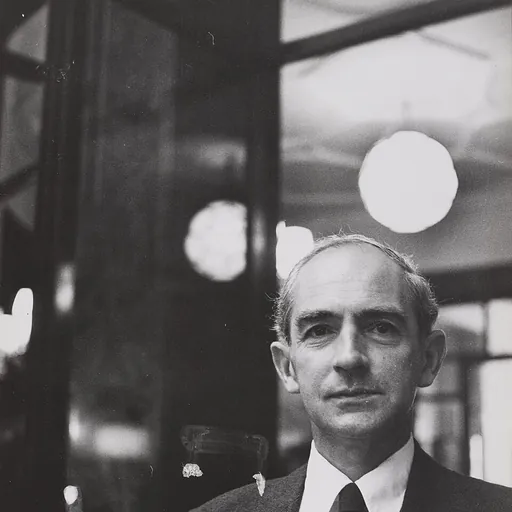
About Christopher Fry
Lived 1907 – 2005 (aged 97). Christopher Fry was a British playwright, screenwriter, poet, writer and translator.
Christopher Fry (born Arthur Hammond Harris; 18 December 1907 – 30 June 2005) was an English poet and playwright. He is best known for his verse dramas, especially The Lady's Not for Burning, which made him a major force in theatre in the 1940s and 1950s.
Biography
Early life Fry was born as Arthur Hammond Harris While still young, he took his mother's maiden name because, on very tenuous grounds, he believed her to be related to the 19th-century Quaker prison reformer Elizabeth Fry. He adopted Elizabeth Fry's faith, and became a Quaker.
After attending Bedford Modern School, where he wrote amateur plays,
Career Fry gave up his school career in 1932 to found the Tunbridge Wells Repertory Players, which he ran for three years, directing and starring in the English premiere of George Bernard Shaw's A Village Wooing in 1934. As a curtain-raiser, he put on a revised version of a show he wrote when he was a schoolboy called The Peregrines. He also wrote the music for She Shall Have Music in 1935.
His play about Thomas John Barnardo, the founder of Barnardo's children's homes, toured in a fund-raising amateur production in 1935 and 1936. It included Deborah Kerr in its cast.
His professional career began to take off in 1938, when he was commissioned by the vicar of Steyning, West Sussex, to write a play celebrating the local saint, Cuthman of Steyning. This became The Boy With A Cart. It would be put on professionally in 1950 at the Lyric, Hammersmith, with John Gielgud directing and the young Richard Burton in his first starring role.
Tewkesbury Abbey commissioned his next play, The Tower, written in 1939, which was seen by the poet T. S. Eliot, who became a friend and is often cited as an influence.
In 1950, Fry adapted a translation of Jean Anouilh's Invitation to the Castle as Ring Round the Moon for director Peter Brook. He also wrote Venus Observed, which was produced at the St James's Theatre by Laurence Olivier. A Sleep of Prisoners followed in 1951, first performed at St Thomas' church in Regent Street, London, in 1951 and later touring with Denholm Elliott and Stanley Baker.
The Dark is Light Enough, a winter play starring Katharine Cornell and Edith Evans in 1954, was third in a quartet of "seasonal" plays, featured incidental music written by Leonard Bernstein. The production also featured Tyrone Power, Lorne Greene and Marian Winters. Christopher Plummer had an understudy role that he wrote about in his memoir. This play followed the springtime of The Lady's Not For Burning and the autumnal Venus Observed. The quartet was completed in 1970 with A Yard Of Sun, representing summer, presented at the Nottingham Playhouse in 1970.
Curtmantles plot deals with Henry II of England and his conflict with Thomas Becket. A Yard of Sun (1970) is set just after World War II at the time of the famous annual horse race Palio di Siena in the streets of Siena.
After the success of his post-war plays Fry bought Trebinshwn, a fine Regency house in Breconshire. When living there he used to walk over the hill behind the house, the Allt, to Llansantffraed church, where the 17th-century poet Henry Vaughan is buried; Vaughan's poetry was a strong influence on him.
During the next ten years, Fry concentrated on further translations, including Henrik Ibsen's Peer Gynt and Edmond Rostand's Cyrano de Bergerac, which were produced at the Chichester Festival Theatre.
In 1986, he wrote One Thing More, a play about the seventh-century Northumbrian monk Cædmon who was suddenly given the gift of composing song; The play was first broadcast on BBC radio, and then performed by the Next Stage Company directed by Joan White at Chelsea Old Church, November 1988, and at Whitby Abbey in Yorkshire, June 1989. Further productions followed in London and Oxford.
His last play, A Ringing Of Bells, was commissioned by his old school, Bedford Modern School, and performed there in 2000. The following year, a new production was performed at the National Theatre.
In later life Fry lived in the village of East Dean in West Sussex, and died, from natural causes, in Chichester in 2005. His wife, Phyllis, whom he married in 1936, died in 1987. He was survived by their son, Tam. In 2007, it was performed in a new production at the Finborough Theatre, London.
Ring Round The Moon was revived at the Theatre Royal Haymarket 1967-68. starring John Standing and Angela Thorne. In 2008, it was revived again, directed by Sean Mathias, once again starring Angela Thorne, graduating from the role of young Diana to the wheelchair-using Madame Desmortes. Other cast members included JJ Feild, Joanna David, Belinda Lang, John Ramm and Leigh Lawson.
Legacy In commemoration of his achievements, Bedford Modern School named the new Junior School hall after him.
Don’t just read it —
keep it.
Full-length biographies made to live with: read them, listen on the way to work, watch them tonight.
- E-book
- Audio
- Video
Instant download · yours to keep · every purchase keeps this site free
Important facts
People in Christopher Fry's life
Named in this biography and alive at the same time





Related people
Same field, nearest in time

Contemporaries
People whose lives overlapped Christopher Fry's


Frequently asked questions
Who was Christopher Fry?
English poet and playwright (1907–2005)
When was Christopher Fry born?
Christopher Fry was born on 18 December 1907 in Bristol.
When did Christopher Fry die?
Christopher Fry died on 30 June 2005 in Chichester.
What was Christopher Fry's occupation?
Christopher Fry was a playwright, screenwriter, poet, writer and translator.
What nationality was Christopher Fry?
Christopher Fry was British.
Sources & further reading
Cite this page
APA: Biography.guide. (2026). Christopher Fry. https://biography.guide/christopher-fry/
MLA: "Christopher Fry." Biography.guide, https://biography.guide/christopher-fry/.
Chicago: "Christopher Fry." Biography.guide. https://biography.guide/christopher-fry/.
Data last updated: 2026-09-20 · Spot an error? Report a correction.
Portrait: Wikimedia Commons · author & licence
Page generated 2026-09-27 04:58 UTC