
About Christian Bök
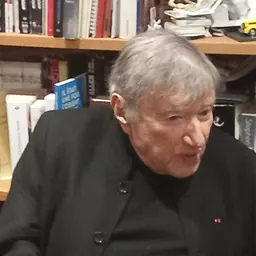
Born 1966. Christian Bök is a Canadian poet, photographer, university teacher and scholar of English.
Christian Bök, FRSC (; born August 10, 1966, in Toronto, Canada) is a Canadian poet known for his experimental works. He is the author of Eunoia, which won the Canadian Griffin Poetry Prize.
Life and work He was born "Christian Book", but uses "Bök" as a pseudonym.
He began writing seriously in his early twenties, while earning his B.A. and M.A. degrees at Carleton University in Ottawa. He returned to Toronto in the early 1990s to study for a Ph.D. in English literature at York University, where he encountered a burgeoning literary community that included Steve McCaffery, Christopher Dewdney, and Darren Wershler. Since 2004, he taught at the University of Calgary — but as of 2022, he works as an artist in Melbourne, Australia, and he serves as a Professor (Honorary Appointee) at Charles Darwin University in Darwin, Australia.
In 1994, Bök published Crystallography, "a pataphysical encyclopaedia that misreads the language of poetics through the conceits of geology." The Village Voice said of it: "Bök's concise reflections on mirrors, fractals, stones, and ice diabolically change the way you think about language — his, yours — so that what begins as description suddenly seems indistinguishable from the thing itself." Crystallography was reissued in 2003 Bök believes that "his book proves that each vowel has its own personality."
Edited by Darren Wershler and published by Coach House Books in 2001, Eunoia won the 2002 Griffin Poetry Prize and sold more than 20,000 copies. Canongate published "Eunoia" in Britain in October 2008. The book was also a bestseller there, reaching #8 on the Top 10 bestselling charts for the year. The Xenotext consists of a single sonnet (called "Orpheus"), which gets translated into a gene and then integrated into a cell, causing the cell to "read" this poem, and in reply, the cell builds a protein — one whose sequence of amino acids encodes yet another sonnet (called "Eurydice"). The cell becomes not only a durable archive for storing a poem, but also an operant machine for writing a poem. The gene has so far worked properly in cultures of E. coli, but the intended symbiote is D. radiodurans ("the dire seed, immune to radiation") — an extremophile, able to thrive in very inhospitable environments, deadly to most life on Earth.
According to Bök from an interview in 2007, the final product will include:
Bök has collaborated with laboratories at the University of Calgary, the University of Wyoming, and the University of Texas (Austin), to realize his design. In 2011, nine years after conceiving The Xenotext, Bök announced that labs had performed a successful test run of his "poetic cipher," meaning that:
In 2015, The Xenotext: Book 1 was published — a work consisting of meditations on both science and poetics (addressing their mythic drives for immortality). This first, "Orphic" volume sets the conceptual groundwork for the second, "Eurydicean" volume, which will document the experiment itself.
The Kazimir Effect In 2021, Bök published The Kazimir Effect (Penteract Press, 2021), listed as one of the Times Literary Supplement's Books of the Year 2021. This arose from a visual poetry project that begin in 2017, inspired by Suprematist Composition: White on White by Kazimir Malevich.
Recognition Eunoia won the Griffin Poetry Prize in 2002.
Bök's poem "Vowels" was used in the lyrics of a song on the EP A Quick Fix of Melancholy (2003) by the Norwegian band Ulver.
In 2006, Christian Bök and his work were the subject of an episode of the television series Heart of a Poet, produced by Canadian filmmaker Maureen Judge.
On May 31, 2011, The BBC World Service broadcast Bök reading "The Xenotext."
Don’t just read it —
keep it.
Full-length biographies made to live with: read them, listen on the way to work, watch them tonight.
- E-book
- Audio
- Video
Instant download · yours to keep · every purchase keeps this site free
Important facts
People in Christian Bök's life
Named in this biography and alive at the same time




Related people
Same field, nearest in time

Contemporaries
People whose lives overlapped Christian Bök's


Frequently asked questions
Who is Christian Bök?
Canadian poet (born 1966)
When was Christian Bök born?
Christian Bök was born on 10 August 1966 in Toronto.
What is Christian Bök's occupation?
Christian Bök is a poet, photographer, university teacher and scholar of English.
What nationality is Christian Bök?
Christian Bök is Canadian.
Sources & further reading
Cite this page
APA: Biography.guide. (2026). Christian Bök. https://biography.guide/christian-bok/
MLA: "Christian Bök." Biography.guide, https://biography.guide/christian-bok/.
Chicago: "Christian Bök." Biography.guide. https://biography.guide/christian-bok/.
Data last updated: 2026-09-25 · Spot an error? Report a correction.
Page generated 2026-09-27 05:11 UTC