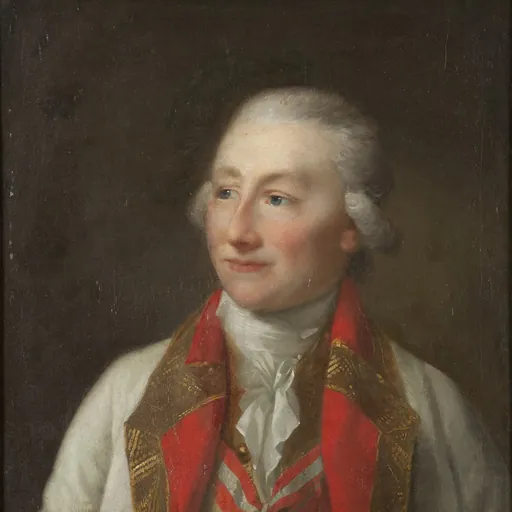
Christian August, Prince of Waldeck and Pyrmont
Austrian and Portuguese General
About Christian August, Prince of Waldeck and Pyrmont
Lived 1744 – 1798 (aged 53). Christian August, Prince of Waldeck and Pyrmont was an art collector, military personnel and military officer.
Christian August, Prince of Waldeck and Pyrmont (; ; 6 December 1744, Arolsen – 24 September 1798, Palácio Nacional de Sintra, Sintra, near Lisbon) was a general in the Austrian service, and last commander and Field Marshal of the Portuguese land army.
Life Christian August was the third son of Prince Karl August of Waldeck and Pyrmont and his wife Countess Palatine Christiane Henriette of Zweibrücken-Birkenfeld.
He was a friend of the arts, and through his parents he was inspired by antiquity. Therefore, his Grand Tour took him to Italy where he was one of the temporary companions of Johann Wolfgang von Goethe on his Italian Journey. Goethe spoke approvingly of a common trip to Pozzuoli and "the company of such a perfect and well educated prince". Waldeck suggested to Goethe to travel together to Croatia and Greece. Goethe declined: "If one looks out into the world and enters the world enters, then one should be wary, so one is isn't carried away or perhaps even goes crazy". Christian August later contributed significantly to the large collection of antiques in the Waldecker Arolsen Castle.
Like his father, the last commander of the Dutch army in the War of the Austrian Succession, Christian August also entered into the military service. In 1770 he was made a lieutenant colonel in the Austrian Dragoon Regiment No. 39 Karl August, Count Palatine of Zweibrücken-Birkenfeld. A year later he became commander of that unit. He fought as a volunteer on the Russian side in the Russo-Turkish War (1768-1774) against the Ottoman Empire. In 1773 he returned with the rank of colonel back to his Austrian regiment, and the Emperor appointed him to be its keeper. Henceforth it was called Dragoon Regiment No. 39 Prince Waldeck. In 1781, he published his ("Small corrections to an attempt to describe the history of the Bavarian War of Succession"). In the Russo-Turkish War (1787-1792), he served under Field Marshal Ernst Gideon von Laudon. He won some battles and was promoted to lieutenant field marshal.
As such, Christian August of Waldeck commanded a division against the French troops at the beginning of the War of the First Coalition in 1792. He was wounded while exploring the fortress Thionville and lost his left arm.
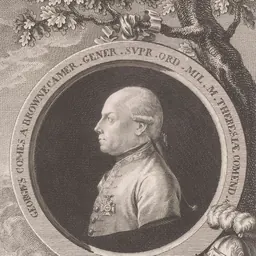
He was summoned to Vienna and was commissioned by Emperor Francis II to write a plan of operations for the joint Austro-Prussian army in the Rhineland, which was however not accepted by Prussia. After painstaking negotiations, he succeeded to persuade the Prussian king to start an offensive in the Alsace. Christian August of Waldeck was in command of an Austrian corps, part of an army commanded by General Dagobert Sigmund von Wurmser. At the conquest of Wissembourg, he commanded the first column to attack. With his troops he crossed the Rhine at Selz on 13 October 1793 and attacked the French defenders in the back while general Wurmser opened frontal attack on the enemy at Wissembourg. Waldeck thus contributed to the decisive victory at Wissembourg. He also distinguished himself in subsequent battles. When general Wurmser retired in 1794, Christian August took command of the Austrian Army on the Rhine, until he had to hand over command to Imperial Count Johann Georg von Browne. He was awarded the Commander's Cross of the Military Order of Maria Theresa for his achievements at Wissembourg and promoted to general of cavalry.
In 1794, he succeeded Karl Mack von Leiberich as quartermaster general of the Austrian army in the Austrian Netherlands under Prince Josias of Saxe-Coburg-Saalfeld. A short time later he became a member of the War Council in Vienna. In 1796, he received the general command over Bohemia.
In 1797 he was asked to take over command of the Land Army of Portugal. With the consent of the Emperor, he took on this job. However, he was unable to reorganize the army, because some influential personalities opposed his plan. He died soon afterwards on 24 September 1798 of "dropsy of the chest".
Christian August von Waldeck-Pyrmont was buried in the British Cemetery in Lisbon on 28 September 1798. The king of Portugal himself donated a tomb monument in the form of a marble pyramid.
Ancestry
References and sources Louis Curtze: Geschichte und Beschreibung des Fürstentums Waldeck. Arolsen, 1850 p. 620 ff (Digitized)
Footnotes
Don’t just read it —
keep it.
Full-length biographies made to live with: read them, listen on the way to work, watch them tonight.
- E-book
- Audio
- Video
Instant download · yours to keep · every purchase keeps this site free
Important facts
Family & relationships
People in Christian August, Prince of Waldeck and Pyrmont's life
Named in this biography and alive at the same time
Related people
Same field, nearest in time



Contemporaries
People whose lives overlapped Christian August, Prince of Waldeck and Pyrmont's




Frequently asked questions
Who was Christian August, Prince of Waldeck and Pyrmont?
Austrian and Portuguese General (1744–1798)
When was Christian August, Prince of Waldeck and Pyrmont born?
Christian August, Prince of Waldeck and Pyrmont was born on 6 December 1744 in Bad Arolsen.
When did Christian August, Prince of Waldeck and Pyrmont die?
Christian August, Prince of Waldeck and Pyrmont died on 25 August 1798 in Sintra.
What was Christian August, Prince of Waldeck and Pyrmont's occupation?
Christian August, Prince of Waldeck and Pyrmont was an art collector, military personnel and military officer.
What nationality was Christian August, Prince of Waldeck and Pyrmont?
Christian August, Prince of Waldeck and Pyrmont's recorded nationality: Kingdom of Portugal.
Sources & further reading
· Wikipedia: Christian August, Prince of Waldeck and Pyrmont
· DBpedia: Christian August, Prince of Waldeck and Pyrmont
Cite this page
APA: Biography.guide. (2026). Christian August, Prince of Waldeck and Pyrmont. https://biography.guide/christian-august-prince-of-waldeck-and-pyrmont/
MLA: "Christian August, Prince of Waldeck and Pyrmont." Biography.guide, https://biography.guide/christian-august-prince-of-waldeck-and-pyrmont/.
Chicago: "Christian August, Prince of Waldeck and Pyrmont." Biography.guide. https://biography.guide/christian-august-prince-of-waldeck-and-pyrmont/.
Data last updated: 2026-09-27 · Spot an error? Report a correction.
Portrait: Wikimedia Commons · author & licence
Page generated 2026-10-04 12:16 UTC