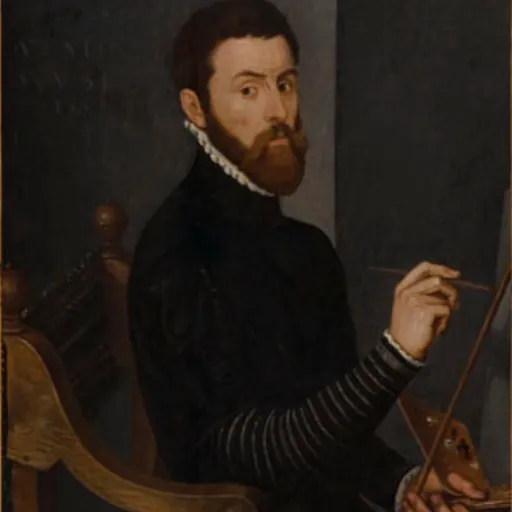
Chrispijn van den Broeck
Flemish painter, draughtsman and print designer
About Chrispijn van den Broeck
Lived 1523 – 1591 (aged 67–68). Chrispijn van den Broeck was a Belgian painter, visual artist, copper engraver, draftsperson and illustrator.
Chrispijn van den Broeck (1523 – c. 1591) was a Flemish painter, draughtsman, print designer and designer of temporary decorations. He was a scion of a family of artists, which had its origins in Mechelen and later moved to Antwerp. He is known for his religious compositions and portraits as well as his extensive output of designs for prints. He was active in Antwerp which he left for some time because of the prosecution of persons adhering to his religious convictions.
Life Chrispijn van den Broeck was born in Mechelen as the son of Jan van den Broeck, a painter. His family members included artists who were active in Mechelen. His family also used the Latinised name 'Paludanus'. He was probably trained by his father.
Chrispijn was then working in the workshop of the leading history painter Frans Floris. Frans Floris was one of the Romanist painters active in Antwerp. The Romanists were Netherlandish artists who had trained in Italy and upon their return to their home countries painted in a style that assimilated Italian influences into the Northern painting tradition. Van den Broeck remained in Frans Floris' workshop until the master's death in 1570. He was together with Frans Pourbus the Elder one of the collaborators of Floris who helped finish Floris' paintings after the master had become incapacitated due to the alcoholism in which he had sunk in his later years. According to the Flemish contemporary art historian and artist Karel van Mander, Chrispijn van den Broeck and Frans Pourbus completed an altarpiece for the Grand Prior of Spain left incomplete at the time of Floris' death.
Van den Broeck became a citizen of Antwerp in 1559.
In 1584, van de Broeck resided in Middelburg for a short time to escape the political and religious unrest in Antwerp. His name was last mentioned in the Guild records of 1589 in connection with a payment. His wife is mentioned as a widow on 6 February 1591. Chrispijn van den Broeck must therefore have died sometime between 1589 and 6 February 1591, most likely in Antwerp.
Van den Broeck's painting Two Young Men (Fitzwilliam Museum) is a double portrait of two cheerful young men or adolescent boys. They are wearing fancy clothes in Italian fashion which were likely also worn by fashionable young men in 16th century Flanders. Their embrace and smiling glances show that the relationship between the two men is close. The boy in black seems to be offering his friend an apple while he looks at the viewer with a smile. The other boy looks with a smile at the boy in black. While an apple was often used as a symbol of physical love, it would be wrong to assume the painting depicts two homosexual lovers. The boys' physical likeness indicates that they are more likely brothers. Based on the symbols used throughout the painting, its subject appears to be death. Two dark owl heads peek out over each shoulder of the boy in black while a crow's or raven's head in profile with its sharp beak pointed towards the boy in black juts out from the right side of the head of the boy in red. Both the owl and the raven are traditional symbols of death. The stone panel at the top of the picture bears the artist's initials and recalls funerary sculpture.
A total of 146 drawings have been attributed with certainty to van den Broeck. Of these, 89 are designs for engravings. His earliest drawing is dated 1560.
His designs were engraved by engravers such as Abraham de Bruyn, Jan Collaert the Elder and Johannes Wierix. He designed the illustration of the allegory of the Low Countries used in Lodovico Guicciardini's Descrizione di tutti I Paesi Bassi (1567).
Don’t just read it —
keep it.
Full-length biographies made to live with: read them, listen on the way to work, watch them tonight.
- E-book
- Audio
- Video
Instant download · yours to keep · every purchase keeps this site free
Important facts
more
Crispiaen van den Broeck, Paludanus Broeck, Crispijn van den Broeck, Chrispin van den Broeck, Crispin Broeck, Crispyn van den Broeck, Crispin Vandenbroeck, Crispin Vander Broech, Crispiaen van den Broecke, Paludanus, Kerstiaen van den BroeckPeople in Chrispijn van den Broeck's life
Named in this biography and alive at the same time




Related people
Same field, nearest in time

Contemporaries
People whose lives overlapped Chrispijn van den Broeck's






Frequently asked questions
Who was Chrispijn van den Broeck?
Flemish painter, draughtsman and print designer (1523-1591)
When was Chrispijn van den Broeck born?
Chrispijn van den Broeck was born in 1523 in Mechelen.
When did Chrispijn van den Broeck die?
Chrispijn van den Broeck died in 1591 in Antwerp.
What was Chrispijn van den Broeck's occupation?
Chrispijn van den Broeck was a painter, visual artist, copper engraver, draftsperson and illustrator.
What nationality was Chrispijn van den Broeck?
Chrispijn van den Broeck was Belgian.
Sources & further reading
· Wikipedia: Chrispijn van den Broeck
· DBpedia: Chrispijn van den Broeck
Cite this page
APA: Biography.guide. (2026). Chrispijn van den Broeck. https://biography.guide/chrispijn-van-den-broeck/
MLA: "Chrispijn van den Broeck." Biography.guide, https://biography.guide/chrispijn-van-den-broeck/.
Chicago: "Chrispijn van den Broeck." Biography.guide. https://biography.guide/chrispijn-van-den-broeck/.
Data last updated: 2026-09-20 · Spot an error? Report a correction.
Portrait: Wikimedia Commons · author & licence
Page generated 2026-09-27 04:57 UTC