
About Frans Pourbus the Elder
Lived 1545 – 1581 (aged 35–36). Frans Pourbus the Elder was a painter and visual artist.
Frans Pourbus the Elder (Bruges, 1545 – Antwerp, 19 September 1581) was a Flemish Renaissance painter who is known primarily for his portraits and religious compositions, as well as a few genre scenes. He was the son of the prominent Bruges painter and cartographer Pieter Pourbus and the father of Frans Pourbus the Younger who became an international portraitist of the European ruling class.
Life Frans Pourbus was born in Bruges as the son of the prominent painter Pieter Pourbus. Pieter Pourbus was originally from Gouda and had moved with his family to Bruges at a very young age. Here he had made a career as a painter of portraits and religious compositions. The mother of Frans was Anna Blondeel, the daughter of Lancelot Blondeel (1498 – 4 March 1561), a prominent painter, architect, surveyor and cartographer active in Bruges. Frans started his training with his father who taught him to paint in the traditional Flemish style. The year he started to work in his father's workshop is not recorded. Around 1550, when he was only 15 years old, he became the chief assistant in the workshop. Frans Floris was mainly known for his history paintings and portraits. Floris played an important role in the movement in Northern Renaissance painting referred to as Romanism. The Romanists had typically travelled to Italy to study the works of leading Italian High Renaissance artists such as Michelangelo, Raphael and their followers. Their art assimilated these Italian influences into the Northern painting tradition. It is likely that Frans Pourbus' father knew Frans Floris personally and had sent his son to study with the leading Italianising painter in Flanders. Frans Floris soon recognised the talent of his new pupil and allowed him to complete his unfinished canvases.
According to the contemporary Flemish biographer Karel van Mander Pourbus intended to travel to Italy in 1566, a trip taken by many of his fellow artists at the time, but abandoned his plans after traveling from Antwerp to Ghent to visit the painter-poet Lucas de Heere. Karel van Mander was at the time a pupil of de Heere. Van Mander recounts that Pourbus clearly did not have his heart in his trip to Italy as he had lost it to the niece of his master. Pourbus travelled back to Antwerp where he married Suzanna Floris, the niece of his master Frans Floris and daughter of Cornelis Floris de Vriendt, a prominent sculptor and architect. Pourbus was a standard-bearer of the civil guard. He became critically ill during the performance of his civil guard duties. He caught typhoid fever by resting near a sewer pipe in the guardhouse where he was stationed. He died as a result on 19 September 1581. His father survived him. His widow married the painter Hans Jordaens the Elder. He also painted a few genre scenes. He painted 14 panels representing the History of Saint Andrew (1572) and a Triptych of Viglius Aytta (1571) for the St Bavo's Cathedral, Ghent.
In 1574 Frans Pourbus the Elder received an important commission from the Saint-Martin Abbey, Tournai to redecorate the choir of the abbey church after the damage caused by the Iconoclastic fury of the Beeldenstorm of 1566. He painted 17 works in three series: a series of the Passion of Christ, which was placed in the choir, a series of the Crucified Christ with the thieves, which was placed in the high altar while the pendants were integrated in the paneling above the choir stalls. The reverse sides of the panels depicting stories from the Life of Saint Martin were visible along the choir aisle.
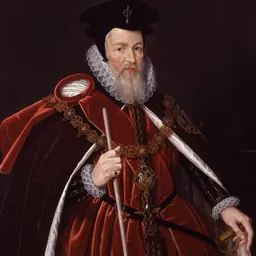
Portraits
During Pourbus' lifetime a number of portrait painters were active in the Habsburg Netherlands. Because of the similarities in style, the works of Pourbus and his near contemporaries Mor and Adriaen Thomasz. Key are regularly misattributed to each other. Pourbus' merry companies often depict people from the middle class enjoying an outdoor party rather than the lowly peasant scenes that were often the subject of this genre. A good example is the Merry company auctioned at Lempertz on 21 November 2009 (lot 1018B). The male and female participants in this composition are wearing clothes in the latest fashion such as high hats, puffed pants and ruff collars. They are enjoying themselves in the outdoors in a garden with plenty of food, drink, music and dance. The scene also includes a black page and a jester. The composition includes allusions to the aristocratic pursuit of hunting such as the dog in the foreground and the falcon on the right. Some couples on the right have separated themselves from the revelers at the table and their amorous intentions are all too clear.
In most cases the moralizing message of a 'buitenpartij' is to warn the viewers to distance themselves from the pleasures and excesses depicted, as these should be morally condemned as a frivolous waste of time and as worldly vanity. One of the origins of the type of the "buitenpartij" is the pictorial tradition of religious representations of a Biblical subject such as "The Prodigal Son", in which a moral story is told through depictions of drunken feasts with erotic overtones. It is possible that Pourbus also intended to convey such a religious or moralising message in his buitenpartijen.
Don’t just read it —
keep it.
Full-length biographies made to live with: read them, listen on the way to work, watch them tonight.
- E-book
- Audio
- Video
Instant download · yours to keep · every purchase keeps this site free
Important facts
more
Frans Poelibus, Frans, I Pourbus, the Elder Pourbus, Frans Porbus, Frans Pourbus d. Ä., le vieux Porbus, Franz Pourbus d. Aelt., Porbur père, Frans Pourbus d. Ae., Porbus, Pourbus d.Äe, Franz Pourbus, frans de pourbus d. ae., franz pourbus d. ae., Pourbus le vieux, Der Ältere Pourbus, Poelibus, Frans d. Ä. Pourbus, Frans Pourbus DFamily & relationships
People in Frans Pourbus the Elder's life
Named in this biography and alive at the same time




Related people
Same field, nearest in time


Contemporaries
People whose lives overlapped Frans Pourbus the Elder's




Frequently asked questions
Who was Frans Pourbus the Elder?
Flemish painter (1545–1581)
When was Frans Pourbus the Elder born?
Frans Pourbus the Elder was born in 1545 in Bruges.
When did Frans Pourbus the Elder die?
Frans Pourbus the Elder died on 29 September 1581 in Antwerp.
What was Frans Pourbus the Elder's occupation?
Frans Pourbus the Elder was a painter and visual artist.
What nationality was Frans Pourbus the Elder?
Frans Pourbus the Elder's recorded nationality: Habsburg Netherlands.
Sources & further reading
· Wikipedia: Frans Pourbus the Elder
· DBpedia: Frans Pourbus the Elder
Cite this page
APA: Biography.guide. (2026). Frans Pourbus the Elder. https://biography.guide/frans-pourbus-the-elder/
MLA: "Frans Pourbus the Elder." Biography.guide, https://biography.guide/frans-pourbus-the-elder/.
Chicago: "Frans Pourbus the Elder." Biography.guide. https://biography.guide/frans-pourbus-the-elder/.
Data last updated: 2026-09-20 · Spot an error? Report a correction.
Page generated 2026-09-27 05:21 UTC