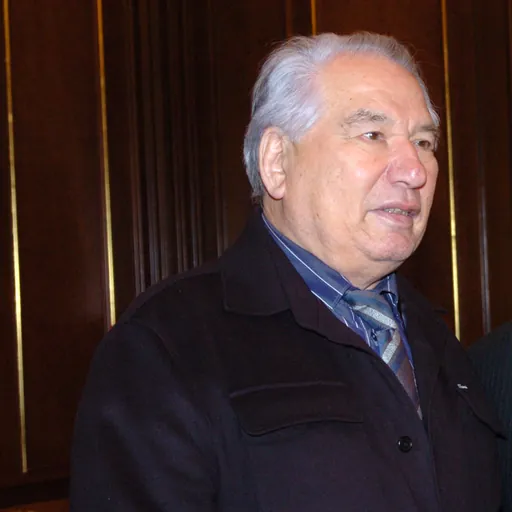
About Chingiz Aĭtmatov
Lived 1928 – 2008 (aged 79). Chingiz Aĭtmatov was a Russian and Kyrgyz politician, diplomat, journalist, translator, novelist and screenwriter.
Chinghiz Torekulovich Aitmatov (12 December 1928 – 10 June 2008) was a Kyrgyz author who wrote mainly in Russian, but also in Kyrgyz. He is one of the best-known figures in Kyrgyz literature.
Life He was born to a Kyrgyz father and Tatar mother. Aitmatov's parents were civil servants in Sheker. In 1937, his father was charged with "bourgeois nationalism" in Moscow, arrested, and executed in 1938.
By 1990 he fulfilled a number of board and administrative positions including on the Supreme Soviet's Committee for Culture and National Languages and the Union of Soviet Writers. at the 7th Moscow International Film Festival, in 1971; and in 2002 was president of the jury at the 24th Moscow International Film Festival. In 1994, he was a member of the jury at the 44th Berlin International Film Festival.
On 16 May 2008, Aitmatov was admitted with kidney failure to a hospital in Nuremberg, Germany, where he died of pneumonia on 10 June 2008 at the age of 79. and where his father most likely is buried.
His obituary in The New York Times characterized him as "a Communist writer whose novels and plays before the collapse of the Soviet Union gave a voice to the people of the remote Soviet republic of Kyrgyz" and adds that he "later became a diplomat and a friend and adviser to the Soviet leader Mikhail Gorbachev."
Literary career
Chinghiz Aitmatov belonged to the post-war generation of writers. His output before his well-known work Jamila in 1958 was not significant. Aitmatov's first two publications appeared in 1952 in Russian: "Газетчик Дзюйо" ("The Newspaper Boy Dziuio") and "Ашым" ("Ashim"). His first work published in Kyrgyz was "Ак Жаан" ("White Rain", 1954). Two other short novels from that period are "Трудная переправа" ("A Difficult Passage", 1956) and "Лицом к лицу" ("Face to Face", 1957). But it was Jamila that came to prove the author's work. Seen through the eyes of an adolescent boy, it tells of how Jamila, a village girl, separated from her soldier husband by the war, falls in love with a disabled former soldier staying in their village as they all work to bring in and transport the grain crop.
1980 saw his novel The Day Lasts More Than a Hundred Years; his next significant novel, The Place of the Skull, was published in 1987. The Day Lasts More than a Hundred Years and other writings were translated into several languages.
Aitmatov's art was glorified by admirers. But even critics of Aitmatov mentioned the high quality of his work. Aitmatov's writing has some elements that are unique specifically to his creative process. His work drew on folklore, not in the ancient sense of it; rather, he tried to recreate and synthesize oral tales in the context of contemporary life. This is prevalent in his work; in nearly every story he refers to a myth, a legend, or a folktale. This collection in Russian should not be confused with the 1969 collection in English titled as well "Tales of the Mountains and Steppes" which is a different compilation containing the three novels Jamila, Duishen and Farewell, Gyulsary! (besides an introduction by A. Turkov Speak out in Golden Words of Truth). He was later awarded a State prize for Farewell, Gyulsary!.
Some of his stories were filmed, like The First Teacher in 1965, Jamila in 1969, and several times To Have and to Lose.
As with many educated Kyrgyz, Aitmatov was fluent in both Kyrgyz and Russian. As he explained in one of his interviews, Russian was as much of a native language for him as Kyrgyz. Most of his early works he wrote in Kyrgyz; some of these he later translated into Russian himself, while others were translated into Russian by other translators. From 1966, he was writing in Russian. By the mid-1990s, as his reputation in Kyrgyzstan was well established, Russian critics attacked him and his 1995 novel Tavro Kassandry ("The Mark of Cassandra")--unfairly, according to literary critic Keneshbek Asanaliev, who commented that Aitmatov's Kyrgys detractors simply reprinted an attack piece by Russian critic V. Bondarenko. The latter also claimed that Aitmatov was anti-Russian, a claim that Asanaliev ridicules.
Diplomatic career In addition to his literary work, Chinghiz Aitmatov was a diplomat who was accredited by 3 countries.
From 1990 to 1993, he was ambassador for the Soviet Union to Luxembourg, but at the collapse of the Union, he was re-accredited by Russia to Luxembourg. Then from 2000 to 2008, he was accredited by Kyrgyzstan to be its ambassador to the European Union, NATO, UNESCO and the Benelux countries, then France. State Prize of the Kyrgyz SSR (1976) Lenin Prize (1963) 1983) Two Order of Lenin (2 July 1971, 31 July 1978) Two Order of the Red Banner of Labor (4 May 1962 and 28 October 1967) Medal "For Distinguished Labour" (1 November 1958) Uzbekistan – Order of Outstanding Merit (11 December 1998) Kazakhstan – Order of Fatherland (23 January 1999) Azerbaijan – Order of Friendship (25 February 2008) Poland – Order of the Smile
Major works in English translation
Jamila / Jamilia («», 1958) in compilation Tales of the Mountains and Steppes, Progress Publishers (1969). (translated by Olga Shartse) Camel's Eye / Camel Eye («», 1961) in compilation Anthology of Soviet Short Stories, two volumes, compiled by Nikolai Atarov, Volume 2, pp. 54–86, Progress Publishers (1976). ("Camel's Eye", translated by Olga Shartse) in compilation Mother Earth and Other Stories, Faber (1989). ("Camel Eye", translated by James Riordan) Duishen / The First Teacher («», 1962) in compilation Short Novels, Progress Publishers (1965). (translated by John French) The Ascent of Mt. Fuji («», written together with Kaltai Mukjamedzhanov, 1973). Farrar, Straus and Giroux (1975). (translated by Nicholas Bethell) Cranes Fly Early («», 1975). Raduga Publishers (1983). (translated by Eve Manning) Piebald Dog Running Along the Shore / Spotted Dog Running Along the Seashore («» / «», 1977) in compilation Piebald Dog Running Along the Shore and Other Stories, Raduga Publishers (1989). ("Piebald Dog Running Along the Shore", translated by Alex Miller) in compilation Mother Earth and Other Stories, Faber (1989). ("Spotted Dog Running Along the Seashore", translated by James Riordan) The Day Lasts More Than a Hundred Years («», 1980). Indiana University Press (1983). (translated by John French) The Place of the Skull («», 1987). Grove Press (1989). (translated by Natasha Ward) The Time to Speak Out («», 1988). Library of Russian and Soviet Literary Journalism, Progress Publishers (1988). (translated by Paula Garb) The White Cloud of Genghis Khan («», 1990). Independently Published (2023). (translated by Dan Szetela) The Plaint Of The Hunter Above The Abyss («», written together with Mukhtar Shakhanov, 1993). Atamura Corporation, Almaty, Kazakhstan (1998). (translated by Walter May)
Don’t just read it —
keep it.
Full-length biographies made to live with: read them, listen on the way to work, watch them tonight.
- E-book
- Audio
- Video
Instant download · yours to keep · every purchase keeps this site free
Important facts
more
Chinghis Aitmatov, Chingiz Torekulovich Aĭtmatov, Chinguiz Aitmatov, Chyn︠g︡gyz Aĭtmatov, Chynhiz Aĭtmatov, Cingiz Aitmatov, Genghis Aĭtmatov, Sh. Aĭtmatov, Shyn︠g︡ghys Aĭtmatov, Tšingiz Aitmatov, Tšõngõz Aitmatov, Ciṅgīza Āitmātova, Tschingis Aitmatow, Ciṅkis Aitmāttav, Čingiz Ajtmatov, Djingiz Ajtmatov, Cengiz Aytmatov, Tshīnghīz Aytmātūf, Chingiz Aitmatov, KaPeople in Chingiz Aĭtmatov's life
Named in this biography and alive at the same time






Related people
Same field, nearest in time




Contemporaries
People whose lives overlapped Chingiz Aĭtmatov's




Frequently asked questions
Who was Chingiz Aĭtmatov?
Soviet and Kyrgyz author (1928–2008)
When was Chingiz Aĭtmatov born?
Chingiz Aĭtmatov was born on 12 December 1928 in Sheker.
When did Chingiz Aĭtmatov die?
Chingiz Aĭtmatov died on 10 June 2008 in Nuremberg.
What was Chingiz Aĭtmatov's occupation?
Chingiz Aĭtmatov was a politician, diplomat, journalist, translator, novelist and screenwriter.
What nationality was Chingiz Aĭtmatov?
Chingiz Aĭtmatov was Russian and Kyrgyz.
Sources & further reading
Cite this page
APA: Biography.guide. (2026). Chingiz Aĭtmatov. https://biography.guide/chingiz-aitmatov/
MLA: "Chingiz Aĭtmatov." Biography.guide, https://biography.guide/chingiz-aitmatov/.
Chicago: "Chingiz Aĭtmatov." Biography.guide. https://biography.guide/chingiz-aitmatov/.
Data last updated: 2026-09-23 · Spot an error? Report a correction.
Portrait: Wikimedia Commons · author & licence
Page generated 2026-09-27 05:05 UTC