
Ching-Thang Khomba
Manipuri monarch
About Ching-Thang Khomba
Lived 1748 – 1799 (aged 50–51).
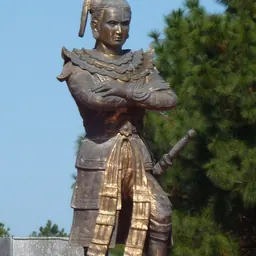
Bhagya Chandra (also known as Ching-Thang Khomba and Jai Singh) (1748–1798) was a king of Manipur in the 18th century CE. He was the grandson of Gharib Niwaz and ruled Manipur for almost forty years (1759–1798). During his rule, he faced several invasions from the Burmese empire, introduced cultural reforms, consolidate Moirang kingdom into Meitei kingdoms and went into exile, but eventually made peace with Burma.
Bhagya Chandra is known for spreading Vaishnavism in the Manipur state. He invented the Manipuri Raas Leela dance. His daughter (Shija Laioibi) played the role of Radha at the first performance and became a popular figure in Manipur.
Background
Bhagya Chandra was a grandson of King Gharib Niwaz, born to his eldest Syam Sai. Syam Sai was the legitimate heir to Gharib Niwaz, but the latter promised the throne to a son of his second wife, Chit Sai (Ajit Shah). Accordingly when Gharib Niwaz abdicated in 1748, Chit Sai became the king. According to the Royal Chronicle, Chit Sai expelled Gharib Niwaz in 1750 and the latter went to Burma, where his niece Sicha was a queen. Syam Sai was also in Burma at this time. In 1751, it was reported that both Gharib Niwaz and Syam Sai had "returned", and Chit Sai sent an expedition to have them killed, and it was done "on the banks of Brahmaputra", according to the royal chronicle.
Chit Sai's treachery was soon discovered and he was chased out of Manipur. He fled to Kachar. His brother Bharat Sai (Bharat Shah) took the throne. But he was also thrown out within a year.
In 1753, Syam Sai's eldest son Gourisiam (or Gour Shah, also known as Marampa) became the king. A Manipuri tradition states that Gourisiam and Bhagya Chandra made a pact to rule alternatingly in five year terms. Accordingly, Gourisiam abdicated in 1759 allowing Bhagya Chandra to ascend the throne.
Burmese invasions While Manipur was going through such turmoil, Burma was rejuvenating itself. The Toungoo dynasty collapsed soon after Gharib Niwaz's death, and Alaungpaya rose to be king, founding a fresh Konbaung dynasty in 1752. The Burmese also started using firearms, possibly acquired from European traders.
The Burmese record states that the Manipuris invaded again in 1754 and Alaungpaya set out to settle scores with Manipur. He personally led an invasion in 1758. Gaurisiam sent Bhagyachandra and his uncle Anand Sai to meet the invasion at Samjok and Tamu respectively. The Tamu force got repulsed to Kakching. Gaurisiam went to join it at Kakching, possibly with additional forces, but they were all defeated. Bhagyachandra fought at Leisangkhong, but he was also defeated. The Manipur Chronicle states that the country was devastated. The Burmese established themselves in the "Land of Meeteis". According to a historian of Burma, Alaungpaya halted in Imphal for thirteen days, took what loot there was (many residents having fled to the hills), threw two heavy cannons into the river, and returned to Ava, while leaving permanent stockades at Tamu and Samjok. The Kabaw Valley was "permanently annexed".
This was only the first of many Burmese invasions to come.
Bhagyachandra ascended the throne in 1759, but his position became "precarious" due to the intrigues of his uncle Chit Sai (Ajit Shah), who was ensconced in Cachar and is said to have appealed to the British authorities for assistance in regaining the throne of Manipur. Upon hearing about this, Bhagyachandra sent his own mission, via an envoy called Haridas Gosain, to Harry Verelst, the Chief of Chittagong. Gosain argued the Manipuri case effectively, sought help against Burmese invasions, and persuaded the British that there were opportunities for trade with China via Manipur. As the British were preoccupied with the affairs in Delhi, it was not until 14th September 1762, that a formal treaty was signed by Haridas Gossain on behalf of Jai Singh and Harry Verelst.
Six companies of British sepoys were sent towards Manipur in 1763, with instructions to "fix post at Manipur and make themselves acquainted with the strength and disposition of the Burmese". The British troops made it as far as Khaspur, then capital of Kachari kingdom, but returned due to an impending war with Mir Qasim. It is also heard that heavy rains at that time hampered further progress and that the troops suffered losses due to sickness. Gourishyam, who had become king again in 1761, wrote to Verelst sending 500 gold rupees for the expenses incurred and promising to pay in produce for the troops to be stationed in Manipur. But the British cut off the transaction after this point. Gourishyam died in 1763, and Bhagyachandra became king again.
The Burmese king Hsinbyushin invaded in 1764, which is again said to be in response to a Manipuri invasion. The Burmese invasion was devastating, causing Bhagyachandra to flee to Tekhao, Assam. Hsinyubshin took away many captives, whom he used for populating his new capital at Ava. A sizeable Manipuri population was formed in Ava, serving in a variety of functions, most notably as cavalry.
Bhagya Chandra, along with his queen and a few loyal attendants, fled to Ahom (modern-day Assam), where they lived under the protection of its ruler, Rajeswar Singha.
First expedition After a test of faith, Bhagya Chandra appealed to Rajeswar Singha for military assistance. Singha agreed and sent an army to overthrow Chitsai and reinstate Bhagya Chandra. The expedition was set back in Nagaland where they were attacked by Naga tribesmen and poisonous snakes. Rajeswar Singha called off the unsuccessful venture in 1767.
Second expedition In November 1768, Bhagya Chandra and Rajeswar Singha decided to make another attempt to invade Manipur. Bhagya Chandra led 10,000 Ahom troops across the Kachar to the Mirap river. Many battles ensued between the Ahoms and Meiteis on one side, and the Naga, Chitsai and the Burmese on the other. In 1773, Bhagya Chandra was reinstated as the king of Manipur.
Reign
During his reign, the Meiteis repelled the Burmese from Manipur. Though his exploits did not equal to Pamheiba's exploits, his reign was characterised by security and consoliadation. He was a great patron of the arts and religion, and his strong Manipuri Vaishnavism reflected on the Meiteis. He was an ardent devotee of Chaitanya Mahaprabhu and during his reign a statue of Nityananda was created in 1795.
In 1796 he moved his capital to Kangla. A year later, on 5 February 1798, he abdicated the throne to his eldest son Rabinchandra. He spent his later years on pilgrimage to various Vaishnavite holy sites, including Nabadwip. He died on 25th December, 1798 in Murshidabad, West Bengal.
Seniority of Haochong and Ngaprum villages by a royal verdict Source:
In 1783, the villages of Haochong and Ngaprum villages contested over seniority and they were presented to the court. The descendants of Meitei King Naothingkhong went to establish village at Yireng mountain to do the formal works which were previously done by the Mayangs. After that, they established themselves in the villages at Haochong and later named as Haochongpan. The court officials examined the royal records and found that Ngaprum villages were established in the reign of Meetingu Khagemba. So, Haochong villages were senior to Ngaprum villages and a royal verdict of that were made known to both of the parties.
In Meitei legends, the real Bhagya Chandra was said to have had supernatural powers. To see whether the usurper was correct, Singha designed a test at the behest of his court. In a public arena, Bhagya Chandra, while unarmed, was to catch and tame a wild elephant.
Confronted with insurmountable odds, King Bhagyachandra is said to have prayed to Govinda (Krishna) for guidance. Govinda appeared to him in a dream and instructed him to enter the arena donning a garland while holding japa beads. At the end of the instructions, Govinda assured him of victory.
It was his daughter Shija Lailoibi who first took the role of Radha in the Manipuri Raas Leela dance.
Under the influence of Bengali missionaries, he also started the tradition of Sankirtan in Manipur.
Literary works Laithok Laikha Jogi
Don’t just read it —
keep it.
Full-length biographies made to live with: read them, listen on the way to work, watch them tonight.
- E-book
- Audio
- Video
Instant download · yours to keep · every purchase keeps this site free
Important facts
People in Ching-Thang Khomba's life
Named in this biography and alive at the same time

Contemporaries
People whose lives overlapped Ching-Thang Khomba's






Frequently asked questions
Who was Ching-Thang Khomba?
Manipuri monarch
When was Ching-Thang Khomba born?
Ching-Thang Khomba was born in 1748.
When did Ching-Thang Khomba die?
Ching-Thang Khomba died in 1799.
What nationality was Ching-Thang Khomba?
Ching-Thang Khomba's recorded nationality: Manipur.
Sources & further reading
· Wikipedia: Ching-Thang Khomba
Cite this page
APA: Biography.guide. (2026). Ching-Thang Khomba. https://biography.guide/ching-thang-khomba/
MLA: "Ching-Thang Khomba." Biography.guide, https://biography.guide/ching-thang-khomba/.
Chicago: "Ching-Thang Khomba." Biography.guide. https://biography.guide/ching-thang-khomba/.
Data last updated: 2026-09-26 · Spot an error? Report a correction.
Page generated 2026-09-27 05:13 UTC