
About Chief Zimmer
Lived 1860 – 1949 (aged 88). Chief Zimmer was an American baseball player.
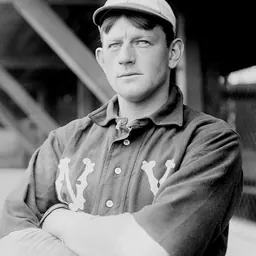
Charles Louis "Chief" Zimmer (November 23, 1860 – August 22, 1949) was an American professional baseball player whose playing career spanned from 1884 to 1906. He played for 19 seasons as a catcher in Major League Baseball (MLB), including 13 seasons for the Cleveland Blues/Spiders (1887–1899), three seasons for the Pittsburgh Pirates (1900–1902), and one season as the player/manager of the Philadelphia Phillies.
Zimmer is regarded by some as "the finest defensive catcher of his day." As a young man, he worked as an apprentice in a cabinetmaker's shop.
He began his professional baseball career at age 23 in 1884 playing in the Ohio State League for teams from Ironton and Portsmouth, Ohio. He appeared in eight games in the Major Leagues for the Detroit Wolverines in 1884. After being released by the Tigers, Zimmer did not play professional baseball in 1885. From 1889 to 1900, Zimmer was regularly among his league's leaders in putouts, assists, double plays, fielding percentage and games played at catcher. Zimmer secured his reputation for catching base runners when he caught the great base stealer "Sliding Billy" Hamilton twice in one game. Sporting Life at the time reported: "Bennett and Zimmer are the only League catchers who have managed to catch Hamilton at second. Zimmer is also the only catcher who has nailed Hamilton twice in one game." Games at catcher. Zimmer appeared in 125 games at catcher in 1890, a figure that stood until 1895 as the Major League record for most games played at the position in a single season. He also set a Major League record for consecutive games at catcher with 111 during the 1890 season, more than doubling the prior record. He led the National League in games caught for the second consecutive season in 1891 with 116 and ranked second in the league with 111 games at catcher in 1892. Double plays. Zimmer's 16 doubles plays as a catcher in 1895 broke the Major League record, and in 1900 he also broke Charlie Bennett's Major League record for most career double plays as a catcher. Fielding percentage. By 1896, Zimmer also had the highest career fielding percentage (.943) ever compiled by a Major League catcher.
Zimmer is also credited with being the first catcher, in 1887, to play from a squatting position directly behind the plate on every play. In prior years, catchers had played further behind the plate often standing, particularly with runners on base. In 1892, when asked how he kept his hands healthy so as to be able to catch in so many games, Zimmer also said he received regular hand massages: "He replied that he made it a practice to visit a massage establishment whenever his hands gave him the slightest cause for trouble. He argues that by the systematic rubbing of the joints all swellings and soreness can be remedied instantly."
Cleveland Blues/Spiders After brief stints with the Detroit Wolverines (eight games in 1884) and New York Metropolitans (six games in 1886), Zimmer joined the Cleveland Blues in 1887. He remained in Cleveland for 13 seasons from 1887 through 1899. Young's biographer, Reed Browing, noted that Young always credited Zimmer for his contributions: As Young's career progressed, no Major League pitcher was more outspoken than he in expressing how much a fine catcher enhanced his performance on the mound. Young and Zimmer quickly became the most famous battery of the 1890s. From the low point in 1890, Zimmer, the club and Young all improved remarkably. In 1891, Zimmer had a career-high 69 RBIs with a 1.6 Wins Above Replacement (WAR) rating. He caught 116 games in 1891,
The following year, in 1892, Zimmer compiled a career-high 3.2 WAR rating and led the 1892 Cleveland Spiders to a franchise best record of 93–56 (.624), good for second place in the National League. The 1892 season was also a breakout year for Young who compiled a 36–12 record with a 1.93 earned run average (ERA). After the 1892 season, Sporting Life described Zimmer as "a temperate, faithful and conscientious player" who was "a great local favorite" and said this about his ability to deter stolen bases: "His throwing is a holy terror to would-be base stealers, and very few men steal second off him when anything but a slow pitcher is in the box."
In July 1893, he suffered a broken shoulder bone and was able to play only 56 games behind the plate. The injury was sustained in a collision with Tommy Tucker. Cleveland newspapers protested and claimed that Tucker was a player with a reputation as a habitual dirty player who had acted intentionally to injure Zimmer. Despite the severity of the injury, the popular Zimmer returned to the lineup in September 1893 after seven weeks' absence, prompting the Sporting Life to predict: "Zimmer can play in Cleveland as long as he pleases."
In 1894, Zimmer became one of the first players to get six hits in a single game, doing so off Win Mercer. Zimmer was the batting hero of the 1895 Temple Cup, hitting a two-run home run to win the decisive game. His cup-winning home run was memorialized in a poem that included the following lines: The score was tied, one man was out,Tebeau was safe on third;As Zimmer grasped his mighty bat,Such cheering ne'er was heard.He swiftly swung his willow,The ball had met its fate;And a roar went up that reached the clouds,Tebeau had crossed the plate. and one week later reportedly signed a contract providing for him to be paid the maximum salary of $2,400 plus an $800 signing bonus. The Sporting Life reported: "If there is one player whose services Mr. Robison(Cleveland owner Frank Robison) cannot afford to lose, it is Charley Zimmer. In spring, summer and fall or any old time at all chief is in condition." On September 24, 1896, two masked men armed with revolvers woke Zimmer and his wife at their home at 43 Steinway Street in Cleveland. The intruders robbed Zimmer of his $60 gold watch and $20 in cash.
In 1897, at age 36, Zimmer continued to impress. He compiled a .316 batting average and a 1.9 WAR rating while helping Young win 20 games for the seventh consecutive season.
Louisville and Pittsburgh In June 1899, Zimmer was signed as a free agent by the Louisville Colonels. He appeared in 75 games for Louisville in 1899, compiling a .298 batting average.
The following year, Zimmer remained the oldest player in the Major Leagues at age 40. He caught 69 games for the 1901 Pirates team that won the National League pennant with a 90–49 record. During the 1901 season, Zimmer caught for his third Hall of Fame pitcher, Jack Chesbro.
In 1902, at age 41, Zimmer caught 41 games, compiled a .268 batting average, and maintained a respectable 1.1 WAR rating. Zimmer agreed and also appeared in 35 games as the team's catcher. Zimmer appeared in his final Major League game as a player at age 42 on September 27, 1903. By the first of June 1903, the Phillies were struggling with an 11–26 record. Zimmer at that time acknowledged that the "task of managing a team that does not stand so well up in the race is not the most pleasant one in the world", but he insisted that he was not discouraged and noted that the greater satisfaction comes not from taking charge of a first-class team and keeping it going, but "to take hold of a team that is down in the race and bring it up to a high standard." The Phillies did improve late in the season, compiling a 16–13 record in their last 29 games. However, with a seventh-place finish, the 1903 season was Zimmer's only one as a Major League manager. In fairness to Zimmer, the Phillies simply lacked the talent to compete with the best teams in the National League, had finished in seventh place in 1902 under Bill Shettsline, and dropped to eighth place in 1904 under Hugh Duffy.
Table games, cigars and groceries During his baseball career, Zimmer was among the highest paid players in the game. He invested his money wisely and was alert for investment opportunities. By 1900, his business interests included "upward of $35,000 invested in the grocery business and real estate in Cleveland."
The game featured a painted ball field with children peeking over the one-and-a-half inch outfield wall as well as lithographed images of Zimmer and 18 other players, including 11 Hall of Famers. The game was played with "a pool cue-type spring loaded device" and "metal clasps located at the nine positions to catch the ball."
In January 1892, Zimmer was offered "a big amount of money" for his interest in the game, and it was estimated "by judicious business management" that 100,000 copies of the game could be sold. In October 1892, Zimmer stated that he expected to sell "a great many of his parlor baseball inventions" over the winter and noted that one New York firm had purchased 600 from him. Two years later, he reported that he had a large number of orders for the game and that he had made over $4,000 from the game over the past three years.
Unlike many baseball players of his era, Zimmer used neither liquor nor tobacco. In 1890, the Sporting Life reported that there were likely no more than a half a dozen professional baseball players who could match Zimmer's claim: "He has never taken a drink of any kind of intoxicating liquor in his life, and has never used tobacco in any shape."
Players' Protective Association During the summer of 1900, the Players' Protective Association, predecessor to the Major League Baseball Players Association, was formed to represent the interest of professional baseball players. Zimmer was elected as the organization's first president with Hughie Jennings secretary. During Zimmer's tenure as president, the organization successfully negotiated for a new rule providing that a player could not be traded or sold without his consent.
Umpiring and comeback as a player During the 1904 and 1905 seasons, Zimmer worked as an umpire: first in the National League where he umpired 151 games in 1904, and then in the Eastern League (a minor league that later became the International League) in 1905.
The following year, he staged a comeback as a player at age 45. In February 1906, he was hired as the player/manager for the Little Rock Travelers in the Southern Association. Even at age 45, Zimmer still displayed superior arm strength. After a Little Rock victory in May 1906, the Sporting Life newspaper reported: "Little Rock showed wonderful improvement and defeated Birmingham in a well-played game. The feature was the throwing of Zimmer to second." He appeared in 41 games as a player for Little Rock.
Zimmer was among a number of Cleveland players who played in an Old-Timers' Day in July 1921; Zimmer, aged 60, caught for his former battery-mate Cy Young, aged 55.
Family and later years Zimmer was married and had three daughters. During his playing career, he made furniture as a hobby during the off-season and filled his home in Cleveland with his handiwork. After retiring from baseball, Zimmer lived in Cleveland for the remainder of his life. He died there at age 88 in 1949. He was buried at Crown Hill Cemetery in Twinsburg, Ohio.
Don’t just read it —
keep it.
Full-length biographies made to live with: read them, listen on the way to work, watch them tonight.
- E-book
- Audio
- Video
Instant download · yours to keep · every purchase keeps this site free
Important facts
People in Chief Zimmer's life
Named in this biography and alive at the same time



Related people
Same field, nearest in time


Contemporaries
People whose lives overlapped Chief Zimmer's

Frequently asked questions
Who was Chief Zimmer?
Major League Baseball catcher
When was Chief Zimmer born?
Chief Zimmer was born on 23 November 1860 in Marietta.
When did Chief Zimmer die?
Chief Zimmer died on 22 August 1949 in Cleveland.
What was Chief Zimmer's occupation?
Chief Zimmer was a baseball player.
What nationality was Chief Zimmer?
Chief Zimmer was American.
Sources & further reading
Cite this page
APA: Biography.guide. (2026). Chief Zimmer. https://biography.guide/chief-zimmer/
MLA: "Chief Zimmer." Biography.guide, https://biography.guide/chief-zimmer/.
Chicago: "Chief Zimmer." Biography.guide. https://biography.guide/chief-zimmer/.
Data last updated: 2026-09-20 · Spot an error? Report a correction.
Page generated 2026-09-27 05:27 UTC