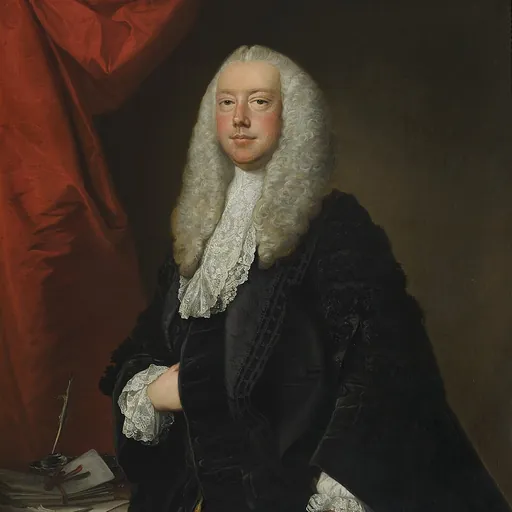
About Charles Yorke
Lived 1722 – 1770 (aged 47). Charles Yorke was a British politician and judge.
Charles Yorke PC (30 December 172220 January 1770) was a British lawyer and politician who briefly served as Lord High Chancellor of Great Britain. His father was also Lord Chancellor, and he began his career as a Member of Parliament. He served successively as Solicitor-General and Attorney-General for several governments, during which he was best known for writing what became the Quebec Act. He was appointed Lord Chancellor over his objections, but he committed suicide only three days after taking the post.
Life The second son of Philip Yorke, 1st Earl of Hardwicke, he was born in London, and was educated at Newcome's School in Hackney and Corpus Christi College, Cambridge. His literary abilities were shown at an early age by his collaboration with his brother Philip in the Athenian Letters. In 1745 he published an able treatise on the law of forfeiture for high treason, in defence of the severe sentences his father had given to the Scottish Jacobite peers following the Battle of Culloden. In the following year he was called to the bar.
His father being at this time Lord Chancellor, Yorke obtained a sinecure appointment in the Court of Chancery in 1747, and entered Parliament as member for Reigate, a seat which he afterwards exchanged for that for the University of Cambridge. He quickly made his mark in the House of Commons, one of his earliest speeches being in favour of his father's reform of the marriage law
In 1751, he became counsel to the East India Company, and in 1756 he was appointed Solicitor-General, a place which he retained in the administration of the elder Pitt, of whose foreign policy he was a powerful defender. On this account neither was his death a suicide, nor did he refuse to seal the patent for his peerage. Though remaining unsealed, the patent expired with its peer-designate.
Family
Charles Yorke was twice-married: She corresponded with William Gilpin, who instructed her and her three children in their art, and she also rendered some of Gilpin's works, including a view of Netley Abbey, as etchings.
She died in 1820. There is a monument to her at St Andrew's Parish Church, Wimpole, Cambridgeshire.
Don’t just read it —
keep it.
Full-length biographies made to live with: read them, listen on the way to work, watch them tonight.
- E-book
- Audio
- Video
Instant download · yours to keep · every purchase keeps this site free
Important facts
People in Charles Yorke's life
Named in this biography and alive at the same time


Related people
Same field, nearest in time




Contemporaries
People whose lives overlapped Charles Yorke's


Frequently asked questions
Who was Charles Yorke?
British politician and Lord Chancellor; (1722-1770)
When was Charles Yorke born?
Charles Yorke was born on 30 December 1722 in London.
When did Charles Yorke die?
Charles Yorke died on 20 January 1770 in London.
What was Charles Yorke's occupation?
Charles Yorke was a politician and judge.
What nationality was Charles Yorke?
Charles Yorke was British.
Sources & further reading
Cite this page
APA: Biography.guide. (2026). Charles Yorke. https://biography.guide/charles-yorke/
MLA: "Charles Yorke." Biography.guide, https://biography.guide/charles-yorke/.
Chicago: "Charles Yorke." Biography.guide. https://biography.guide/charles-yorke/.
Data last updated: 2026-09-24 · Spot an error? Report a correction.
Portrait: Wikimedia Commons · author & licence
Page generated 2026-09-27 05:08 UTC