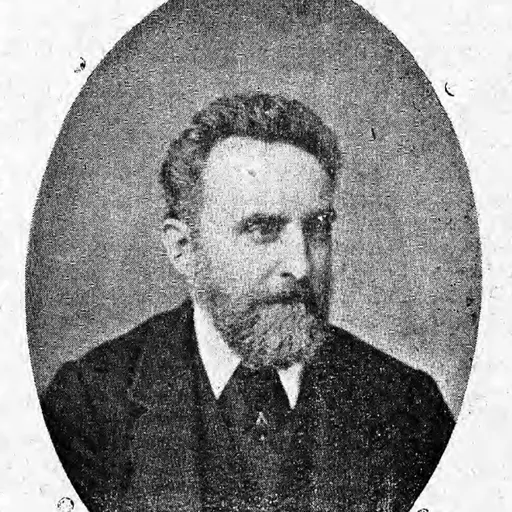
About Charles Wilkins
Lived 1830 – 1913 (aged 82). Charles Wilkins was a British postmaster, librarian and writer.
Charles Wilkins (bardic name: Catwg, 16 August 1830 – 2 August 1913) of Merthyr Tydfil, Glamorganshire, was a prolific writer of historical accounts of Wales and its industries. He produced pioneering reference works on the histories of Merthyr Tydfil and Newport; the coal, iron, and steel trades of South Wales; and Welsh literature. He was also founding editor of The Red Dragon: The National Magazine of Wales.
Background Charles Wilkins was born on 16 August 1830 in Stonehouse, Gloucestershire, the second of nine children of William Wilkins, a Chartist bookseller then postmaster, and Anna Maria Wilkins (née Jeens). From 1840 the family lived in Merthyr Tydfil, Glamorganshire. Leaving school at the age of fourteen,
Wilkins married Lydia Jeens in Stonehouse in 1859. She died giving birth to their third child in 1867. The following year, Wilkins married Mary Skipp in Topsley, Hereford; they had two children.
Wilkins was Glamorganshire secretary of the Cambrian Archaeological Association, a fellow of the Geological Society of London, and a member of the Aberystwyth College committee.
Historian, writer, editor alt=19th-century periodical's title page showing a drawing of a dragon. Motto: – "The Red Dragon will lead the way"
Wilkins' major works included the first histories of Merthyr Tydfil and Newport, a history of Wales, a history of Welsh literature, and histories of the coal, iron, and steel trades of South Wales.
In 1877, Wilkins was "initiated into the mysteries of the Druidic lore", and at the 1881 National Eisteddfod, held in Merthyr Tydfil, he won a £21 prize (approximately ) and gold medal for the best "History of the Literature of Monmouthshire and Glamorganshire from the earliest period to the present time." His bardic name was Catwg. However, at the time of his retirement in 1898 the degree was described as PhD, though he "never permitted the title to be made any use of". and "Dr Charles Wilkins". The Maine institution associated with the degree was closed in 1887 due to fraudulent transactions. |group=lower-alpha
From 1882 to 1885, Wilkins was editor and writer for the monthly periodical The Red Dragon: The National Magazine of Wales. This English language magazine published articles on Welsh history, biography, and poetry, and was a "calculated attempt to reach out to a new public literate in English but unschooled in a knowledge of Wales". Though traditional and conservative, it included women writers and displayed a "sense of admiration and affection for working people in Wales".
Death Wilkins died on 2 August 1913 at his home in Merthyr Tydfil and was buried at Cefn Cemetery, Merthyr Tydfil.
Legacy Except for his 1867 history of Merthyr Tydfil, reviews of Wilkins' major works were generally glowing, though not necessarily disinterested as they were published in newspapers for which Wilkins also wrote.
On his retirement in 1898, Wilkins was described as "a literary postmaster: successful editor, prolific writer, and sound historian – an Englishman with a Welshman's enthusiasm" He was described as "the first to write the history of Merthyr and Newport, the first to gather together the facts about the coal, iron, and steel trades of South Wales, and the first to set forth in due order the story of [Welsh] literature from 1300 to 1650."
Malcolm Ballin's modern study of Welsh periodicals notes that during Wilkins' editorship of The Red Dragon the magazine displayed a "sustained awareness of the pressures on the poor and a clear-sighted appreciation of the realities of working life"
Wilkins was a prolific pioneer in his field and later research has demonstrated some errors and imbalances in his writings. For example, Wilkins was the chief architect of Lucy Thomas' fame as "the mother of the Welsh steam coal trade". His 1888 account gives the impression of Thomas as an enterprising woman who actively went after new markets, whereas evidence now suggests that this work was mainly conducted by her agents, particularly George Insole. Later authors have also commented on the "notorious unreliability" of some of his work. Nevertheless, Wilkins' labours have "smooth[ed] the paths of all future writers on these subjects"
Literary editor Meic Stephens concluded that Wilkins "endeavoured, not least in the pages of The Red Dragon... to create in the English language a readership with sympathies like his own, and for that attempt, some fifty years before it became feasible, he deserves to be remembered". Wales, Past and Present (1870) (The History of Wales for Englishmen The History of the Literature of Wales from 1300 to 1650 (1884) The History of Newport (1886) The History of the Iron, Steel, Tinplate and Other Trades of Wales (1903).
Wilkins' other writings include: Storm and Calm (1870, fiction) Buried Alive: A Narrative of Suffering and Heroism, Being the Tale of the Rhondda Colliers, with Further Details (1877) Robert Fitzhamon: An Historical Romance of Glamorgan (1880, fiction) To be Sold by Auction (1881, fiction) A Memorial Sketch of the Visit of the Marquess of Salisbury to Newport, Mon. (1886) (The Salisbury Memorial: Gwent in the Old Days, The Morgan Family Merthyr Tydfil Illustrated: (including Aberdare, Dowlais and the Beacons) (1903, Edward J. Burrow ed.) Historical sketches of the Bute family, Noteworthy Men and Women of Wales (newspaper series), Welsh Industries (newspaper series), and Health and Holiday Resorts (newspaper series) numerous Red Dragon articles (1882–1885) such as: biographies of notable Welsh people, Shakespeare in Wales, The Shipping of Wales, Pioneers of the Welsh Iron Ore Industry.
Don’t just read it —
keep it.
Full-length biographies made to live with: read them, listen on the way to work, watch them tonight.
- E-book
- Audio
- Video
Instant download · yours to keep · every purchase keeps this site free
Important facts
People in Charles Wilkins's life
Named in this biography and alive at the same time


Related people
Same field, nearest in time




Contemporaries
People whose lives overlapped Charles Wilkins's




Frequently asked questions
Who was Charles Wilkins?
Welsh historian
When was Charles Wilkins born?
Charles Wilkins was born on 16 August 1830 in Stonehouse.
When did Charles Wilkins die?
Charles Wilkins died on 2 August 1913 in Merthyr Tydfil.
What was Charles Wilkins's occupation?
Charles Wilkins was a postmaster, librarian and writer.
What nationality was Charles Wilkins?
Charles Wilkins was British.
Sources & further reading
· DBpedia: Charles Wilkins (writer)
Cite this page
APA: Biography.guide. (2026). Charles Wilkins. https://biography.guide/charles-wilkins-postmaster/
MLA: "Charles Wilkins." Biography.guide, https://biography.guide/charles-wilkins-postmaster/.
Chicago: "Charles Wilkins." Biography.guide. https://biography.guide/charles-wilkins-postmaster/.
Data last updated: 2026-09-23 · Spot an error? Report a correction.
Portrait: Wikimedia Commons · author & licence
Page generated 2026-09-27 05:06 UTC