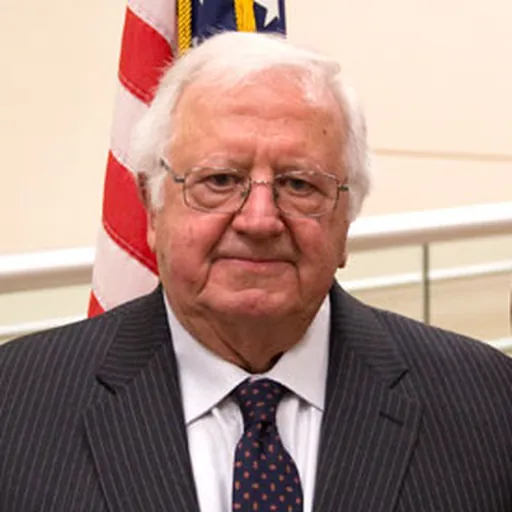
About Charles Warren
Lived 1927 – 2019 (aged 92). Charles Warren was an American lawyer and politician.
Charles Hugh Warren (April 26, 1927 – November 7, 2019) was an American lawyer and Democratic politician who served in the California State Assembly from 1963 to 1977 and held a Cabinet-level position as chairman of the Council on Environmental Quality (CEQ) under U.S. President Jimmy Carter from 1977 to 1979.
In the California State Assembly, Warren became a strong proponent of environmental initiatives. He was one of the principal authors of the Coastal Protection Act, which established the California Coastal Commission as a permanent body, and the bill that created the California Energy Commission. At CEQ, he oversaw the promulgation of legally binding regulations for federal agency compliance with the National Environmental Policy Act requirement for environmental impact statements.
Early life, education, and military service Warren was born in 1927 in Kansas City, Missouri, and spent most of his childhood there and in Kansas City, Kansas. When he was a young child, the family moved to Kansas City, Kansas, where he started elementary school, finishing elementary school in Kansas City, Missouri, after his family returned there. He attended Benton High School in St. Joseph, Missouri, where his family lived for about years, then returned to Kansas City, Missouri, where he graduated from Paseo High School in 1942 at age 15, having skipped two grades during his early education. Too young to join the United States military, which was absorbing the majority of male high school graduates in that World War II year, he took a job in North Kansas City with Standard Steel Works, a steel fabricating company that was manufacturing equipment for the military.
While he was working at the steel company, Warren began attending night school at a junior college in Kansas City, then enlisted in the military in the Army Specialized Training Program. As an Army trainee he was enrolled in an accelerated engineering program at Kansas State University. After doing well academically there, he was accepted into a military training program in Japanese language and area studies that was being conducted at Yale University. He completed that program shortly after his 18th birthday, having spent four-quarters at Yale. As an 18-year-old in the summer of 1945, he began basic training at Camp Roberts in California. His military training was cut short after Japan's surrender ended the war. The Army then sent him to the University of Minnesota to continue his studies of Japan and its language. After three months in Minnesota, he was sent to Japan, where he spent the final year of his U.S. Army service.
Career in government and law As a student in the Bay Area, Warren developed an interest in politics. He joined the San Francisco Young Democrats, serving as its chairman at one time, and helped to organize the California Democratic Council. After law school, Warren was admitted to the bar and joined a San Francisco law firm that represented labor unions. After some time there, he moved to Los Angeles, where he went to work for a larger law firm. In Los Angeles, he decided to focus his attention on his legal work and stayed out of politics for several years. He became engaged in electoral politics in 1961 after Democratic political operative Dick Tuck, who knew Warren from his political activity in San Francisco, encouraged him to become a candidate for a Republican-held California State Assembly seat in a Los Angeles County district. The state system, which cost some $137 million and took more than a decade to implement, was scheduled to be completed in 1985.
Reminiscing during oral history interviews in the 1980s, Warren commented on his unexpected status as a successful environmental leader:
Among a small circle, I became a minor celebrity and received credit which I did not deserve for things which I did not fully understand. I was considered an environmentalist, but I'm not sure I was deserving. Certainly I had environmental concerns, but I'd given such concerns only limited thought and attention. The regulations, which were designed to resolve problems that had been identified in the early years of implementing the requirements of NEPA, were well received. They remain in force as of 2012, having had only one amendment to one subsection over the years since their adoption.
Warren left CEQ in 1979 to return to California for "personal and family reasons". He joined the faculty of the University of California, Davis. In January 1986 he was an unsuccessful candidate for the Commission's chairmanship, losing to fellow Democrat Michael Wornum by a vote of 8–4. In 1993, while working as executive director of the Lands Commission, Warren encouraged Mobil to pursue a proposal to use land-based horizontal drilling to access offshore oil near Santa Barbara. The proposal, known as the "Clearview project", was opposed by environmentalists. It required approval from the University of California, Santa Barbara, which owned the drilling site. In 1995, the university refused to grant permission for drilling, citing incompatibility with nearby land uses. Mobil abandoned the project the following year.
Personal life Charles Warren married Audrey Paul in 1963. He is the father of three children.
Don’t just read it —
keep it.
Full-length biographies made to live with: read them, listen on the way to work, watch them tonight.
- E-book
- Audio
- Video
Instant download · yours to keep · every purchase keeps this site free
Important facts
People in Charles Warren's life
Named in this biography and alive at the same time



Related people
Same field, nearest in time



Contemporaries
People whose lives overlapped Charles Warren's


Frequently asked questions
Who was Charles Warren?
American lawyer and Democratic politician
When was Charles Warren born?
Charles Warren was born on 26 April 1927 in Kansas City.
When did Charles Warren die?
Charles Warren died on 7 November 2019.
What was Charles Warren's occupation?
Charles Warren was a lawyer and politician.
What nationality was Charles Warren?
Charles Warren was American.
Sources & further reading
· DBpedia: Charles Warren (California politician)
Cite this page
APA: Biography.guide. (2026). Charles Warren. https://biography.guide/charles-warren/
MLA: "Charles Warren." Biography.guide, https://biography.guide/charles-warren/.
Chicago: "Charles Warren." Biography.guide. https://biography.guide/charles-warren/.
Data last updated: 2026-09-23 · Spot an error? Report a correction.
Portrait: Wikimedia Commons · author & licence
Page generated 2026-09-27 05:05 UTC